• We live in interesting times. The famed ‘fast changing world’ – the best we can do to describe the overwhelming whirl of evolution as it gathers pace.

    I believe that we’re in the midst of the early chapters of a new age. Ken Wilber calls it integral. James Altucher would call it “choose yourself”. Seth Godin talks about the connection economy. I used to think of it as the age of the realized entrepreneur. I think I was half right.

    Our ideas of professional work are in the midst of great flux. The professional used to be someone who had a trade – a craftsman, farmer, healer, soldier.  Then it was a job was had, with a contract and a role, and a boss.

    Now the standard is more like a vocation, which originally means calling. It’s professionally answering the call to the higher, to the gods, to what burns deep inside your heart.

    The enactment of this new professionalism is transformational by nature, that is, by following the call of the gods, we must become someone new and travel the mythological hero’s journey.

    The hero isn’t a person, the hero is an archetype – the one who hears the calls, steps onto the path, and is initiated into their higher self through great challenge. It is the sacrifice of comfort for the greater realization of your reason for being here.

    This is not an abstract concept. It is the thing that happens to us all, if we consent. Or even sometimes when we don’t. It was a hero’s journey for me 6 years ago when I decided to leave the comfort of employment at a fast growing internet company, and leapt into the unknown, with some vague notion of being an entrepreneur and talking about consciousness.

    It’s what it takes to write a book that bears genius in its pages. It’s what Steve Jobs must have had to go through to return to Apple after being fired, and creating the first iPhone.

    The map I present in this article is my attempt to show you who this hero is, or more precisely, what makes each of us heroic, and how we can use this map to better navigate our own journeys and transformations.
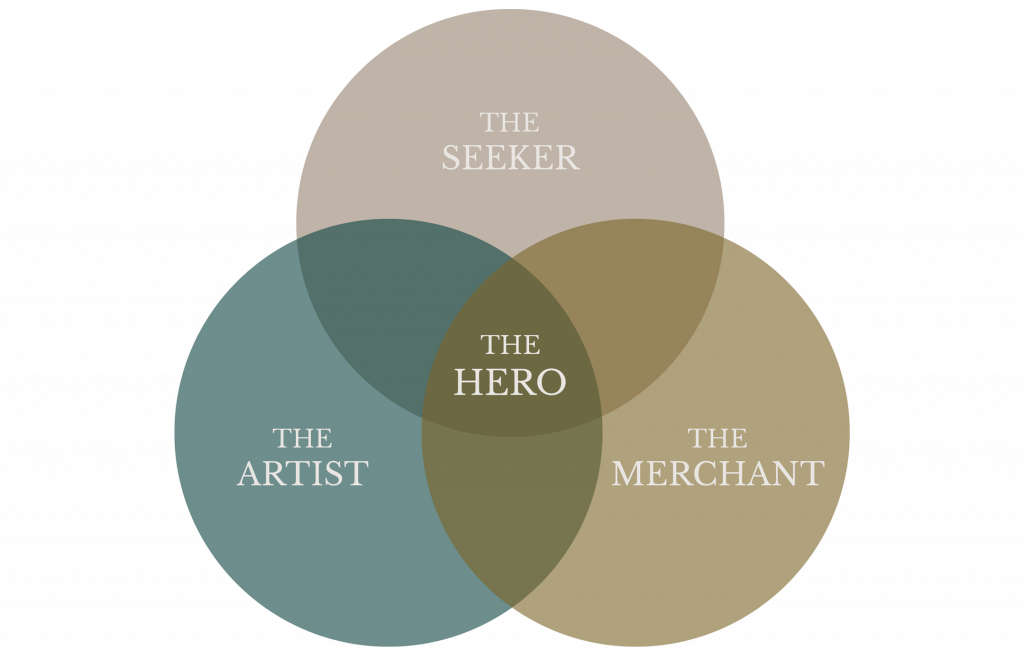
    This is the hero as I see it, the intersection of three fundamental professional archetypes – the seeker, the merchant and the artist.

    And it is the roots of this archetypal trinity that I will begin my story with.

    The philosophical roots of being

    Running throughout philosophy – from the Bhagavad Gita, through Plato, through Immanuel Kant, through Jurgen Habermas and up to the present day – is a triadic structure that under various guises, has been presented as deeply intrinsic to reality.

    The ancient Greeks thought of the three domains of life – art, morals and science, and the three transcendentals that related to them. Karl Popper called them the objective, subjective and cultural. Kant wrote his three great critiques.

    Ken Wilber, whose work first introduced me to this pattern, ties them to universal pronouns – I, We and It. He calls them The Big Three. They are the first demarcations we make in the oneness of reality. They are that fundamental.

    For Plato they were the good, the true and the beautiful. And it is that frame I want to use here.

    The three languages

    You can think of these three ideas – the good, the true and the beautiful – as three languages.

    Each one fundamentally different from the last, and yet each one fundamental to human experience. That is – one language cannot describe the territory of another language. Yet each one is part of the whole, and so where one finds truth, one will also find beauty, and goodness.

    “Words which give peace, words which are good and beautiful and true, and also the reading of sacred books: this is the harmony of words.”
    – Bhagavad Gita, 17:15

    To find the harmony in the three, you must learn to hear the individual melody of each language. For the language of truth, cannot tell us what is beautiful. The language of goodness cannot tell us what is true. The language of beauty cannot tell us what is right and just.

    The True

    The language of truth is the language of discovery and precision. It is the language of deep science – that deliberate and practical means by which we test the world, and ourselves, and discover ever deeper truth about its reality.

    It is something we uncover and reveal, it is something that we posit and falsify. The language of truth seeks to gently or forcefully, spear the squirming fish of meaning, and define its patterns and structure.

    Is it true that human beings evolved from higher apes? Yes. It took us a long time to discover this truth. But it’s now self evident for most fo the world.

    Is it true that if I spend enough time looking into the nature of my own experience, I will be unable to find the location of my own consciousness? Yes. I’ve tried. Like thousands of yogis and roshis. It’s not in my head, it’s not in my toes. It doesn’t even seem to limited to my body. It’s kind of everywhere and nowhere.

    When we seek the truth, we must attack and destroy our own assumptions about what is. We must bind together polarities that feel uncomfortable, and find harmony in the integration of relative truths. This frees us, and liberates our notions of what is possible, and who we are.

    “And you will know the truth, and the truth will set you free.”
    – Jesus of Nazareth, John 8:32

    Ken Wilber’s famous phrase is that “everyone is right”. Every single human perspective has some partial truth. But for that to be true, we must also hold that some are more right than others.

    The great seekers of truth understand this, they constantly seek for greater truth that transcends the partial truths.

    “He who knows only his own side of the case knows little of that. His reasons may be good, and no one may have been able to refute them. But if he is equally unable to refute the reasons on the opposite side, if he does not so much as know what they are, he has no ground for preferring either opinion.”
    ― John Stuart Mill, On Liberty

    Truth is an objective science, whether the terrain physical, conceptual or mystical. Mathematics is a dialect of truth. The Tao Te Ching is a treatise on mystical truth.  Cartography is mapping physical truth.

    To know what is true, reality must be examined, tested and mapped.

    The Good

    Whether any of this is a good thing is an entirely separate question.

    The good is the language of ethics.  What is right, just? How do we know? It is not an objective science – it is not a solitary investigation. It is a collective exploration of our own ethical principles. The codes by which we feel it is right to live.

    “To prefer evil to good is not in human nature; and when a man is compelled to choose one of two evils, no one will choose the greater when he might have the less.”
    – Plato, The Protagoras

    Is it good that many people still suffer, and struggle to have enough to live? No. I don’t know anyone who thinks that’s a good thing.

    Is it good that the homicide rate in the West are at their lowest rate in recorded history? Yes.

    Is it good that we have ever more free markets? That’s tough. I’d say yes. Many would say no. It’s an unknown. We’re still in the conversation.

    “Morality is not just any old topic in psychology but close to our conception of the meaning of life. Moral goodness is what gives each of us the sense that we are worthy human beings.”
    – Steven Pinker

    The language of the good is relational. You and I have a conversation, create mutual understanding, and thus form a We – something greater than the sum of its parts. And in that collective We, decide what we think is just and right. It is not scientific. It is not subjective. It is inter-subjective.

    To decide what is good, we must engage in a conversation about how we want to live with one another.

    The Beautiful

    When we ask what is beautiful, we enter the domain of art. It is about expression and provocation. It is the ultimate subjective world. For beauty is in the eye of the beholder, and the I alone.

    Beauty cannot be scientifically tested – it cannot be proved to be true or false. No one can declare that the Mona Lisa is officially ‘beautiful’ or that Star Trek is not.

    Nor can it be said to have moral foundation. Is it good that Tolkien spent two decades making up Middle Earth, and writing The Lord of the Rings? It’s the wrong question.

    The question is, did it change your experience? Were you struck by it? Did it leave you with a question mark in your experience?

    “We can slip into the Beautiful with the same ease as we slip into the seamless embrace of water; something ancient within us already trusts that this embrace will hold us.”
    – John O’Donohue

    Beauty is the ultimate subjective experience. The phenomenological aesthetic. An expression of something utterly indescribable, and yet instantly recognizable.

    How can you describe the language of a sun set? The untranslatable feeling of looking out as our great star sinks once more behind the horizon, as it’s done since the beginning. Writers have spent centuries to describe the beauty of a sun set, and none of them have nailed it. We can never nail it.

    Beauty is what is all around us, we know it intimately, and yet to capture it, is to capture the most striking and elegant butterfly. As soon as it’s in a net, it becomes less beautiful.

    “Never lose an opportunity of seeing anything beautiful, for beauty is God’s handwriting.”
    – Ralph Waldo Emerson

    To see what is beautiful, I must look with my own eyes.

    The three archetypes

    It is these languages that the three archetypes – the seeker, the merchant and the artist, speak in.

    These are not the only branches that grow from the roots of the languages. These are what I have come to think of as the professional dimension of these three languages. That is, how do the good, the true and the beautiful, show up in the domain of contemporary work?

    The Seeker

    The seeker seeks truth. Whether it is the deep spiritual truth of Adyashanti or the deeply human truths of Brene Brown, the impetus is to explore the unexplored, map the terrain, and come back to teach us.

    “It is not the possession of truth, but the success which attends the seeking after it, that enriches the seeker and brings happiness to him.”
    – Max Planck

    It’s manifest in the Tibetans who sat in caves in silence for thousands of years and developed the most exquisite maps of human consciousness. It’s the Victorian explorer who braved the dangers of uncharted seas and discovered new lands. It’s the physicist who finds new theoretical models that explain the unexplainable.

    In the professional arena, it is the seeker who shows us the way. Their brilliant mapping of difficult things gives us a path through the struggle. Their unquenchable thirst for deeper understanding keeps us curious, humble, and constantly learning. It could be a scientific seeking of truth, like Tim Ferris. It could be mystical seeking of truth, like the Dalai Lama.

    The vice of the seeker is pride – the seeker who claims to have found the truth, a truth no-one else has. They revel in it, boasting of the truth they know, denigrating the truth of others.

    It is the spiritual teacher whose existential arrogance leads them to outrageous claims, or relational abuse. It is the scientist who refuses to believe any kind of truth other than his paradigm, disparaging claims that fall into a different language or dialect.

    The mature seeker understands that they are an instrument for truth, using themselves to understand ever deeper and more elusive truth that they share for the benefits of others.

    Famous Seekers
    Jesus Christ, Albert Einstein, James Cook, Brene Brown, Adyashanti, Tim Ferris, Isaac Newton, Christopher Columbus, Alan Watts.

    The Merchant

    The merchant trades in the good. Whether it is the material goods of Wholefoods or the political goods of Barack Obama, the conviction is the same – that trading goods benefits everyone.

    “Man is an animal that makes bargains: no other animal does this – no dog exchanges bones with another.”
    – ­Adam Smith

    Trade happens between people. It is an intersubjective conversation about trust, permission and integrity. To trade, you have to believe the other person has good intentions. When they do, and you do too, more good is created, more ethical wealth is generated. The world becomes richer, in materials, freedom and culture.

    In the professional arena, it is the merchant that knows how to scale their impact, to bring their goods to ever increasing numbers of people, or at ever increasing depth. The merchant is the innovator who who builds brilliant new apps, or the marketer, who knows how to speak to their audience.

    The great vice of the merchant is greed – they use their mercantile skill, subterfuge and manipulation to extract maximum value for them self, at the expense of everyone else. This is the Victorian factory that uses its workers as expendable cogs in an industrial machine.

    They have forgotten that what is good is only determined in fair and transparent marketplace of goods and ideas, where we decide together, what is ultimately valuable, just and good.

    Famous Merchants
    Adam Smith, Steve Jobs, Seth Godin, Bill Gates, Warren Buffet, John Mackey, Jeff Bezos, Henry Ford.

    The Artist

    The artist creates beauty. Whether it is the mystical beauty of Leonard Cohen or the magical beauty of Neil Gaiman, the compulsion is to make something from nothing, and touch us.

    “Every human is an artist. The dream of your life is to make beautiful art.”
    – Don Miguel Ruiz

    The artist follows an invisible design, obscured even from the artist them self. It reveals itself as the artistic path is followed, and the picture comes as if from the page.

    Art happens in the spaces between things. The afternoon left free of appointments, and a song on the radio inspiring a burst of new writing for hours. It happens when you walk in the park, enjoying the beauty of the birds playing in the trees, and something moves in you.

    In the professional arena, the artist is the one who creates things. Through some mysterious process they produce artifacts – writing, paintings, music, design – that touch people and change things.

    The artist’s great sin is envy, or more precisely, the great fear that they are in truth, mediocre, one of the bottle, not special. And so to spare them this great pain, they seek to acquire the prestige or standing of others around them.

    They forget that beauty is seen through the eyes of the gods, and instead, judge their beauty through their own narcissistic eyes. They replace the great I for the small I, and endeavour to prop up their own ego by being the most beautiful person, rather than the person who creates the most beauty.

    Famous Artists
    Michelangelo, Neil Gaiman, Leonard Cohen, William Shakespeare, John Lennon, Rumi, Darren Aronofsky, Rainer Maria Rilke, Herman Hesse.

    The hero of a new age

    These are three fundamentally different vocations. They are based on languages that describe three fundamentally different worlds. And while each of us will be a native speaker in one archetypal language, the goal is to integrate these three archetypes in you, infusing their worlds into your work.

    Never has there been a time when integration across these three worlds has been more needed or more possible. This I believe, is the professional imperative of our age.

    Now I have given you a simple map, can you see where you are on it? What is your native language? Which is most foreign to you? Where do you have tension between the types?

    I am a native artist. And for most of my life, the world of the merchant was completely foreign to me. Much of my personal work over the last few years has been to integrate the merchant more deeply into my work.

    This is the first part of the map – the outer three archetypes. In part two, I will explore the fourth archetype – the hero – and how it relates to this trinity of the seeker, the merchant and the artist.

    For the hero is you, the future you, that is yet to be created through the journey of transformation. And to be a professional hero, is I believe, the vocation of this new age.

  • Wish upon it. Pray to it. Follow it.

    Do not think you are it, or believe other people when they say you could be. Do not mistake the mortal for the divine.

    The proper posture is one of devotion. The star is not reached through fame, it is never reached. It is the source of divine potential, an infinite omega point to which we are endlessly beckoned.

    Where does your star call you? What do the heavens whisper?

    If you don’t know, you must ask.
    If you do know, you must ask.

    For your destination is that transcendent possibility, the unmanifest future that already rests within you. Just as the oak is already contained within the acorn.

    And when the light of heaven shines down upon you, you will reach toward it. Like the tree that grows steadily toward the sun. The reward is illumination. Of you and your extraordinary beauty. The price is the same.

    And you will shrink before its splendour, and the exposure of your own. This is only to be expected, for you are cradled in the innocence of one who has forgotten who you really are.

    This is not a fault to be corrected. It is the divine design of something we cannot comprehend.

    The star asks that you face it, and be guided by it. That you stand naked before the light, and follow the path it shows you.

  • It’s been three years now since I started calling myself a coach. I’ve worked with a whole range of people. It’s been challenging, it’s been enlightening, and it’s been deeply fulfilling.

    Sometimes, a client’s life has been truly transformed – issues that have blocked them for decades dissolves, and a new path opens up in front of them.

    Sometimes I’ve worked with a client and we didn’t fit that well, and I think they walked away feeling grateful but a little disappointed.

    Sometimes it’s not until 6 or 12 months after the coaching that my clients tell me everything has changed, and how thankful they are for the work.

    I’m still very much a student of coaching, but I feel it’s time to speak to some of the principles that I’ve discovered in my work.

    This is not an exhaustive list. Neither is it particularly carefully structured. It’s a bunch of ways I think about coaching, and things I try to remember every time I sit down with a client.

    These are not principles of coaching.

    They are principles of my coaching.

    If they don’t work for you, please ignore them completely. If they do work, use them.

    1) You have to coach your way

    When you try to be a “good” coach, when you attempt to get it “right”, when you do your very best to fit in with what a coach is expected to do, you will strangle the mojo. Your mojo. Your way.

    Coaching is simply a method of helping someone.  How do you want to help them? How do you organically work with someone if you drop the ideas of best practice?

    Do you want to create a safe space, listen deeply, and help them extract their own answers? Do you want to lovingly challenge the fuck out of them, express your opinions, and push them?

    Do you feel more powerful when you keep the pace really slow, and explore the somatic and emotional feelings of the moment? Do you like to ignite the fireworks of ideas and dreams, and be buffeted by their explosiveness?

    There’s no code. There’s no rulebook. There are no guaranteed steps to success. There are no models of perfect practice.

    There’s you, your client, and the conversation that wants to occur between you. It’s an emergent mystery.

    Do it your way. Find your way. Take risks to understand your way. Reflect to define your way.

    It never ends. But it’s your way.

    2) Surrender and desire in the face of the unknown

    To coach someone is to enter into the unknown. For an hour or more, you’re going to enter a conversation, a meeting, and neither of you knows what’s going to happen.

    And yet, into this unknown space, we bring things.

    I bring into the conversation a desire to really get this person in front of me – who they really are. I want to feel their pain, and their desire. I want to understand what they’re being called to, and help them face it. I strive to orient them from what is most true.

    My clients bring their aspirations and struggles, and the commitment they’ve made to the coaching journey. They often bring questions or specific challenges. Sometimes they come with an epiphany they’ve had since our last conversation, and a new view of their reality. They bring their fears and wounds. They bring their brilliance and natural wisdom.

    And we enter unknown territory.

    We surrender to what wants to emerge in the space between us. We surrender to the great mystery. And let the conversation surprise us.

    We follow our desire. We create the conversation we want to have.  We envision the life they want to live.

    And we see what happens.

    3) It’s about them

    It’s not about you.

    It’s not for your gratification. It’s not meant as a support for your insecurity. It’s not supposed to validate your sense of worth.

    The purpose of the work is for you both to serve one of you.

    The coach gets helped too in the process. But the goal is to serve the client. This is what distinguishes coaching from a friendly chat, or brainstorming, or a healing treatment, or a strategy meeting.

    You’re both there to help them create something they want. It’s about them.

    4) You’re not impartial

    It’s about you too. How could it not be? You can’t turn off your own humanity.

    Therapy mistakenly believed we could be ‘impartial’. It’s a nice idea, and a noble intention, but impossible in reality.

    Don’t pretend you don’t have opinions. You do.

    Don’t hide your intuitions, because you’re supposed to be objective. You’re not.

    You have desires. You feel things about the relationship, and your client. It’s not a problem. It’s not something to hide.

    Your job is to learn how to include yourself in the conversation such that it is in the most service of your client.

    If you’re sitting there watching as they desperately scrabble around for an answer, commendably being “impartial” when you actually know exactly what they need to hear. Say it.

    If you’re growing irritated by their avoidance of something, and you realize you want to go deeper. Reveal it. Tell them, and then hash it out.

    Learn to feel when it’s the right time to keep quiet, and when it’s the right time to reveal your own experience.

    5) The truth of language

    If you’re going to play in the depths with people, you need to understand how the words we use, open or close the moment.

    Sometimes I have intuitions about big decisions my clients make. I feel whether the direction will truly serve them. Sometimes I tell them.

    Perhaps they’ve just been asked to take part in a big new project, and they’re thinking of doing it. But believe its resistance at play, tempting them away from the thing they actually want to be doing. I decide to tell them.

    “That’s not a good idea. You shouldn’t do that.”

    If I say it like this, I close the conversation. Instantly. Not because I’m being “negative”, but because I’m not being linguistically accurate.

    My statement is factually untrue.

    It’s not objectively a “good” or “bad” idea. There’s no universal rule that says “you shouldn’t.” These are not objective facts. And if I convey them this way, I either close down my client and they lose touch with their own centre. Or they feel unseen, or pissed off, and they throw up their guard, or withdraw.

    It’s an opinion, not a fact. And more importantly it’s my opinion. So share your opinions, as opinions, and you’ll maintain a free market on “the truth”, helping both of you find more of it.

    “I don’t believe that’s what you really want to do.”

    Then you can have an honest conversation about it.

    6) I love my clients

    I love who they are, and who they become as we explore what they’re really called to.

    I think about them before sessions. They pop up in my awareness from day to day. I’ll text them sometimes. I’ll forward links sometimes. I do it with ex-clients too.

    I want my clients to succeed. Because if there is anything I wish for a human being, it’s that they continually discover who they are, and express themselves in the world through art and service. That they contribute, and change things.

    So when I see the people I work with travelling this path it gives me enormous fulfilment and pride.

    And if I ever notice myself getting wrapped up in trying to “be a good coach” or get validated by them, I pause, and I put my attention on my heart, and my love for them.

    7) Challenge them, as love

    And when I love them, I can begin to really challenge them. I can push them because it’s what my heart wants to do with them, for them.

    “I think you’re hiding. And I think you know it too. But you’re afraid, so you’re not listening to yourself.”

    Challenging my clients has been a challenge for me! I don’t want to upset people, I don’t want to offend them, make them angry so they pull away from me. I’m British. One needs to be polite. I’m also introverted. I like peace and harmony.

    But when I have my heart open, my anger can flow in service of them. Not with aggression, or ill intent, but simply the fiery strength to say:

    “I love you, and I think you’re holding back.”

    8) Connect with faith

    God. Your higher self. The universe. Whatever you want to call it, you have to stay on connection with what is larger than you. Both as the coach yourself, but also to help your client do the same.

    In the midst of transformation and change, reality can look pretty weird, and feel incredibly confusing. What’s true? Do I really want to make this audacious new training program? Who am I to write about the theological nature of reality?

    Without this sense of connection, the overwhelming doubt and chaos of the unknown can shut you and your client down.

    Trust that God wants something from you. From them. Feel it. Connect with it. It’s what gives light in the dark times. It’s what gives strength in the midst of the existential wobble.

    And it’s beautiful. And incomparably powerful.

  • What is the purpose of life? What is your purpose? My purpose?

    It’s a word that is as clichéd as it is important. And one I have wrestled with as much as it has inspired me.

    So often we talk of it as a thing, an ideal we must live up to, a definition we must clarify. And once we find it, then we can get on with living it.

    I don’t think it is a thing. A thing can be found. Like a rock or the village of Ingleton. A purpose as far as I can tell, cannot be found. It is not lying in wait, out of sight, just around the next insightful corner.

    It is an encounter, a posture, a potential, that calls forth what is within you, asking you to give it, to the world outside of you.

    Here’s one story of how I think it plays out…

    Your role in the great play

    Your purpose is to fill your role in the great theatre play of life.

    It is not pre-scripted.

    The great director will not judge your performance. He hasn’t given you lines to deliver like a talking mannequin. There is no correct script you must adhere to.

    But your role is pre-shaped.

    You have been given a name, and a nature. A flavour and a feel. A history and a possible future. You cannot change these contours of the soul.

    And so it is your task to live into your role, unfolding it as you play it. Discovering it as you act it out. Sinking into the original nature of your character as you improvise in the emerging story.

    You must play out the most mysterious of contradictions. Surrendering to the director’s instruction, and creating your own self-generated narratives. You must do both.

    Listen to the whispers

    The one’s that come from beyond you. The ones that are spoken by whatever we call that which is larger than ourselves. This is the director of the play, trying to give us hints and prompts.

    Can you become quiet enough to hear them?

    These directions are not always ones you want to listen to, or follow. They don’t simply lead toward freedom and applause, they lead to the facing of those things that all your addictions are designed to turn you away from. They lead toward the speech that you have the most difficulty uttering.

    And yet it is in those dark encounters that you will truly learn your own nature. The shadowy corners that when faced, lead around the bend, into an awesome and humbling new light.

    Write your own script

    What do you want to say?

    What course does your own heart want to chart?

    It’s up to you. It has not been laid out in some kosmic blueprint. Your chosen movements are not being pulled by some unseen puppet master. You have been given a role in the great improvisation. You have been given the rare gift of spontaneity.

    You must trust the will of your heart. The desire of your own character. How do you want the story to end? And how will you choose to unfold your own plot toward the possibility of that finale?

    The journey is not pre-written. The ending cannot be known before the curtain falls, if it ever does. The point, is not to adhere to what is supposed to happen, but rather to follow the movement of the unfolding story.

    It’s a surprising, twisting and turning discovery. A delightful step, that leads to a challenging leap, that becomes an embarrassing stumble, that recovers into another delightful step.

    And they are your steps to take.

    How will you play?

    You have not been given the lead-role – I’m sorry but you haven’t. You are not the star of the show. But rest assured that is not because you have been passed over for some more impressive performer. It is that there is no lead role. No chosen star.

    This is an ensemble piece. The greatest ever created. A great sprawling epic, played out on the world’s stage, with the most shocking of twists, and the most exquisite of resolutions.

    And no-one knows the ending. Not even the director.

    How will you play?


  • Human beings have been trading stuff for an awfully long time. Some say for 150,000 years. It’s one of the biggest differentiators between us and the animals. It’s made our lives rich and cooperative.

    Here’s how it works…

    If one guy is great at making stone axes, and another guy is great at making wooden spears, then it helps everyone if they stick to their specialism, and swap stuff. In one sense, it’s simple math.

    Ug takes 1 day to make a stone axe. He’s good at it, because he’s practiced a lot.

    Stig takes 1 day to make a wooden spear. He has a natural way with the tree’s product.

    Ug never found the wooden thing easy, his fingers don’t work that way, so when he makes a wooden spear, it takes him 2 days. Stig is equally inept with stone axes. It just doesn’t bend the way his lovely wood does. It takes him 2 days to make one.

    Both of them need both tools.

    So if they are uncooperative and selfish, they simply make everything for themselves.

    1+2+1+2=6 days total work.

    However, if they stick to their specialisms, and Ug makes two stones axes, and Stig makes 2 wooden spears and they trade, then the calculation creates a different result.

    1+1+1+1=4 days total work.

    That’s two extra days created, one each, which they could use to make cave paintings, or practice their craft, or hunt more food, or hump Jane, or each other.

    Trade has become outrageously specialized in today’s world. We’ve gone way beyond spears and axes.

    What is your specialism?

    What can you do that no one else can do? Or what could you do, given enough hard work, that no-one else can?

    That’s what makes you special.


  • He whispered to me this morning while I was making coffee. Amongst the sound of the grinding of beans, his voice spoke through my own lips.

    “This is not the way.”

    He didn’t refer to the way I was grinding the beans. I don’t think he has much to say on that subject. He was speaking to the larger grind. The grind of life.

    He meant the way I feel sorry for myself when things don’t go my way. The way I isolate myself when I feel ashamed. The way I silence myself when I feel angry.

    “This is not the way.”

    Not lounging in self-depreciating clouds of cigarette smoke and self-righteous armchair philosophy. Not maintaining my masks of professional competence and success. Not running away from love, from opportunity, because I don’t want to be tied down.

    That way leads full circle, to the source of my complaint.

    “I’m special, and no-one sees it” cries my ego.

    And the weight of his accusation mounts on the evidence table. The momentum of my writing, slowing to a dutiful march. The scores of likes on my Facebook posts, dried up in the political massacre. And more damning that all of it, the unshakable feeling that I’m off track, lost down some overgrown siding.

    I’ve fucked it up.

    That’s what the other guy says. The one who lurks in the recesses of my mind. He’s always there, the compulsive pessimist who doesn’t want to see me fall in pursuit of avarice.

    I’m running out of options. The escape routes keep bringing me back to the same room, where the walls are closing in and the rats have already scarpered.

    I sit down in the corner, light up another joint. Maybe this way I can see through the fog. Maybe I just need one more high to finally break through to the truth.

    And as the medicine takes hold I forget the question and sink down into the comfort of my dream. Until the effects inevitably wane, and I notice the walls again. They’re moving slowly enough that I don’t panic, and fast enough that I know I can’t stay here much longer.

    I reach for another chunk of hazelnut chocolate.

    “This is not the way.” He says.

    Well what is the fucking way oh great oracle? I’m pissed. The scorn is desperation, not hatred. Give me the map shit-face, I’m dying down here.

    He doesn’t answer. He just looks me full in the eye in that unwavering way he has. He loves me. That’s what makes him so infuriating.

    I pause. Something in me doesn’t run away like I’ve been doing a lot lately. I sit with him. He looks like Jesus, but he feels like me.

    Time slows down. I hear the hum of the refrigerator in the corner. The distant sounds of the world outside going about its business. I feel it, the poignancy of the moment. This moment. The one I can feel when I soften my searching. The one I can taste when I open my mouth and breathe it in.

    The one that holds the entire history of the universe, and the unknown future of all there is. Balanced, exquisitely.

    This. This is the way isn’t it?

    He doesn’t say anything, he just smiles.

    This place. The one where I keep walking, as slow as I possibly can, so that I notice just how beautiful the landscape is. The one where I choose each step, not from strategy, but from attention. The lift of my knee, the reaching of my toes, the planting of my foot, the casting of my gaze. One more step. Then one more step. Then one more step.

    What’s the way? I ask him.

    He doesn’t say anything. But I feel my heart break. Just a little, like the first crack on the surface of an egg as what is inside makes its way to what is outside.

    I’m scared. I tell him.

    He nods, in his bamboozlingly beautiful way. A nod that contains both bottomless compassion, and utter neutrality. I don’t know how he does that.

    I am scared. I’m scared of getting punched. Or laughed at. I feel just like I did when I was a little boy at Lowfield Primary School. My unconscious and innocent eccentricity met with unconscious and innocent ridicule.

    I had the wrong shoes. I cried when boys weren’t supposed to cry. I didn’t fit their society, I stood out, which wasn’t a good thing in working-class Sheffield.

    “You’re a man now.” He says.

    I don’t feel like one. I say before I think about it. I feel like a fraud.

    “That’s what makes you beautiful.” He says.

    He’s got me. Clever little fucker. He knows exactly where my weak spots are. He turns my own arguments against me. And I know exactly what he means.

    It’s the way of revelation.

    Not the kind of revelation accompanied by angels’ harps and priests and holy oppression. It’s the path that reveals. Uncovering what once was covered. Disclosing what was once locked away. Showing what was once held in shame.

    It’s not about me. It’s not some faux-vulnerability where I wash my dirty laundry on Facebook (I tried that – the high lasted as long as the social news cycle). It’s about revealing what I see.

    The world I see.

    The one that delicately surrenders itself as I look into my woman’s eyes, and see how deeply she loves me. The one that pulls the rug from under my complacency as I remember what truly fires me up. The one that brightens someone else’s down-trodden day as I tell them about mine.

     “That’s the way.” He says, and turns away to leave me to my gratitude.


  • There are those moments that happen, periods in our lives, when we reach a fork in the road.

    The wheel of life has revolved, and we’re faced with a choice. A momentous choice perhaps. We feel it, like a beckoning from the future, or an intolerance for the present.

    Something wants to change.

    “I don’t want to change. I like things how they are. It’s safe here, familiar.” The voice inside me says.

    The resistance spins its insidious web, telling me how dangerous it is to change. The ego clings to its notion of itself.

    “Maybe this is a distraction, and not really what I want.” the resistance whispers in my own voice.

    But I can tell it’s signifiant. It’s palpable somehow. I just know, I feel it.

    I’ve reached a turning point.

    *

    There are two choices.

    We can choose the change that presents itself, follow the new course, and discover the undiscovered.

    Or we choose normality and keep plodding along the highway of what we already know. The wheel of change keeps on turning, and the choice point is passed over.

    And in one sense, it doesn’t matter what we choose. Because even if we plump for normality, the wheel keeps on turning. And sooner or later it comes full circle and the choice point is presented anew.

    Except this time, the urgency has been increased. The volume level higher. The insistence harder to ignore, the status quo harder to rationalize.

    It will keep turning, returning to this point, until we choose what we’re asked to.

    So in the longest sense of the game, we can’t go wrong.

    But the price is time.

    *

    I feel it. The turning point returned. I’ve been here before. Everything slows down. The buzz of my refrigerator hums louder, as the air in the room grows sharp.

    Life is asking me to level up, to embrace my power, to choose to show myself, to fulfil what I’m capable of. The fork in the road is right there before me.

    “Will you take it this time?”

    “Do I have to?” I whine. “It’s hard, I don’t think I can.”

    No, I don’t have to. And nor do you. We can plough on, doing what we’ve always done. It will come around again. It has before. It will again.

    But do you want to keep praying the price? The price of wasted moments?

    *

    Will you turn toward your higher self, and walk his or her path?

    It’s not some moral standard you must adhere to. There’s no judgemental God or parent who will castigate you if you flunk out.

    It’s up to you.

    Do you want it?

    Or would you rather turn back toward the safety of the couch, or a cigarette. The familiarity of a comfortable existence. Doing the work you’ve already been doing, because you’re good at it. It’s fine how it is.

    The turning point is yours. It’s not something you have to take. You can sit back and wait until the wheel has spun so many times, that the tension is unbearable, and you can’t feel a choice, except to leap. That’s life’s way of ensuring you take the true path eventually.

    You can do that if you want. I can too. I’ve done it plenty of times.

    Or, you can slow down. Right now. And take a breath, deep in the centre of your belly.

    It’s you that lies down that scarier path. Your truer nature embodied and lived a little more, with every small step you take.

    I don’t want to hurry you. But life is waiting for you down there. How long it will take for the wheel to turn around to this point once more? Do you want to wait and see?

    Or do you want to take that first shuffling step, down the road untraveled?


  • We want to change.

    It’s built into our nature, the very substance of life.

    We want to realize the vision that we see in our mind’s eye. We want to fulfil the potential we feel in our soul.

    We’re told it’s possible, just a decision away.

    We want it fast. As fast as a book downloaded to our kindle. Or a tweet sent out to the world. We want it fast, because the world is fast. Faster than ever before.

    We want to change, and we want it now.

    The imperceptibility of growth

    Between the day of my birth and the age of 17, I grew from around 1 foot 8 inches, to 6 feet 3 inches.

    I did not see this growth happening. I didn’t wake up each morning and notice the .009 of an inch I’d grown over the last 24 hours.

    But whenever I would see my family at Christmas, Grandmothers and Uncles would proclaim “my, haven’t you grown!” Because they saw it.

    Growth happens so slowly we don’t see it.

    It’s only in the retrospective measurement – the drawing of pencil marks on the door-frame, months or years in between – that the heightening becomes evident.

    This principle doesn’t just describe physical growth.

    Making sense of the multitude

    I’m bumbling about my day, trying to do my best with an odd hand of cards.

    Stuff happens. I do some writing. I have a coffee break. I coach a client. I listen to a podcast. I’m working habitually, on instinct. I’m following my agenda. I’m trying to notice when I check out of my experience and drift. I’m focussed on doing my work, building something.

    And then I try and make meaning out of it all.

    I journal. I talk with friends over lattes and cigarettes. I practice and meditate, allowing the feel of myself to express itself in movement and in stillness. I check in with my advisors, both human and divine.

    And I try to spin a narrative that makes sense. One that stretches to include what I didn’t before know. One that reaches out to embrace what is asked. One that makes me feel like a sane and good person.

    I try to keep in step with my ego.

    The story that holds it all together

    When I say ego, I don’t mean what we often mean: an over-inflated sense of self. I just mean a self, period.

    The origin of the word comes from the Latin for self. Freud made the word popular. Except he actually didn’t, because he never used it. He used the German pronoun das ich which just means the I.

    James Strachey, whose English translations of Freud popularized him, changed the I to the ego to make it sound more scientific.

    The self. That strange aspect of ourselves that’s hard to pin down, because like Alan Watts said, “trying to define yourself is like trying to bite your own teeth”. To see the self, you have to use the self to see it.

    Those voices in your head? That’s not schizophrenia, that’s the human condition. We are not one thing. We are a multitude. But to make sense of ourselves, we create a story of who we are.

    I’m Ewan. She’s Jenny. He’s a moron. I’m neurotic. They don’t get it. I’m someone who spends inordinate amounts of time trying to understand the un-understandable, because I feel purposeless unless I do.

    We’re like bails of straw, with a myriad of aspects, feelings, memories, dreams and karma.

    And the ego? A stretchy piece of string that holds the whole bundle together.

    Hopefully.

    The game of growth

    Sometimes the string becomes hard and inflexible through lack of exercise. We say “this is who I am”, and we constrict the changes that want to occur.

    Sometimes we stretch the string itself, without the bail of our multitude pushing the expansion. The story becomes bigger than the reality. And we say “he’s got a big ego”.

    Sometimes we don’t know how to make sense of the expansion of ourselves, and the string becomes tight around us, straw spilling from its grasp. We become overwhelmed and we say “I don’t know who I am anymore.”

    Sometimes we experience all of this in a single moment as we follow the movement, and spin the yarn, and tell a story that makes sense, and helps others make sense of this infinite mystery.

    And that’s the game of growth.


  • What’s the point?

    I don’t mean, in the self-deprecating fashion that we can be prone to. The one where the internal voice whines “oh, what is the point?”

    I mean, what’s the point – the sharpened statement that conveys the essence of what you do?

    Do you know?

    Do you have it written down? Do you tell people?

    The age of specialism

    I remember those times when someone asked what I do, and I had this vague response that killed any curiosity they’d had a moment before.

    “I’m an entrepreneur.”

    “Interesting. And how long have you lived in Amsterdam?”

    In a crowded marketplace, where more and more people are setting up their stalls, sharpening the point of what you do is what distinguishes you from the throng.

    This is the age of specialism.

    The mass market is full up.

    The ones who succeed are those that get ruthlessly specific about who they serve, and how they serve them.

    So that they can get on with the business of serving them.

    Help people make a decision

    When someone reads your website, they want to make a decision. They want to decide if you’re someone who could help them.

    The word decision means the opposite of incision. To make an incision is to cut into something. To make a decision is to cut away the excess.

    They want to cut away the unclarity.

    “Yes. That sounds exactly what I need right now. I’m interested.”

    “No. Not what I’m looking for at the moment. But thank you.”

    It’s your job to help them make that decision.

    The point of your work, is the tip of the sword. The sharpened point, where the breadth of everything you do, comes down to one small and refined idea.

    A sharpened point is what allows you to sink the blade of your service deeper into their being, opening up possibilities, freeing potential.

    It’s what allows the person you’re relating with, to decide if they want to spend more time with you.

    The magic is in the specificity

    “I help designers be more effective.”

    There are a million people helping designers now. And everyone wants to be more effective. What do you really do?

    “I help designers create beautiful work that moves their clients to tears.”

    The sharper the point of your blade, the deeper it will go into those who want you, and the more powerfully it will turn away those who need another’s help.

    The magic is in the specificity of your words.

    The clarity is not just for them

    It’s for you too.

    If you know – because you’ve worked hard to hone the words – what the point of your work is, then it becomes obvious when you stray from the path.

    If I have left the point of my work dull and blunt, then my penetration into the world will be dulled and blunted.

    Bluntness begets bluntness.

    Sharpness begets sharpness.

    And we live in a time where people want the keen blade of truth, to open up their world in beautiful ways. A time when they want the right person. One they trust.

    Show them the point of your work, so that they can go deeper, if they want to.


  • “We’ve reached such an incredible level of freedom that for the first time in history we have to manage our own mutation. It’s up to us to decide what it means to be a successful human being. That’s the philosophical task of the age.” – Peter Koestenbaum

    I’ve ruminated on that quote for well over a year now. It comes back periodically to tempt me with its invitation. This morning it came back again.

    What does it mean to be a successful human being?

    I care about success. Genuinely care. I’ve been ambitious for a long time, I have things to do, changes to bring.

    And yet success is something I’ve never felt on gentle terms with. It’s often felt like a black figure hanging over me, berating me for not achieving the level I’m supposed to. The hare of success disappearing over the hill, while I plod along, not measuring up.

    I’ve wrestled with my ambition, baulked at the images of success I was fed. Rebelled, dropped out, found inspiration, dived in.

    So I want to talk about success with you. Because I think Koestenbaum is right. There are few more pressing issues. And in a world where we don’t have to follow the old rules of success, I think it imperative to deconstruct the inherited definitions, and build a new an image that draws forth our ambition as a creative expression, rather than pressurizes it, as a milestone to attain.

    The prescribed rules of success

    My first ‘proper’ job was at a small marketing agency in Liverpool. I’d recently graduated and got the job as a temp, and they’d liked me so offered the position to me permanently.

    I was the receptionist. A job that is not supposed to be filled by a heterosexual male. I’d answer the phones, welcome clients to the office, make coffee, open mail, complete little admin tasks. Mostly I watched video clips, played on internet forums and worked on ideas for my first business.

    They saw I was over qualified and twice offered me a position as a junior account manager. It’s rather a sought after path in the marketing and PR field. I said no. I said I wasn’t interested. They were confused.

    The thought of diving deeper into the world of clever adverts, schmoozing clients and pouring over spreadsheets made my heart go dark. But they couldn’t understand it.

    I’d turned down advancement, to stay on the lowest rung of the ladder.

    According to their world, I’d broken one of their rules of success.

    Rule #1. You must climb higher

    You work your way up the ladder. Your pay cheque gets bigger and bigger. You have more impressive sounding job titles. The really successful people run entire companies.

    But I never wanted that kind of success. I always felt like an outsider in that game, though it took me a long time to come to peace with that feeling.

    Many years later, I dropped out of the corporate game all together. I started playing the online entrepreneur game instead. It was a big relief. I had a lot more room to express myself.

    Success here is building a brand for yourself, generating a big mailing list, doing 6-figure launches, being called a ‘world expert’ on someone’s tele-summit. The milestones look a different, but I realized the rule was the same. Climb higher, at any cost. And it was in this game that I really came face to face with the second rule.

    Rule #2. More money = more success

    How much revenue did you do on your product launch, how many thousands? 50? Good job. 100? Wonderful! You’re on the way toward real success now son.

    Money is great. I like money. I like having it, I like creating it. I like being able to invest it in things I want, things that enrich me. Training courses. A month in Bali. A new leather jacket. A box of Lego for my partner’s son.

    I remember early on in the entrepreneur game we did an affiliate deal with a big website. They were the trend setter in our field, the mother ship. We crafted a really clever marketing campaign, and it worked. We brought in over $50k in revenue. It was the most revenue I’d ever done. I got my own biggest pay day. $6k, which felt like an extraordinary amount of money.

    According to the rule, we’d succeeded. But I couldn’t feel the accomplishment. I didn’t hear people telling us how much the program had helped them, how appreciative and inspired they were. Mostly I heard silence, or grumbling about big marketing promises that weren’t delivered on. I felt ashamed. Uncomfortable.

    I’ve done countless product launches since then, some brought in more money, some less. The one’s that felt like a success were those that helped a lot of people. Which sometimes correlated with big revenue, and sometimes didn’t.

    Rule #3. Success is appearing successful

    This is an insidious little bugger of a rule. One I’ve only been starting to catch myself playing by recently.

    I’ve worked very hard to present myself as being successful. I’ll drop in little lines in my writing that demonstrate how successful I am. How much I charge (because money = success remember). How far I’ve come (because successful people always climb higher).

    “Do not doubt it dear reader. Despite my obvious vulnerability, I am very successful. And you are not. Never forget that. And if you want to be successful like me, then pay me a bunch of money for coaching and maybe you’ll win too.”

    That’s not success. That’s insecurity. I’ve done that more than I like. I’m sorry, I was doing what I thought was right.

    As the air fast escapes from the balloon, I realize it’s just another rule that I never consciously agreed to play by.

    The original nature of success

    The root of the word comes from Latin. To succeed means literally to “come after”. It’s a sequential thing. There’s one thing, and then it’s succeeded by another thing.

    There was an open field there once. Now there’s woodland.

    The original meaning is value neutral. It doesn’t mean the succession is good. It doesn’t mean the woodland is better. It just came after the field.

    The definition of the word changed in the late 1500s. It came to mean the accomplishment of a desired end. The neutral mechanic of succession had desire and preference added in. Success came to be defined by whether the outcome matches the desire.

    You start with one kingdom, do some invading and end up with two…success!

    You start with no money, and after it you still have no money…failure!

    You start with no qualifications, and end with a PhD…success!

    You start with people being in connection with mother earth, then technology distracts us from nature and we despoil the environment…failure!

    Certain ends are successful. Others are not.

    It is not the addition of desire and preference that I take issue with. Not at all. The problem is that so often we do not question the preference that gives the defined end.

    We mistake the end for the success itself without questioning whether the movement of succession is what we actually want.

    Success is becoming a celebrity, therefore if I too become a celebrity, I will be successful.

    But the end is not the point. The celebrity is not the point. The point is this…

    From whence does the desire come? And is it yours?

    Toward a new definition of success

    To my great grandparents, success was working the farm effectively, so they and their family had enough food to eat. It was a noble goal for the world they lived in. But that is not my world, or yours.

    In its most pure sense, success is succession. It is one step after another. It is the movement down the path of life. If you’re moving, you’re succeeding.

    The deeper cut however, is to truly choose the substance of the path. To truly tune into the deepest desire you are conscious of, and walk that path, wherever it ends.

    Because if we do not stop to consider that substance, that desire, we end up succeeding at someone else’s quest.

    We climb the rungs of the professional ladder, because our culture tells us that is what successful people do. We look at the artists or entrepreneurs we consider successful, and we try to emulate them. We carefully construct a mask of success, because that’s what we think will fill the hunger of our ambition.

    And then maybe we realize that it is all without substance – an idea of success that floats like a balloon filled with hot air. The tether, so easily cut, revealing the true desire that is not based on an idea, but on the very yearning of the soul.

    The successful path

    As I walk, one step succeeding the last, I become more intimate with the dirt under my feet, and the stars over my head. They whisper to me…

    Be true. So true it scares the life out of you.

    Show yourself, the good and the ill.

    Let the lessons of the universe be taught through the folly of the personal.

    Never forget your heart.

    Go first. Ignore the rules, except the one’s you find in yourself that are true because they feel true in the deepest part of you.

    Let others follow if they want to. Don’t persuade them, their following must be freely chosen.

    Light the way. Hold the torch of your truth as high as you dare.