• I don’t want to feel it.

    Whatever the fuck it is, I don’t want to get close to it – that feeling lurking inside. Because I know it changes everything.

    The feeling is me.

    The feeling is my actual experience of the universe, in this moment, as I let the tingles creep over the outsides of my hands, and my spine starts to uncoil of its own accord, and the buried grief from a lifetime ago yells to be acknowledged.

    The feeling is everything. The unfiltered phenomena of life in this skin on this earth, under these stars.

    And encoded within the feeling is everything I am. And everything I don’t want to face.

    You don’t want to feel it

    It is understandable. Life is a shockingly visceral affair. There’s a lot of it, and not very much of you. It plants itself inside your body, pulls on your nerves, weighs down on your shoulders, plucks at your heart strings, squeezes at your guts.

    It’s understandable you don’t want to feel it. Because if you choose feeling, the result is non-consensual. Once you peel off the hardness and shake out the stuckness, you are then plunged into feeling itself. All of it.

    You don’t get to choose what you feel, and what you don’t. You can’t let in the nice stuff and keep out the painful. It’s all or nothing.

    Easier to stay numb. Safer to veg out. Simpler to maintain that you are nothing more than the ideas in your mind, and the job that you perform, and the identity you’ve been given.

    Much better not to feel.

    There are two fundamental ways to do this.

    One. You can rise above it

    Rise above the feeling.

    You can do this through calming breaths, positive mantras, or simply arguing with the utility of feeling in the first place.

    You can seek out the holiest of holy spiritual ideals, and float above yourself on a cloud of love and unicorns.

    You can drink five espressos a day, and drown out the feeling with a heroically full schedule.

    You can craft a superior and grandiose throne for yourself from which you can condemn and banish this feeling.

    You can do many of these at once! You may even be able to do it for years, decades. Some do it right until the bitter end. But bitter then you will be, for you will have spent your entire life in evasion.

    Because the feeling is none other than experience itself, which is none other than God, who is none other than you.

    And so as you rise above yourself, you ascend to a plane unearned, and thus pull rank on God himself, and claim that you know better than he, what should be felt, and what should not.

    You will not find yourself this way.

    Two. You can sink into it

    There is another way to wriggle out of this inconvenient problem of feeling. The relief of the full bodied collapse.

    Fall. Fall so fully into the feeling that you become it. Let it consume you and pull you down into its dark and warm embrace.

    Let the feeling becomes so full that the line between you and it dissolves as you become One.

    When you emerge once more, you may feel grateful. You might call it catharsis. You might even have paid workshop leaders to take you into this experience so you can feel like you’re making good progress toward finally healing yourself.

    You can spend a very long time looking for yourself in the intensity of the feeling. But it will not provide what you seek.

    For while you may believe you have honoured the feeling by communing with it so fully, what you have actually done is to have merged with it.

    You have unplugged your consciousness from awareness, and relieved yourself of the responsibility of experiencing the feeling. You have collapsed the boundaries and returned to the infancy in which there is no difference.

    You cannot feel the feeing if you are the feeling.

    You will not find yourself this way either.

    The movement of the centre

    First, drawing in the fullness of breath, to fill your chest and dilute the dry nameless pain. Bringing to life what you don’t want to feel.

    Then, slowly releasing the fullness of breath, to empty yourself and return to the silence. Reminding yourself that you are more than what you can feel.

    First, expanding up and outward, giving you a higher perspective so you can lead the chaos of life as it happens.

    Then, hunkering down and inward, bringing you into contact, so you can surrender to life as it happens.

    Up and out. Down and in.

    And in this moment it all comes together.

    The heart, held in the centre, delicately moving back and forth, regulating the flow of life.

    It is in this feeling that you reside.

    This is where you live. All of you.

    This is where you’re closest to God.

    This is where you find yourself.

  • We do something no other animal does. We speak and think in words.

    It is this ability that gives us such incredible power, for we can imagine something in words, that doesn’t exist in reality.

    Words are the magic through which we create the world.

    They are also the magic through which we obscure it.

    Words are names

    They’re the names that we gave to the things around us. Table. Me. Sad. Mountain. Eat. Tree. You. Sun. These things had no name before we learned to speak.

    Perhaps the names we gave things were arbitrary. Perhaps the fact that we called water, water and not fart is complete chance. Someone called it a random sound, and it caught on, and now we’re stuck with it.

    I suspect not. I suspect there is a subtle connection between the sounds of things and the nature of things. The name water does sound rather like the bubbling of a mountain stream. At least, it sounds more like that than fart.

    Regardless, now the names are old. Water is definitely water. Sad is definitely sad. Beauty is definitely beauty. The names are deeply embedded, and when we say them, we call forth the spirit of the thing.

    We now know this from science. The mind does not distinguish between the real thing and the imagined thing. To a thirsty person, both real water and imagined water increase their thirst.

    The line between the names and the things themselves is not so clear as we might believe.

    And so by our speaking a thing’s name, we call it into existence.

    Names call forth reality

    “I can’t do it.” I say to myself.

    I’m going back through my journals, trying to identify the key threads from my life over the last year. I have this inkling that if I can find them, it will help me untangle my present reality. Pages are spread out all over the floor. There are a lot of words to sort through.

    “It’s too hard, I can’t do it” I say to myself again.

    And as I name this world, it arrives, like a loyal dog to greet me, and give me what I asked for. And lo and beyond, I find that the task is indeed beyond me, that I in fact cannot do it. And the little loop in my mind links up. I said the words, and reality confirmed their truth.

    But this is where our magical ability to name the world gets confusing.

    Because we can say things that are in fact, not true, and yet the world of those names will spring forth as if they were.

    My statement “It’s too hard. I can’t do it” was not an accurate observation of reality. It was a prediction.

    I have predicted the future, and determined that no matter what I do, I cannot find what I am looking for in these journals of mine. The task is beyond me.

    But by naming it, I have made it true.

    True names create intimacy with reality

    I take a deep breath. I pause. I try again.

    “I’m afraid. I’m afraid I can’t find what I seek.”

    My body and mind relax, as if I’ve just said the magic password.

    What I just said was true for me. I accurately named the experience that was already happening. And now my whole body has softened, and I feel in tune once more.

    It is when the unnamed reality, and the named reality fit with one another, that our experience of the world feels good, and the doors of the moment open, allowing us to witness what comes next.

    Now the fear has been named, it goes back to sleep, nestled into me, and I return to the pages on the floor.

    And then I don’t know where the time has gone, and I wake up to find a whole map laid out, with timelines, and themes.

    Be mindful of what you name

    Because what you say will become your reality. It will become true.

    If you narrate the script of your own self-delusion, then deluded you will be.

    If you name the misery that you think you deserve, then misery you will be given, and you will feel deserving of it.

    If you name yourself as the same person you’ve always been, that that person will you remain.

    Or, you can attend to the actual feel of the moment, and watch as experience bubbles forth of its own accord. And as you watch, you can simply name what arrives.

    Tree. Birds flying. Smile. Loneliness. My heart opens. Ache. The feel of life itself. Ahhhhhhh.

    As I name things in this way, I am like Adam, naming what the divine mystery gives me in each and every moment.

  • Because the moment that you agree to something, when in truth you don’t want it, you betray something.

    You betray yourself.

    “Yes sweetie, I’ll come to that party.”

    Except I don’t want to go.

    I would be absolutely clear about this fact if I actually looked inside and felt myself. I don’t do this. Because I know it’s really important to her. I know everyone there expects me to attend. I don’t want to seem rude. I don’t want to let anyone down.

    So I say yes.

    It doesn’t go well.

    People ask afterwards “is he ok? He didn’t seem himself.”

    Yes, he’s well. He just betrayed himself a little.

    The truth of your desire is felt

    Some tell us that desire is the root of suffering, and that if we give up our wanting, we will become enlightened. Or that wanting is selfish and greedy, and good people give to others and do what’s expected.

    Others tell us to follow our bliss, to do whatever we want, that this way we will create heaven on earth. They say we deserve our hearts desire, and we shouldn’t let anyone get in our way.

    Neither of these forms of wanting are what I am referring to. Because I think neither of them are true.

    The truth of your desire – of what you really want – is not a momentary whim. It’s not the child’s desire to have that toy now! It’s not the kind of want that needs to be met – the grasping that the Buddhists rightly tell us leads to suffering.

    It’s not even something you really get to choose.

    The truth of your desire is felt. It’s already in there, in your body-mind, before your social filters get hold of it and pass it through the appropriateness test. It’s whole, real. It’s given to you, a feeling of organic attraction that simply has you want to move closer.

    The feeling of desire could be simple and calm. It could be mountainous and overwhelming. It could be big enough that it includes all kinds of smaller things that you don’t want. What makes it true, is that you feel it. It’s not an idea, or a logical conclusion, or a fearful aversion, it’s real, and true.

    So when you’re asked to commit to something, and you don’t feel this truth of desire, why would you agree?

    There’s conflict either way

    Arnold Mindell said:

    “When you are true to the world, you come into conflict with yourself, and when you are true to yourself, you come into conflict with the world.”

    I choose conflict with the world. Every time.

    Or at least I should – when I remember that it’s a choice, and I remember that my own truth is true, and I can feel that pillar of strength that seems to wind all the way down into the earth, and all the way up to God.

    When I remember all that then I’ll choose conflict with the world.

    It’s backing myself and what I want, or its backing everyone else, and agreeing to what they want. It’s conflict either way. Pick your poison.

    The truth is there, if you know how to look

    It’s in your whole body. The whole feeling of yourself, from the highest capacities of your mind, through the vulnerabilities of your heart, into the simple knowing of your gut.

    “Yeah, that sounds interesting.”

    “Sure, ok.”

    “Well, yeah, that would probably be good.”

    All of these mean no.

    The truth of your desire is conspicuous. It’s a resounding and unmistakable signal. It doesn’t have any flimsiness to it. It emerges from inside, rooted, simple, true.

    Yes.

    When you feel it, you know it. It’s as if a bell is struck, and the note makes your entire being resonate with the truth of it.

    You may not like the truth. It may be inconvenient. It may grate against your sense of moral obligation, or appropriateness. It may mean you have great conflict with those around you.

    Maybe the consequences of acknowledging your truth feel too costly, and so it seems easier to lie to yourself, and acquiesce.

    No sweetie. Don’t do it.

    Don’t agree when you know it’s not what you want.

    Because if you do you’ll only sabotage it anyway. You’ll ensure you have a miserable time, or everyone else has a miserable time. Or you’ll regret it afterwards.

    Or worse, you won’t notice any of these things, and you’ll go through life gradually betraying yourself piece by little piece, until you don’t even know who you really are any longer.

    No.

    Don’t do anything you don’t want to.

    This way, you’ll spend your entire life doing only things you do want. And who doesn’t want that?

  • She came too close.

    She presumed too much.

    She took what she needed.

    I’ve spent my life trying to keep her happy, making sure I’m giving her what she needs. There’s something in my base-code, an algorithm that says her emotional well-being is my responsibility.

    So when she’s unhappy, my code tells me it’s my fault. And I must comply with her demands.

    She’s not a specific woman, she’s woman, and when she calls, I must answer.

    It’s taken me years, but slowly, through much work, with much help I’ve learned to see underneath my programming. And underneath it exists a line. A demarcation between she and I.

    I don’t know precisely where the line comes from. But if I pay attention, the feeling of its violation is unmistakable, like an enemy coming into home territory uninvited.

    And I’ve learned that the line is mine. One to be spoken.

    “No. I don’t want to give you what you want. Back you go.”

    The violation of boundaries is a universal human experience. It’s the inevitable consequence of the fact that we are separate, and yet yearn for union.

    We violate these lines in different ways.

    He is an expert at overt violation, rough and physical, he just grabs what he wants, brutally shoving dissent out of the way. She is an expert at covert violation – subtle and emotional – she schemes and manipulates, sliding past dissent unseen.

    It took me years to notice that she violates too. I thought it was just him. That’s what I’d been told, but it wasn’t true.

    “You always do this.” She says in that voice that cuts right through into my shame. “I hate that you don’t think of me first. I’m wondering if you actually love me at all! If you did, you’d give me what I want.”

    The average man is not a good player in this emotional game. He thinks in simple terms. He’s clumsy in the emotional world and crumbles in the face of her power.

    “Sorry.”

    He drops his head, beaten by her shaming, he tells her he’ll do better next time, and be a good boy.

    Or he desperately fights back, closes his heart, refuses to swallow the shame, pushes it back at her with force and aggression, defending himself behind his shields and armour.

    Both tactics end up in the same place. The place where we’re alone, and hurt and ashamed. Both of us. All of us.

    The alternative is to draw the line.

    It’s there, waiting for you to take its implicit truth, and create its explicit form. The line is real. Its existence is the very definition of self-love.

    “No.”

    But don’t forget to keep your heart open. Maybe she doesn’t know where your line is. Maybe you’ve never told her before. Maybe you’ve never told yourself before, and the line is just newly acknowledged.

    Tell her with love.

    “No sweetie.”

    The line is drawn.

    And then, magically, I can see her as if for the first time. The woman in my head dissolves – the one who always does this to me – and the woman in front of me appears, real and human.

    There she is, the woman on the other side of the boundary.

    She’s beautiful. I can see that now. Now that I don’t have to desperately defend against her attack.

    I see her now as her. I see her unique being, her good intentions, her imperfect actions. She’s like me, but different.

    And now I’ve shown her where she can’t cross, I have all the space in the world from which to love her.


  • I’m at a party.

    It’s the biggest party I’ve ever seen, and friends from all over the world are here. More and more are pouring in through the doors. The room is vast, and it seems to grow with each new guest who comes in.

    I look around. I’m not quite sure what the rules are. It’s different to other parties I’ve been to. I just wonder about and try and work out the game. I notice some people are pinning stuff on the walls, and I go over and read them. There are cute little notes about what they’re up to. I try it. It’s nice.

    As I’m looking at the things on the wall, these little devices get handed out to everyone. I look at mine. I don’t really know what it is. Then all of a sudden I hear this booming voice coming out of giant speakers placed all around the room. We all turn and look. It’s one of my friends! And he’s speaking into the device. I realize it’s a microphone.

    Wow! That’s cool. I try it. It really works!

    I say something into the microphone, and everyone listens! And then some people come over say a few things about what I said in return, say whether they liked it or not. And I feel good! I said something, and I got attention! They go away again after a moment, and I feel a pang of loneliness. It was so nice to have their attention, to feel liked. But no matter, I just pull out the microphone again and say something else, people come back again and the loneliness goes away.

    It’s amazing! I can say anything! I experiment. I talk about menial things, about my cat or TV. I say really honest things, sharing my true beliefs on topical matters.

    Everyone’s getting the hang of it. I look around and watch. Some are shy about the microphone and seem to prefer just listening. Some are speaking almost constantly, and paying little attention to the people congregating around them. We all feel so connected. This is a party like no other!

    I can say whatever I want, and everyone has to listen! It’s like we’re all on a collective stage, and everyone has their own podium! I marvel at the democracy of it.

    But as we get more enthused, the noise level begins to climb. Everyone’s talking away in their microphones. People aren’t waiting until anyone else is done speaking, they just pull out their microphone and their voice booms through the speakers. It’s hard to hear what anyone is saying.

    When I pull out my microphone again, it works fine, but no one hears what I say. No one comes over. Did I say the wrong thing? I feel alone again.

    I look around again and I see someone across the other side, surrounded by people talking to them. How did they get so much attention? I feel jealous. So I follow them around to see what they do.

    They’re saying stuff that’s edgy. It cuts through the growing din of microphone broadcasts. How clever!

    I try it. I say something a bit edgy into my microphone. It works! I get people’s attention, and now they’ve come over again, and thankfully I don’t have to feel the loneliness anymore. And more than that, I get to see which people like me when I’m edgy, and which don’t. I’ve never got to play with this before!

    And then this trend catches on too! Lots of people start getting edgier. Some people are even getting aggressive, and starting to fight with each other. No one’s in charge, there’s no host I realize! People are shouting in their microphones, trying to order the chaotic din.

    I try not to fight with people, but it’s starting to turn into a shouting match.

    I can’t make sense of what’s going on. It feels really uncomfortable. And I feel divided. One part wants to keep saying what I really think and fuck the haters. One part wants to just get some love and validation like I used to, have people like what I say. It confuses me.

    The room is pulsating, the conversations moving faster and faster. People broadcasting into their microphones constantly, people coming over to aggressively agree or disagree with them.

    People are saying nasty things to each other. They say nasty things to me. I try not to say nasty things back, but it slips in sometimes. I see it happening to my friends too.

    I keep going. I keep speaking into my microphone. Sometimes loads of people gather around me and I feel great! Other times no one comes and I feel foolish and hope no one heard what I said.

    And then I see some people leaving. Some are announcing it first into their little microphones. Some are just walking out without a word. I realize I’m struggling to remember what life was like before I arrived.

    I begin to wonder what the hell I’m doing here. I look around, and I see few people having a good time. I realize I’m not having a good time.

    So I leave too.

    As soon as I leave I exhale. A breath I didn’t know I’d been holding. I feel lonely, but the kind of lonely where I can hear myself think again. I feel grateful that I don’t have to worry about the microphone. I don’t have to work out what to say, in just the right way, so people like it and I get attention.

    Instead, I meet my friends outside, like we used to meet. We drink wine, coffee. It’s quiet, and I realize how much I was shouting to be heard. And how much I needed the other party goers to acknowledge that they heard me.

    It’s nice out here. There are trees, and houses, and birds, and I can see the sun above the horizon. There are people sat quietly together, looking into each other’s eyes.


    This was written six weeks after I stopped logging into Facebook.

  • The first is the one between birth and death. This life. The one you’re living right now. The unfolding of what was, through what is, into what could be.

    The second is the other life. That between death and rebirth. It’s the elusive life, because in the midst of its living, there is no concept of itself. And so we can never speak of it.

    It is where you return to. But when you return to it, you are not there to experience it.

    We do remember it though. The feel of it is there in every moment. It’s there in every cell of existence, the source of every single atom and non-atom. That which gives everything and nothing.

    It is the insidious knowing that we are not originally of this plane. That we are fallen.

    And in the broken yearning for home, we search for what we came here to discover.

    Everything that plagues us has been exquisitely designed in our second life, to live in our first life.

    But to seek the second life as the goal is to miss the point. Because our return is the only inevitability.

    To live the first life as a pursuit of the second, is to clench in anticipation of the relief of tomorrow, because we cannot give ourselves over to today.

    And today is the game. This life is the beautiful gift we gave ourselves.

  • I’m a sensitive man.

    By that I don’t mean one who is touchy, emotionally volatile, or easily hurt (though I have all these characteristics), I mean in the literal sense of one who has a high capacity for sensing.

    I’m pretty sure I was born sensitive. Though I was also born the son of a somatic therapist. As a child, my father would encourage me to cry, to express my desires and to feel the impact of things. He said feelings were good, and so under his tutelage, and the natural sensitivity of my mother, I learned to feel. A lot.

    It’s a double edged sword. One side powerful. One side compromising. And it’s a characteristic that I’ve struggled to integrate with the fact that I’m a man.

    Here’s how the established logic worked inside my mind.

    1. I’m a man.
    2. Men are supposed to be masculine.
    3. Sensitivity is a feminine trait.
    4. Therefore, I’m either not masculine, or I should stop being sensitive.

    It’s been a long road to untangle that one. And I don’t just mean conceptually, I mean somatically and archetypally. The cultural voices are loud. The biology is deeply wired. The new models are still sketchy.

    But untangle it all we must. Times are changing remarkably fast, and we’re rushing to create new stories about men and women, to fill the void left by the throwing out of orthodoxy.

    Should men be sensitive? How can deep feeling and masculinity co-exist? These are pressing questions for our culture, and for me personally. Here’s my take on the answer.

    Sensitivity is the opposite of numb

    We consider insensitive people to be those that don’t consider the feelings of others. They’re not aware of the impact of their behaviour. This stems from the fact that they can’t actually feel themselves, and thus cannot feel others.

    They don’t notice that the loud conversation they’re having on their phone is irritating every other person in the otherwise silent train carriage.

    They don’t hear their own loudness. They don’t notice their own blindness. They can’t feel their own delicate and ever changing emotional flavour.

    They’re numb.

    This is very helpful in certain situations, or for certain roles. And it’s a vital adaptation to the experience of pain, an adaptation that we all make in some way or another. A child who is abused must desensitize themselves. The pain will kill them otherwise. And we’re all abused to one degree or another.

    You could also say that sensitivity is the original state. The state we are born in, a permeable sponge of experience.

    Being sensitive doesn’t mean you’re ‘emotional’, it means you’re more highly attuned to all sensory data. It’s like a highly calibrated microphone, able to pick up the quietest of sounds – things no one else can hear. But when a siren goes off, the sensory input is too high, overwhelming the microphone and distorting what’s captured.

    It is this sense of overwhelm that I experienced as I child in school. When other kids said hurtful things to me, I experienced the hurt with great visceral detail. Break times were the hardest – the sensory overload of more children than I’d ever seen in my life, all playing at once. I would find quiet corners to hide in.

    Though it also meant that I could sense the mood of my teachers as soon as they walked in the room. He’s angry today – better stay quiet. She’s happy today – maybe she’ll take us to the music room again!

    As I got older I tried as hard as I could to hide my sensitivity. It was a weakness that was not respected by my peers. So I played it tough (as best I could), so I could be one of the boys.

    We don’t want our boys to be sensitive

    Traditionally, we don’t encourage boys to be sensitive. We tell them they need to toughen up.

    And for a culture that long required its men to physically protect its borders – whether the farmer protecting his family from criminals, or the soldier protecting his people from invaders – sensitivity was indeed not a useful capacity for them to have.

    The chief consequence of high sensitivity is the possibility of overwhelm. I feel so much that I get flooded by sensation and lose myself.

    In the midst of combat, when people you care about depend on your conscious vigilance, this is a serious handicap. Freezing up from overwhelm as the enemy storm toward you means death. And not just for you, but for your comrades who depend upon you, and your family, who will have no one left to protect them.

    This is why tough men call sensitive men ‘pussies’. This is not actually a denigration of female genitalia, but rather a comment on the disposition required for men in combat. That is, you need to be hard, not soft.

    Soft means dead. And dead men can’t protect anyone, which is what we’ve spent millennia doing. Thus history has bred us to be tough. It was an evolutionary necessity. We’re all the descendants of tough men who numbed themselves sufficiently to go to war, and protect us from invaders.

    But now the men are confused

    For an unbelievably long time, this is how it was. Men did men’s jobs and women did women’s jobs. This wasn’t a patriarchal conspiracy; it was the way things were. Women spent their lives creating our homes and bringing up our children, and men spent their lives working our fields, and protecting our borders.

    In a couple of generations, we’ve unravelled millennia of tradition. And we’re all reeling as a result.

    Men are confused. I’ve been confused. I was brought up at least as much like a girl as I was a boy. My father himself was trying to work out what it meant to be a man in this new age.

    My culture confused me. It told me guns and violence were wrong and were the ills of history. And yet at the same time, fed me exhilarating films and cartoons where men used guns and violence for good. I didn’t know what was true.

    And it’s because we are confused. All of us. We ripped up the rule book, and now we no longer know where we stand.

    Women have done a pretty damned good job at learning the masculine game. They’ve stepped into the public arena and learned how to be hard. Women who kick ass are celebrated. As they should be.

    Men who feel a lot are still struggling.

    The sensitive men of old

    It was a couple of years ago now, in the midst of a training course with my Tantra teachers that I asked them about this topic.

    “I’m worried. By sensitizing myself, am I not compromising my masculine ability to get shit done, to drive through difficulty? I’m worried I’m making myself less of a man.”

    They told me of the men of the past, the ones who felt deeply, and were celebrated for it.

    The most effective hunters were those who could feel the animals as they walked through the forest, and thus knew where to find them.

    They told me of the Polynesian Wayfinders. The veritable kings of the South Pacific tribes, who through their immense sensitivity could feel the layers of ocean currents beneath their wooden canoes, know where they were, and thus navigate across hundreds of miles of open ocean with no compass or sextant.

    These guys were so deeply sensitive to the world that they facilitated the spread of a people from the Indian sub-continent, all the way down to New Zealand, and all the way across to Hawaii.

    That takes balls man. And I mean that literally – the way they developed that sensitivity was by tying their testicles to the tiller.

    It takes a real man to be sensitive

    And by real man, I don’t mean the macho man of old, but the man that is equipped with the range and depth to face our new evolutionary challenges.

    This man need no longer be the specialist of old – the soldier, who had to numb himself in order to survive the horrors of war. For, many men are still playing that role in their droves, it’s just that the battlefield went indoors, and the weapons became products and stocks, and the killings monetary in nature. But they’re still numb.

    And becoming a deeply sensitive man so you can nurture children, empathise with the oppressed and cry in the woods with your brothers is not enough. I’ve met these men, I’ve been this man. It doesn’t work.

    The answer I believe, is that the sensitivity of the modern man must be used for the purposes of masculine ideals, just like the men of old. While our world has changed radically since those times, the principles are I believe, the same.

    A sensitive man is so much less capable of creating unnecessary hurt in another, because he feels the hurt in another. And as he deepens his ability to feel, he is released to embody that archetypal masculine action – penetration.

    It is this nature that is under cultural attack. But the problem is not that men penetrate, it’s that they do so without feeling the consequences. The more I as a man am able to feel what it is I am penetrating, the more I am able to take skilful and appropriate action.

    By feeling the texture of my client’s heart, I can slice through his avoidance, into the truth of what he does not want to face.

    By hearing the pain and suffering of those around me, I can hunt down the dangerous ideas that maintain their victimhood.

    By sensing the currents of my life and all those I am connected to, I can navigate through the unknown, to a better and more beautiful future.

    Men are designed to penetrate, to break through boundaries, to pierce the status quo, to open what was closed. This can be done with grace, or with brutality. And sensitivity is the difference that makes that difference.

  • Speak the truth.

    What moves you. What perplexes you. What pisses you off.

    Whatever comes out. The more you say it, the more wants to come.

    Keep speaking, even if it’s just for you, to untangle the mess in your head, scribbled in a notebook and kept on a shelf.

    And then. More often than you’d prefer.

    Share it.

    Publish it.

    Give it to as many people as you can.

    Some will like what you say, and ask you to say something else, something more. Then you have one more listener. And one more person who might be touched by your words.

    Don’t do it to get attention – because you’re lonely and want people to look at you.

    Speak because you have something that you must say. That you want to say.

    Because speaking what is inside, changes what is outside. And then inside in return.

    And that’s what we’re here for.

  • There’s a part of me that doesn’t want to be conscious – to feel, to actually notice what’s going on around me

    And so when I’m not looking, it sneaks around behind me and steps into me, putting his hands inside my hands.

    When I can’t find a way to say what I want to say as I write, he takes over, gets up and smokes a cigarette.

    When I don’t know what to do with my discomfort and anxiety at the great work project in front of me, he rescues me, and I turn to Facebook and divulge myself of the responsibility of feeling myself.

    When I can’t find a way to be with the grief and longing in my heart, he steps in swiftly and feeds me cheesecake and pasta, and all the feelings melt away in culinary overwhelm.

    These are my time disruptors. They are the crutches of my attention. The habits that I can always lean on when the present moment becomes something I want no part of.

    The magnificence of the moment hides itself from me as I look for solace out in the future, that imagined reality where I will finally have resolved all my problems. Or in the memories of the past, where I look for the reasons I can’t find what I’m now looking for.

    All the while, the gift of this moment goes unclaimed.

    I’m sorry sweetheart, I neglect you don’t I?

    And then there it is, the utterly simple beauty of noticing now. The way the candle flame flickers and reminds me that time is moving. The miracle of a roof, and a glass of wine, and the fact I get to spend my time writing things like this.

  • The professional. A role as old as Adam.

    The professional used to be someone who had a trade – a craftsman, farmer, healer, soldier. The new professional is one who follows a vocation – literally a calling.

    And by following this calling, the call of the gods, we step into the shoes of the hero. We travel the mythological hero’s journey.

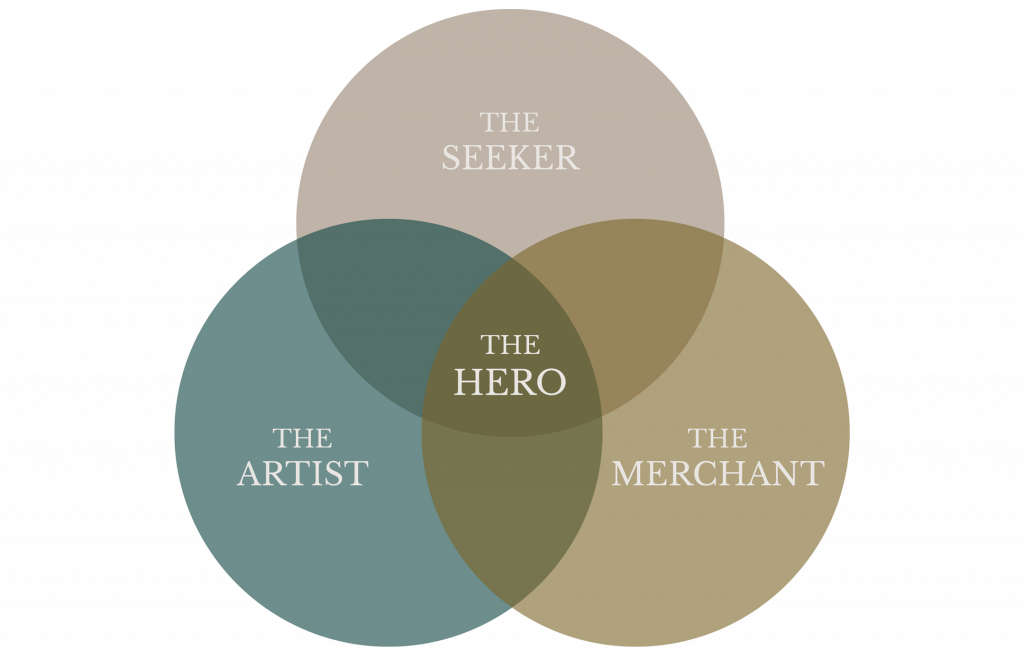
    The hero is the intersection of three fundamental professional archetypes – the seeker, the merchant and the artist, as I wrote about in part 1.

    The seeker seeks the truth and shows us the way. Their mapping of reality gives us a path through the struggle. Their unquenchable thirst for deeper understanding keeps us curious, humble, and constantly learning.

    The merchant is a tradesman of the good. Whether it is material goods, political good or spiritual good, the merchant knows that by trading what they have to those who want it, the world is made better.

    The artist creates beauty. Their compulsion is to make something from nothing – the mysterious process that even the artist himself does not understand. By doing so they create things that touch us and change us.

    The hero is a different order of archetype. The hero is all about the journey, not the character. The journey that the hero embarks upon is defined by the process, not the content.
    The hero walks the eternal quest, constantly working to unwind the code that lies deep within his soul, and to realize the vision that he is called to create.

    The hero is the one who hears the call to adventure, to transformation, and through doubt and resistance finds the courage to say yes.

    This great transformation changes you, and so as you complete the cycle, and return home, you return changed, and the world with it. You return to the marketplace, complete with a new consciousness, and new hands, with which you help those who need you.

    “We have only to follow the thread of the hero path, and where we had thought to find an abomination, we shall find a god. And where we had thought to slay another, we shall slay ourselves. Where we had thought to travel outward, we will come to centre of our own existence. And where we had thought to be alone, we will be with the whole world.”
    – Joseph Campbell, The Hero with a Thousand Faces

    Tension fuels transformation

    It is the creative tension that exists between the outer three types – the merchant, the seeker, and the artist – that drives the hero.

    It is the contradiction or paradox between the outer trinity that demands conversation. The heroic journey is in part, the quest to integrate these languages, these aspects inside you.

    How can I make money (merchant) from my creative expression (artist)? How do I bring the truth that I understand (seeker) into the marketplace (merchant)?

    The hero is not simply the overlap of the three types of the trinity. It is the transcendent principle, held in tension by the first three.

    The point is to mine that tension, for it is the fuel that propels the hero on his journey.

    The Hero Cycle

    Phase I – Disintegration

    No one knows how long ‘normal’ lasts. But if you pay attention, you’ll begin to notice that sooner or later, what once felt right, now feels wrong. What once worked, is starting to suck. Something is out of whack.

    This is not a fault in the execution of your life, or a fundamental flaw in who you are.

    No. This is simply the wheel of transformation starting to turn. God is beginning to crank on your lever, turning you toward a fuller, more beautiful version of yourself. Can you feel it?  This is the call to adventure – the whisper in your ear.

    You are so much more than you dare believe.

    You have a choice. Will you listen? You cannot turn off the whisper, but you can refuse its council.

    You can numb the pain of your dissatisfaction. You can eat burgers. You can binge on Game of Thrones. You can bury your head in the sand and simply refuse to look God in the eye.

    It is your right. But the consequence is an ever deeper journey into the cycle of phase one, into disintegration.

    If you refuse long enough your life will literally fall apart.

    Some choose to let themselves fall apart, and die. They live out increasingly empty and meaningless lives. They die from drugs or illness. They literally kill themselves.

    This is God’s way of forcing you to choose. Life or death?

    Will you choose life? Will you look into the light and see the image of who you are asked to become?

    The hero is the one who answers that call.

    When you surrender to this divine will, when you seize your own sovereignty and choose the path before you, you commit to something with untold power and consequence.

    “Until one is committed, there is hesitancy, the chance to draw back, always ineffectiveness. Concerning all acts of initiative and creation, there is one elementary truth, the ignorance of which kills countless ideas and splendid plans: that the moment one definitely commits oneself, then Providence moves too.”
    – William Murray, The Scottish Himalaya Expedition

    You say “yes”. You consent to the journey you have been asked to make. You step into the unknown, knowing it’s something you must do. And by doing so, you cross the first threshold.

    Phase II – Initiation

    The path extends before you. You are in esteemed company. Every great hero has passed this way.

    “Do you think that you shall enter the garden of bliss without such trials as came to those who passed before you”
    – The Quran, verse 2:214

    Turn to your mentors. Turn to those inside you – the harmony of your highest potential, who you are at your most essential. Turn to those around you – your friends and advisers, the ones you trust most deeply. Read again the great minds that nourish you and show you what you don’t yet understand.

    For you are on a journey that has already passed beyond the edges of your known reality. And as you consent to its invitation, you are drawn into the most challenging of new experiences.

    You will be stretched beyond your edge. You will be hurt. You will feel strife and suffering. But it is not the suffering of unmet commitment in the first phase, it is the existential kicking that you will receive at the boots of the unknown.

    Can you meet it? Can you rise up and face it with courage and conviction?

    These are the trials. Their purpose is not to ultimately break you, but to stress the muscle of your being, so you can be built anew.

    You will be tested for exactly as long as you need, in order to be ready for the great battle in the dark. Your initiation climaxes with the facing of your greatest fear – the great dragon at the heart of your being.

    You are both the hero, and the foe. It is not an exorcism of your demon, it is an alchemical meeting. Can the light in you meet its equal and opposite darkness?

    This is the culmination of all your initiatory challenge. The great showdown. The hero is the one whose leg shakes as he stands up tall, and looks the demon in the eye.

    You will be slain. Some great rock that your identity has rested on will be obliterated. Something or someone dear to you will die. Something that clouded your eyes from the truth will be ruthlessly ripped away.

    When you die, you cross the second threshold.

    Phase III – Transformation

    You have emerged from the dark underworld. But while you have faced down the great darkness and survived, your quest is far from over.

    For now, you must come to terms with who you have become, who you are becoming. You do not understand yourself, you have new eyes, new capacities, but they are foreign. The world has changed, because you have changed.

    Who are you now?

    You have been gifted a great blessing – your prize for meeting the dragon and being changed in the alchemical meeting of light and dark. But what do you now do with this great boon?

    If you were the protagonist in a movie, you would receive a great magical sword, or the secret to a great power. In your journey, the boon is one of deep and profound realization.

    You are rewarded with the greater consciousness and greater power of one who has faced down their fear and been reborn in their own higher image.

    You are on the road back home, but you may feel strangely alone. Perhaps those who you used to associate with no longer understand or see you. This is to be expected, for you no longer understand yourself.

    You are being transformed. What once propped up your identity has been whipped from under you. What once lay in the realm of strict possibility has been realized.

    You must come to terms with yourself – your new self – and realize what you are now capable of. What will you do with this great gift, this great boon?

    When this internal transformation is re-organised into a new understanding of who you are, you cross the third threshold.

    Phase IV – Integration

    The legend of a hero does not end with his great achievement, or her great discovery. The imperative for the one who has discovered great power, is to return with it. To return home.

    You return to the marketplace – the communities that matter most to you – with helping hands.

    “The Hero shall now begin the labour of bringing the runes of wisdom, the Golden Fleece, or his sleeping princess back into the kingdom of humanity, where the boon may redound to the renewing of the community, the nation, the planet, or the ten thousand worlds.”
    – Joseph Campbell, The Hero with a Thousand Faces

    You offer your goods, you speak your truth, you reveal your beauty. You integrate this new you, back into normal life, back into your work.

    You harvest the great fruits of your labour – the existential gift of your journey. You create your art, imbibed with the truth you now see. And give it, to feed those around you.

    As you do this, all the pieces begin to come together. The change that has occurred inside you is transmitted through you into the world around you. You change the world.

    It is not a single moment. This is your work now – to integrate who you have become with the world before you. You must straddle the two worlds of the dark and light, of the unknown and the known, and give yourself for the benefit of those around you.

    Blessings to you dear one, you have made it through. God has drawn you through the great change, the turning of the wheel, the latest revolution in the eternal quest.

    You now know your work. Your work is to live it, be it, create it. This is the phase of great productivity. Appreciate it honour it. For the next turning maybe closer than you would like to believe.

    The eternal cycle

    There is a new hero born anew with each cycle of the journey. For by the time the wheel turns full circle, and calls you on a new adventure, the hero that was born in the last chapter is now the one who clings to normality and safety.

    Every great leader knows that what got them to where they now are, is the very thing that will impede them from getting to the next stage.

    Where are you in the ever turning cycle of the hero? What phase do you find yourself in? For the nature and necessity of each phase is fundamentally different from the last.

    If you are trying to stably define who you are, and yet are in the first half of the cycle, your attempts will be fruitless. For the point of disintegration and initiation is to break you down, and burn off the dead wood of who you think you are. Give yourself to it.

    If you are looking for the thrill of adventure, and yet find yourself in the second half of the cycle, you will sabotage the work you must do. Your mission now is to understand yourself as you now are, and bring the fruits of your transformation back to the marketplace.

    The quest may be eternal. But your time here in this life is not. Know where you are, what you are asked.

    Your job as the hero is to devote yourself to this turning, no matter where you may find yourself on the journey.