• My upbringing gave me a very strong narrative about business: it’s corrupt and corrupts good people.

    It took me many years to unwind this story and reintegrate the archetype of the Merchant back into my worldview and life.

    It’s been a great lifeline for me, when I’m feeling like a shy artist, or entrepreneurial imposter, to remember the ethic of the Merchant. Giving the value and goodness you have is what makes things better for all of us.. And to not do that, for fear of this or that, is essentially selfish.

    This is a good antidote for any of us who can tend to hide away our light, for fear of what might happen.

    The archetype of the Merchant

    The Merchant is in the business of goods and services. Modern economic theory names this “value”. Which is a powerful, though somewhat dry notion. The deeper quality is “good” or “goodness.”

    This is the transcendent ethic at the heart of the Merchant, to offer goods in service of the greater good.

    It’s hard to appreciate this sometimes, given the scandalous ethics that so much of our actual global marketplace currently embodies. Nevertheless, beneath this cultural shadow is the deeper ethic of providing value, of creating goodness.

    Here’s the basic mechanic.

    When I provide you with something that carries high value for your particular circumstances, and you give me something back which is also highly valuable to me, then we both end up better off. The amount of total value is higher after our exchange. We’ve done something good for each other; we’ve created goodness that didn’t exist beforehand.

    Back in the day, this was pretty simple stuff. I’ve got goats, and you love goat sausages. You’re a baker, and I have no time/skill for making bread (I’m looking after all the goats). So we create an agreement, where I swap you my goat sausages for your bread. We’re both richer as a consequence of the exchange.

    We’ve both done something good for one another, and received that goodness back. The result is a net profit on both sides of the goodness equation.

    Our society is fixated on money as the metric of value. It’s so hard for us to imagine a world in which this wasn’t the case, that we’ve ended up falling foul of the shadow of money.

    The shadow of money is that it purports to be the goodness itself – that it itself is the value. While in fact, it is the measurement of value. We’re mistaking the sausage for the stick that measures it.

    Why is this important?

    Because understanding it unlocks a new level of freedom for the entrepreneur who doesn’t know how to “bring in more revenue” or the freelancer who wants to “make more money”.

    Magic dashboards

    Imagine a metrics dashboard that would show you the current status of your business. And the big window at the top says “Goodness provided to people this month”. (Rather than our actual metrics dashboards, which of course feature “income” or “revenue”.)

    It’s a magic dashboard, so it can actually measure the total value of all the things you’ve done. There are countless things that make this number go up, but which have no financial exchange attached.

    An hour on zoom with someone, helping them out with their thing. Sending out a productivity cheat sheet to the folks on your mailing list. Messaging someone with the idea that popped into your head on Thursday. Getting out the barbeque and cooking up some goat meat sausages for your friends and family.

    These things would all pump the numbers in this imaginary value dashboard. If this thing actually existed, you could measure your success by “goodness created” rather than “money earned” (or God forbid, “number of social media likes”.)
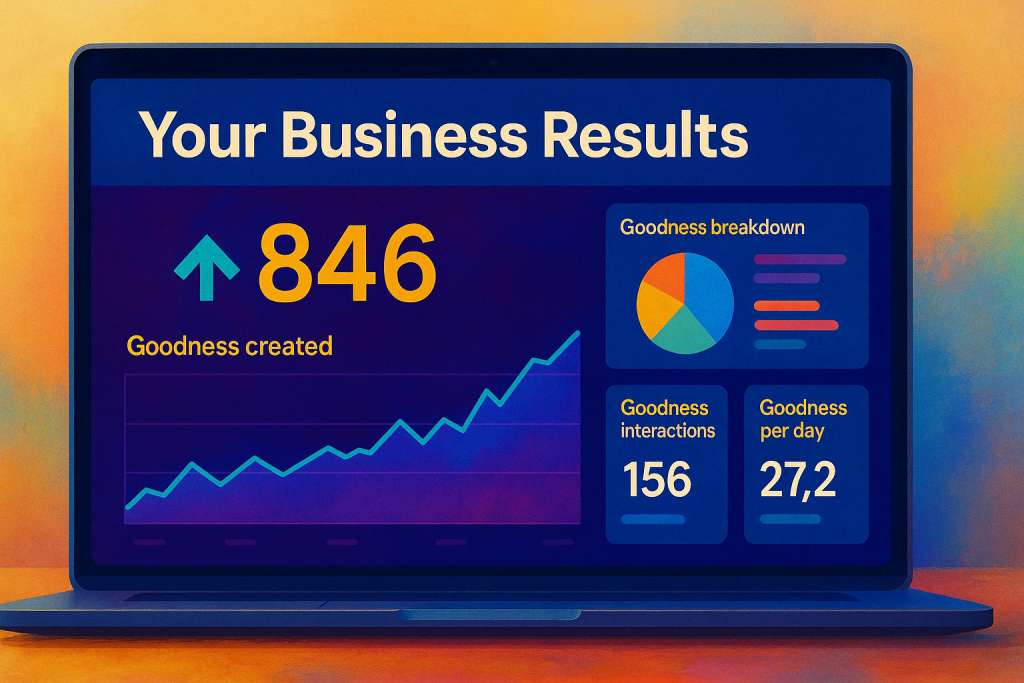
    I like this idea. It casts the game of business into an entirely different light. The goal is giving goodness, which by the law of the merchant’s code, and a result of his skill, results in a receiving back of reciprocal goodness.

    In other words, over the long term, as you saw your “goodness created” go up, you’d also see your revenue (monetary income) rise along with it. For the two are of course deeply related. Since, at the energetic root of the merchant’s action lies the exchange of value, which creates extra value.

    The filling of one extra goat intestine with fresh meat is no skin off my nose…it’s “cheap” to me. Yet the convenience of munching on your tasty bread with no extra effort expended, is really quite valuable to me. So the swap creates extra value that hitherto didn’t exist. That’s the equation at the root of commerce.

    Our culture has made it exceptionally easy to do. Because money fills a second role for us, alongside it’s “measurement of value”. It is a “store” of value. In other words, I can “store” the value of my goat sausages in the form of money. Classically this was coins. Everyone valued the metal the coins were made of, and so could safety “sell” the coins again in the future.

    We barely even use coins any longer. Our money is now digitalised, such that I can swap it for unprecedented numbers of things with unprecedented ease.

    And that’s of course where the shadow of money rears its ugly head. We shoot for money being the target, the goal of business and life. Forgetting that the point is the sausage, or the deep satisfaction that comes from doing what you’re really good at, knowing it really benefited someone else.

    Playing a good game

    The goal is to create goodness. Doing what you’re good at and giving that goodness to others in the form of goods or services.

    Even “non-professional” goodness counts! Calling your mother to catch up can create more goodness than brainstorming a new business strategy.

    One thing to remember however is that you create a great deal of goodness when you start with what you’re good at. Where is your value? I’m assuming you don’t make premium goat sausages. So what is it?

    From the ethical perspective of the merchant, selfishness is when you don’t proactively offer your goodness in the marketplace.

    I know a great many “old souls” (this one included) who struggle to fully present their value in the marketplace, because they don’t want to be pushy, or they feel like imposters. While from the inside this can feel real and important. From the outside it results in your goodness being withheld from people who would benefit from it. Which is indeed a form of selfishness.

    So the perspective shift is from “how can I make more money?” to “how can I create more goodness (value)? Even if you do want to create more money, the metric I suggest you optimise for is ‘goodness created’.

    If you want to be strategic about it, you can ask yourself “how can I create goodness for the people I want to work with professionally?” This helps you funnel your goodness toward the people you want to build your business for.

    It’s a lot easier for someone to say “I’d like to pay for more of the goodness you’re already giving me.”

    Another way of looking at this is that it’s a practice of generosity — of giving your goods, without a strategic objective of return. The law of the universe seems to handle the returns (you’re not in control what they are).

    This is a form of reciprocation. Humans are wired to reciprocally return generosity. Indeed, many people feel guilty if they’ve been given a kindness and haven’t returned one.

    The real payoff though, is the shift of focus from the stick to the sausage. The point is the goodness. The practice of doing what you’re good at, and of doing good in the world. This makes us feel useful, like we’re making good on the gifts and plans we came down here with.

    You get to be good to people. Live a good life. Which feels so good.

  • Human beings have been trading stuff for an awfully long time. Some say for 150,000 years. It’s one of the biggest differentiators between us and the animals. It’s made our lives rich and cooperative.

    Here’s how it works…

    If one guy is great at making stone axes, and another guy is great at making wooden spears, then it helps everyone if they stick to their specialism, and swap stuff. In one sense, it’s simple math.

    Ug takes 1 day to make a stone axe. He’s good at it, because he’s practiced a lot.

    Stig takes 1 day to make a wooden spear. He has a natural way with the tree’s product.

    Ug never found the wooden thing easy, his fingers don’t work that way, so when he makes a wooden spear, it takes him 2 days. Stig is equally inept with stone axes. It just doesn’t bend the way his lovely wood does. It takes him 2 days to make one.

    Both of them need both tools.

    So if they are uncooperative and selfish, they simply make everything for themselves.

    1+2+1+2=6 days total work.

    However, if they stick to their specialisms, and Ug makes two stones axes, and Stig makes 2 wooden spears and they trade, then the calculation creates a different result.

    1+1+1+1=4 days total work.

    That’s two extra days created, one each, which they could use to make cave paintings, or practice their craft, or hunt more food, or hump Jane, or each other.

    Trade has become outrageously specialized in today’s world. We’ve gone way beyond spears and axes.

    What is your specialism?

    What can you do that no one else can do? Or what could you do, given enough hard work, that no-one else can?

    That’s what makes you special.


  • Sweetheart, you don’t get it.

    You don’t realize just how beautifully valuable you are. So very precious. So very special.

    Because you’re like me. You forget. You deny it. You disbelieve it.

    It’s not your fault. It’s not a pathology – something that went wrong. There’s a disease. Adyashanti says it’s an affliction of the Western mind. It’s the disease of chronic unworthiness.

    That no matter how well you do, how much people love and appreciate you for who you are, you have this doubt. This place deep inside, where you actually don’t believe you have any value. You’re not worthy.

    It shows up in everything you do.

    You’re confusing things. It’s ok sweetheart. I do it too. It’s not a mistake, it’s part of the path. But you still don’t get it.

    Value. Worth. Worthiness.

    It’s not all the same. There are two radically distinct kinds of value. And when you confuse them, it’s a recipe for existential crises, delusion and confusion.

    Which is never fun.

    So, let’s see if we can’t clear that up.

    Essential Worth

    You have this in complete abundance. And what’s even cooler, you don’t have to do anything to create it or prove it.

    You are one of the most conscious and beautiful beings the world has ever seen. So am I. And so is your grandmother, the wall street banker and Justin Beiber (yup, even Justin).

    You’re a human being. That’s already pretty fucking rad. It’s a precious, precious gift.

    The Tibetans say it’s very rare to be born as a human. They tell a story. Imagine the whole world is a giant ocean. And there’s a turtle that swims around under the surface. And there’s a golden ball, floating around in the currents. Now what are the chances of that turtle popping up above the surface and catching that golden ball in its mouth? Pretty darned slim. Well, that’s the same chance you have of being born human.

    You get born a human. Wow!

    And just like the snowflakes and the trees, every single one of us is totally unique.

    By definition of being uniquely human, you have essential worth. You have the most sophisticated biological hardware in the known universe. And you have a unique software system – your own consciousness – that sees things distinctly from every other human being.

    Essential worth. You don’t have to prove it, or stress about it because you were born with it. And it can never be taken away.

    Worldly Worth

    This one is different.

    When you’re born, your worldly worth bank account starts at zero. It’s something you must create. It’s your usefulness out in reality.

    Imagine Mozart was alive today. He had all his musical genius. But in this world he doesn’t compose or perform anything. He spends his life eating nachos on the sofa, beating off to expensive porn and never leaving the apartment someone else pays for. He has no worldly worth. In fact, he may even have negative worth. He consumes more that he creates. He consumes a lot of nachos, a lot of porn, and doesn’t create anything in return.

    Worldly worth must be created. It’s the value that is useful to other people.

    And this is what business is interested in. The market place.

    If I spend 2,000 hours learning the ancient art of cosmic monkey spanking, then I am valuable to all the people that want to spank their own cosmic monkeys, but don’t know how.

    And they will want to give me value in return for teaching them. They give me $100 a session, or special primal favours.

    When we make that trade, the world literally gets more valuable.

    Worldly worth. You have a bunch of it already, but you can create more. You must create more, if you want to do your true work in the world.

    We confuse these kinds of value

    If you deny the existence of essential value, like the modern marketplace often does, then you will spend your live striving to prove your worth by building immense worldly value. But its fruitless, because you’re trying to prove your humanity, your essential value, and that can never be proved.

    If you deny the existence of worldly value, then you become impotent. You wait for your work to ‘emerge’ (often spiritual speak for naïve inaction), believing your natural inner unicorn will be recognized if you ‘trust’ in it. But it’s crazy making, because your worldly value has to be created. It doesn’t just pop along magically.

    When I put out new stuff, the fear is that my heartfelt offer will be met with indifferent silence. No one gives a shit. No one wants to accept my invitation.

    And when I’m not watching, the undifferentiated scripts start to wind their suffocating bodies around me.

    “If no one pays you for this, it’s going to confirm that you’re actually worthless Ewan. I know you think you’re special and unique, but the evidence will be there fuckwit. You’re worthless.”

    What it would actually confirm is that my worldly worth in the particular area I just created something in, is not what I thought it was.

    And the antidote is simple. Either I’m offering my worldly value to the wrong folks, in which case I find the right tribe. Or I don’t have enough value in this area, and I just need to put the work in to get better.

    Usually it’s just fear and doubt though. And it can be so insidious. “Maybe it was all a delusion. Maybe I’m actually not worthy.”

    And of course, the irony of it is that the more we trust in our essential worth, the easier it is to own and create our worldly worth.

    Do you invest in your worldly worth?

    You can’t invest in your essential worth. It’s not a thing that can be increased or decreased, only felt or denied.

    But your worldly worth can be increased indefinitely. If you want it to be.

    And that’s where you and I tend to struggle isn’t it? In our noble attempt to transcend the materialistic absolutism of the modern marketplace, we throw out the worldly baby with the greedy bathwater.

    But worldly worth is the root of service and making a difference in the world.

    The math is simple. The more you invest in and develop a worldly capacity, the more it’s worth.

    I’m a more valuable coach today than I was 3 years ago. Because I’ve run the cycles on it. I’ve clocked up hundreds of hours of coaching, and it shows when I sit down with someone to help them.

    How seriously do you invest in your worldly worth? Do you put your money on the line?

    Often we shy away for paying for our own growth, because we doubt the value.

    “Oh, it looks interesting, but $2,000 for a 5 day falafel workshop? That’s too steep. It’s not worth it.”

    But you love falafel! It’s your life, your passion, your love!

    The absence of value lies not in the promise of the program. It lies in you. You don’t believe you are worth $2,000 of investment.

    “I’m a falafel amateur. I’m not ready for spending that kind of money. It’s above my level.”

    It might be true. But more often than not, we doubt our worth. We don’t trust our essential worth, and so we shy away from investing in our worldly worth.

    We believe the story in our head, that’s compounded by a confusion about the nature of value. Because what’s the point in investing in myself if I’m worthless in the first place?

    Then it’s like pouring champagne in a toilet full of piss.

    I’m in your corner

    Sweetheart, you don’t realize just how valuable you are. And how valuable you can be.

    It makes me sad. It’s sadness at my own doubt too.

    I was told “whatever you do Ewan, it’s wonderful. It doesn’t matter how good it is!” It was progressive at the time. Now it’s painfully lopsided.

    Because we hold back don’t we? We don’t trust we can do it, create it, own it. We doubt it will turn out well if we really own our essential value, and step forth and develop our value in the world.

    But that’s why we’re here. If we couldn’t grow and serve, and leave the world better than when we came in, we wouldn’t be here. That’s the whole point sweetheart.

    You’re so fucking valuable. Never believe the doubt that you are. You already know how much worth you possess.

    And go forth, and build a level of value in your world that matches that inner knowing. That is what will enable you to leave your beautiful mark on the world.


    If you’d like to go deeper into this mission – your mission – and learn how to courageously step out into the world, then take a look at my new small group program: Emerge.

    There are still a few places left.

    Take a look here.

    And if you do feel called to step in. Do so. You’re worth it.