• Life is a series of ups and downs. Anyone who’s lived one and thought about it will attest to this universal truth.

    Sometimes life feels amazing. We’re in flow, high on the joy and achievement of what we’re doing. It seems as though the gods have aligned, and we’re flying along the causeway of purpose.

    Sometimes life feels fucking hard. We’re pulled down into the fear, grief and resentment, wondering why on earth nothing is going our way. It seems as though the world has conspired to fuck us at every turn.

    It’s the dance between these polarities that defines in large part, the human journey.

    We come here to learn. To incarnate in Earth School is not for the faint of heart. It’s no picnic. Earth is like a melting pot of our galactic diversity. And things never stop changing here.

    This is quite aside from our current predicament, living inside a culture that has drifted further than ever before from the spiritual truth of who we really are. We’re carrying generations of trauma from centuries of heinous abuse and violence. Our technology has outpaced our wisdom so far, that we’re actively destroying the biosphere in which we live. Uncertainty is at unprecedented levels, far higher than our neurobiology is built to handle.

    It’s not an easy place, or time, in which to be alive as a human.

    The Depths are Here to Teach Us

    If you think of the lows as the wrong way, and try to escape them or avoid them, because you think you need to be up higher, then you will miss the point entirely.

    For the lows are teaching us something that we can learn in no other way. Why else would an enlightened and immortal soul willingly choose to come and incarnate down here in this severely limiting and scary experience? Because it’s an incredibly potent form of learning. You get the message, deep down inside you, forged in the midst of dense struggle. It’s embodied learning in the most literal sense.

    The infuriating truth is that, if you keep running into the same wall, it’s because you haven’t got the message yet. Infuriating to the little one in us, who rails and whines, baffled by the unfairness of it all.

    “Why does it have to be so hard? I’m trying so hard and then this happens! I’ll never solve this!”

    We choose this. And whatever wall you keep banging your head against is the one you knew you were coming here to work out. You wanted to. In fact, you were excited to come and take on the challenge.

    Though it’s a lot easier to feel excited and capable when you’re an enlightened soul on the other side. It’s a lot fucking harder when you’re Ewan, or Jim, or Janet, wondering how on earth to get through it.

    We don’t want to descend. Our culture does not value it—we’re taught that it’s better to be flying high than down in the dumps. But a culture that refuses the journey of descent produces leaders and stories still captured by their own shadow.

    If we were to trust our inner compass, we would climb all the way down to where the clues and directions lie.

    Surrender to the Descent

    Over the last couple of years, I’ve developed a practice of “going to the bottom of the well”. It’s been forged in those low moments.

    When I’m in the “life feels fucking hard” zone, and the dark clouds form up, I stop what I’m doing, and face the pain. And I allow the ‘negative’ emotions to pull me down into the truth of the moment.

    To do this I have to contend with my conditioning, which wants to resist this descent. It’s dark, it’s scary, there could be all kinds of monsters down there (says the little voice inside). At the very least it’s going to hurt or feel really unpleasant.

    I have a hundred patterns which want to distract me or pump myself up and push it away.

    Instead, I choose to trust the deeper knowing, which has no fear of the dark, which knows it’s all just different dimensions of source, of God.

    So, I allow myself to fall, to descend right to the bottom of the well.

    When you allow yourself to fall right to the bottom of the well, you encounter a whole bunch of feelings, sensations and experiences which are challenging to be with. This is the point. This is the stuff you’re desperately trying to remain afloat on top of. Using increasing energy to keep yourself away from.

    When you learn to just be in the pain at the bottom, you’ll begin a healing process. For when the dark comes into the light, it begins to transform.

    But what I’ve found most powerful in this practice is this…

    At the bottom of the well, there are messages written on the walls. They’re messages that you can’t receive anywhere else. You can’t hear them higher up in the hustle and bustle of life. Only here, only down at the bottom of the well can you fully receive them.

    How to Go to the Bottom of the Well

    So how do you do this, practically? Here’s what I suggest.

    The next time you feel yourself being pulled down into the dark, make a choice to do so consciously and with intent. This is the first challenge—to be conscious enough to notice you’re already feeling low, and then choose to trust the fall.

    Find a quiet and safe space where you can make the journey.

    Light a candle. Put on some evocative music. And get on the floor. Getting on the floor is important. It’s the physical representation of “down”. Get on your knees and put your head on the floor, or lie flat on your back. If it’s really dark, curl up like a foetus.

    Close your eyes.

    And trust God as you’re taken down.

    Let go. Surrender. Allow yourself to feel all you are feeling. Let thoughts drift past. Allow your body to soften to the feelings you fear.

    If you feel scared, just allow yourself to be afraid. If you feel sad, just allow that grief to move you. Let your body move as it feels. Just stop clenching, and allow the feelings to do what they will through your movement.

    Breathing is important. Keep breathing. This is what allows everything to move. Breath is the spirit that adds light to the mixture.

    And then listen for the messages. Watch your thoughts for things that really speak to you.

    There’s a knowing that is available here. Open yourself to it.

    It may not be easy to hear. You may want to turn away from it. Keep surrendering.

    The more you let go, the more space there is for wisdom to enter. Watch for it. You might hear it, as a voice whispered. You might see it, like a dream image in your mind’s eye. You may just feel it and know.

    And then take your message, and nurture it. Like a small ember that can light a fire that burns through the wall you keep banging your head against.

    Remember it. Write it down. Tell the story to someone you trust. And let it do its work.

    And if you don’t get the message? Never fear, another invitation to the bottom of the well will come around before long.

    This is the gift of the dark. To show us what we don’t want to admit or cannot bear to see. But only in the light of this insight can we find the path forwards.

    And as you learn to appreciate these gifts of the dark, and you become accustomed to the trip down to the bottom, it will become much less scary. Indeed, it will become a super-power. A capacity to access deep knowing and higher wisdom that is found in no other way.

    It gives you a structural integrity that can hold the whole of you. It allows you to find the way into the higher reaches of yourself. For as Jung said, “No tree can grow to heaven unless its roots reach down to hell.”

    Befriend the descent into the dark and it will teach you all you need to know about the higher path forwards.


  • For as long as I can remember I’ve had dreams. My mind seems to naturally conjure future visions of how amazing things could be.

    This is a double-edged sword.

    On the one hand, it’s a powerful imaginal capacity. It underpins key parts of my mystical and shamanic work. It allows me to understand and see other people’s visions (great for coaching people). It gives possibility to life.

    On the other hand, it’s easy to conjure the picture of something, and way harder to actually create it here in the 3D. This can lead to a habit of living in my magical imagination, rather than doing the work in the physical world.

    Therefore, I’ve spent many years studying and experimenting with different approaches to “realizing your dreams” or “reaching your goals”.

    One of the most important conclusions I’ve drawn is that this endeavor is best seen as a journey — not just as a nice metaphor, but because it most closely resembles the actual territory.

    So, if like me, you can struggle to bridge the big picture vision, with the small practical steps, this is for you.

    How on earth do I do this?

    The voices start chattering. All the worries and challenges spiral into an imagined nightmare.

    “It’s too hard.”

    “I’m not good enough”.

    This kind of stuff normally comes up when I’m thinking about the thing I always think about. How to step deeper into the arena and dare to boldly show my hand. I’m holding an image of a glorious potential. As I conjure it my soul and heart hum to its tune.

    But today, like other days, the negative voices seem to be winning out.

    We all know that they’re not to be trusted as the authorities they profess to be. We all wish they’d pipe down and get in their place. They feed the doubt.

    “How on earth do I do this?”

    Which is just a stone’s throw from “I can’t do this.”

    So let’s map this out. For as I said, I’ve come to believe that these things are not simply metaphorical journeys. The structure of the journey is embedded in the way our body-mind works with this stuff. I think this is because they both have the same deeper root, the transformational cycle from which they’re both modelled.

    Here’s a way of looking at it.

    Corners you can’t see past

    I see a future vision, of how my life could be. It comes to me in a moment of calm perhaps, or a heightened state of consciousness.

    Insight. Seeing.

    I’m inspired—the vision lights something up and I feel a bubbling excitement.

    Then, perhaps the next day, I sit down to start working on it. And I realize how big or hard it feels. So I stop. From my limited perspective, it looks like it’s a long way off, in fact it’s so far off I can’t even see it. The vision euphoria starts to wane, and the quest seems more difficult and less appealing.

    If I were to zoom out and see like the eagle sees, I would be able to see a winding pathway that leads from my starting location all the way through the landscape to the location of my vision. In fact, I might see an entire root system of pathways, spreading out from here to there.

    Now when I zoom back in again, and view this through the eyes of my human self, I see a forest of trees before me. I remember the route I saw from above, and now I see a pathway running out in front of me. But I can still only see so far. At some point the pathway bends and I can’t see past it.

    I can’t see past the corner.

    Once again, this is a metaphorical truth embedded in the life journey. It’s the way our human mind makes sense of travelling through time and space.

    The corner is the future location that you can’t see past.

    For example, “I know I’ve got to get on a plane and go to this thing. But I truly have no idea what to do when I get there.”

    That’s the point that you can’t see past.

    The only way to navigate the journey is to take the steps along the pathway, until you reach the corner, at which point your view will open up once again and you can work out your new heading.

    The reason the vision you seek can feel so far away and so impossible, is that it lies around 11 corners.

    I can’t see past the 1st corner, let alone the 11th.

    I can’t see it, because the person who walks around that 11th corner is different to the one standing here. He’s the product of having walked around the preceding 10 corners. And been changed by each of them.

    So, the gameplan in its first instance, is to focus on the steps, and not the corners.

    Steps along the path

    Pick the direction (which implies the destination) and see the pathway. See the steps that follow on from one another, and end up at the corner you can’t see past.

    I go in a North-Easterly direction, get across that muddy river, up the bank on the other side to the tree line, then I can see how to tackle the big hill.

    Or, I’ve got to finish the copy drafts, find some new images, get some feedback, work it over again, upload everything to WordPress then I’ll be able to see how to announce this thing.

    I know enough about the direction and path that I can take. I know the steps that get me to the next corner. And then it’s a case of take those steps. The first. Then another. Then another. Taking consistent steps is much more important than the size of them.

    I learned a profound lesson from Jordan Peterson about this. The steps you commit to must be small enough that you can actually do them (over ambition raises the risk you in fact do nothing). The telltale sign of an appropriately small step is that you feel kind of stupid aiming for it.

    “Like really, that’s all I have in me?”

    Jordan describes a man who he worked with many years before whose life was a big mess. His first goal was to tidy his room (which was also a big mess – go figure). That was his corner – having a tidy room. And his first step? All he could manage for the first week, was to take out the vacuum cleaner, put it by his door, and look at it every day.

    That was the first step for him. The one he could take and did take.

    The work of the manifester

    The work is to keep seeing the next step, and taking it even when it seems stupid, and especially when you feel stupid for struggling with it.

    Even one step each day adds up to something bigger than you might think. As the seemingly meagre rhythm stabilizes, you find your groove and start to notice the sensation of momentum.

    This is when you feel like you’re being pulled along (not simply pushing yourself forward). Like a river current that adds its power to your movement.

    And before too long you’ve reached the first corner. And then you’re around the next few corners, and things look quite different.

    So, if the vision feels too big, or the challenge too great, and you don’t know how on earth you’ll ever get there…just head for the first corner. Take the steps, especially when you feel a bit stupid for lowering your targets.

    Trust that the one who keeps taking steps, is the one that makes it to the next corner. And trust that the one who has made it there, will be equipped get to the next.

    Until you realize you’ve reached your destination. And you can enjoy it for those glorious moments, until the next journey calls your attention once again.

  • The first time I met one of my guides, I had no idea that’s what he was.

    He was a strange, hooded figure that showed up in a “journey” during my first weekend shaman workshop. The workshop was full of people I’d tried my best to avoid in life – tribal yoga pants and feathery spiritual auras abounded. I smoked cigarettes on the break and reassured myself I was different.

    There were no psychedelic substances involved. It was based on the simple power of the drum and rattle. I was clean, clear and sceptical.

    The figure I met (who later turned out to be a guide) was like a half human-half reptile, hooded and carrying a staff. He sat me down in front of a fire, in a cave next to a great underground lake and stared into my eyes. I don’t even remember if he said anything, but I remembered him.

    The practice I was taught during the workshop – soul flight – is a foundational practice of shamanism. You journey to the other realms, and there meet with spirits who guide and heal you.

    I did further training that year with the same teacher in England. And then I went home and experimented for two years.

    Voices through the Veil

    I was riding home from the park. I’d been seeking council from “hooded-shaman dude” (who by this point I’d worked with in a number of ceremonies). It had gone deep, but now I was done and heading home for dinner.

    As I coasted along I “melded” with his memories. And suddenly I was riding a horse across a savannah in a magical landscape. The significance of both the scene itself and the fact I was melding memories, was running through my body. I felt alive. The wind was no longer cold it was magical. The movement of the ground under my feet was the dry sand under the horse’s hooves.

    Then he did the thing that was the pebble that started the landslide change in my worldview. He spoke directly into my mind—like a call being patched through straight to my brain, with an accent.

    He teased me.

    “You know it is pretend horse, right?”

    He made me literally laugh out loud.

    I can’t fully replicate his humour in writing. It’s in the absolutely perfect timing and tone of his jokes. Like when someone lands the perfect line and it strikes right in your weak spot, but it feels really good and opens your heart. He did that.

    And then I knew. Because I can’t do that to myself. The point of that perfect joke is that you don’t see it coming. I hadn’t, and now I was really laughing.

    Something opened then and he really started speaking to me. Inside my mind, like all the other voices do, but now I knew it was someone else, and the signal got really clear. We began to have a back-and-forth conversation as I cycled home.

    And by the end of the bike ride, I was starting to get a bit freaked out. I asked him to “please leave me alone and stop talking to me!” Which he did, and my mind returned to its normal “alone” feeling. Which was a relief. Like stepping off the rollercoaster.

    I knew things were going to be different though.

    *

    A couple of days later I sat on a bench in the forest, and we started talking again. I’d done some integration, I’d re-assured myself I wasn’t doing something terribly wrong, and I’d decided it was time to have a frank conversation.

    There’s something about me. I fundamentally trust people’s hearts. And, I have an incredibly sensitive alarm system for stuff that is off-key or dissonant. It’s a capacity I’ve tuned and cleaned over the years.

    And here was a particularly weird new challenge. I was readying myself to talk with an “imaginary friend” who wore a hood and seemed to have a crocodile’s tail protruding from the back of his cloak (though it’s hard to tell sometimes in dream time). My rational guardians were on fucking edge.

    “This is fucking weird Ewan. And you know it! Test this fucker out.”

    And yet while I trusted the cautionary advice, what was really curious was that my alarm system was not going off. This is a pattern which would repeat itself many times – the rational alarm beeping, my intuitive trust knowing it was right and true.

    So, I dived in and I asked him some really fundamental questions. I wanted to know who on earth I was talking to, and how deeply I could trust this strange character.

    I wanted to get a read on him. My intuitive capacities were in trust, but my map of the world didn’t have a good explanation for what was happening, and who he was.

    “Are you alive?”

    “Of course. I am talking to you aren’t I?” He enjoys my questions. Like a loving school master encouraging a student. “But not in the way you think of as alive”.

    “Do you have a name?” I ask him. I can feel his presence, as though he’s sitting next to me on the bench.

    “Yes. But I will have to teach you some things to tell it to you.”

    He then proceeded to show me what “names” were to him, in his life. They were really quite different to ours. He showed me how to visualise it. I closed my eyes, and I found myself sitting in a big stone chair and carved into the rock around me are symbols. He points to the ones above me.

    Above my left shoulder was a strange beast head, lizard like.

    “What is this symbol on the left?” I ask him?

    “This is a dragon.” he says.

    Above the right shoulder was a symbol I definitely knew: a moon.

    “OK, and so what does this have to do with your name?” I still hadn’t grasped it.

    “This is my name. Or at least one I am giving to you to call me with. But you must read from the other perspective.”

    I stood up, took a few paces, and looked back at the bench where he was sitting. I could see the symbols above his shoulders.

    “Read left to right”. He pointed first to one symbol, then the other. “My name is Moon—Dragon.”

    Well fuck. I was amazed and delighted. How fun! A name made from special symbols. I loved it.

    But fuck. My rational alarm system could foresee the implications already. I was going to be one of those people who talk to spirit guides with weird names. Fuck, fuck.

    “Were you once alive as a human?”

    “Yes.”

    “How long ago did you live?” I ask him.

    “How do you measure time?” He replies.

    Well, that was a bloody good question.

    I did my best to draw out some diagrams in my notebook that explained about solar years, and then how we wrote numbers.

    After a bit of back and forth, and number sequence translation he gave me the answer…

    “Moon—Dragon died 39,327 years ago”.

    Well, that was a lot more precise that I was expecting.

    *

    Over the following months he showed me how to do things. Little rituals in the woods. The key was to be like a child. Which is more accurately: ‘be child you’. This is where the innocent knowledge of the other side already exists, and where we instinctively know how to “play with the spirits”.

    And concurrently to all of this I was fiercely analysing my experiences with scepticism and logic. I wrote regularly in a “magic journal” where I would attempt to secularize my experiences and make sense of them without relying on anything I considered woo-woo hoodoo. In other words, could I rationally explain my irrational experiences?

    In retrospect I can see that it’s mostly my mind catching up. The experiences were real and deeply meaningful. Which my soul knew, but which my model of reality and its egoic keepers, were still trying to salvage as the boat went down.

    Awakening to the World of Healing

    Moon—Dragon was the first of four primary guides that have introduced themselves to me.

    I say introduced themselves, because they gave me names to call them, and they told me about who they were and what they were here to help me with. But these are just names for my ease. Souls don’t really have names.

    I needed their names to help me develop intimacy and trust with each of them.

    It was in January this year that things went to another level, and where that trust was to be utilized.

    It started with a (delayed) trip to Turkey to meet up with a very old friend with whom I had discovered a shared fascination with all things magical.

    The delaying of the trip is a story for another time, but let’s just say it was an unplanned initiation into shamanic healing, through my own transgenerational trauma.

    When I got to Turkey, we spent 5 days catching up while visiting Göbekli Tepe and other ancient temple sites. We talked magic, we reached for it. And when I returned home, it showed up.

    I was innocently performing a simple ceremony that one of my other guides had showed me. And then in the midst of it all hell broke loose. She guided me through a spontaneous healing session – one that I had been trained in technically by my shamanic teacher in England, but which I had never actually performed.

    Before I knew it my world had been changed once more.

    I had been dispossessed of a certain family illness that I had hitherto had absolutely no knowledge of, and which turned out to reveal some very interesting results, once healed.

    For that was the real world-changer. I had discovered what healing really was.

    Honestly, I’d had little interest in “healing”, even though I had trained in many methods of shamanic healing, I felt it wasn’t for me. I wasn’t drawn to it. In a sense, I didn’t believe in it.

    This was the real stuff though. What shamans call “direct experience”. I’d already tasted the depth of information possible through my guides. Now I was having direct experience of their healing power.

    This ceremony was the first in a series (that’s till continuing). I’ve been led through a kosmic network of esoteric knowledge, all revolving around my own healing process.

    Chapter one was lineage work. Trans-generational illnesses. Each one took me back into the lives of one of my ancestors and (often) a moment in their lives when something got all wonky.

    My task was to travel back in time, through the astral passages, and heal it. Which I did (I think!). At least enough to get me to chapter two, which is still in operation as I write these words and concerns the traumas of my own childhood (which inevitably lead back into my family history once more).

    I didn’t know any of this was possible.

    I had no idea guides could actually facilitate ceremonies. For that’s exactly what they did.

    “OK Ewan. Just feel your heart. Do you feel how much I love you? It’s your choice. There is no rule. Feel yourself and your own truth.”

    When I was feeling scared, they’d reassure me.

    And when I had no idea what I was doing, they simply talked me through the steps, just like a workshop leader would. Except they were talking to me inside my heart-mind, and the scenes around me were of other times and spaces.

    “Now comes the healing, are you ready?”

    “Yes.”

    “OK, take a breath – yes. Now let yourself dissolve into the moment. Ready? Turn to your left and meet it.”

    It was almost never what or who I expected it to be. It was always simple and beautiful. And something I could never have found alone. Each one changed me in some way, though it’s hard (mostly) to say how. The combined effect however is undeniably different. More me.

    The (Meta)Physics of Guides

    My worldview on the other side of these experiences is different. Some parts of reality map have been re-written, and huge new swathes of what I now know are “real” have been sketched in.

    Here are a few travel notes.

    We’re definitely not alone. In fact, some of the voices in your head, that you know well, are none other than your own guides. They hide out, covertly doing good.

    When we die, we don’t die. The opposite. We return and remember who we are, which is an eternal soul, with a lifetime of lifetimes of memory.

    This one—the soul (me without the amnesia)—is also the one who planned out a great deal of what I’m now living through incarnation. Certainly not all of it (soul plans are just that – plans, which have a whole lot of potential for going “off-map”), but the key stuff? Oh yes.

    The stuff I repeatedly bang my head up against was all anticipated and “set-up” for me to learn through. Those are (by definition) the particular challenges that my character in this life needs to learn through, in order to unlock the higher character upgrades. That’s how the system is designed to work.

    Incarnation in this three-dimensional reality is a choice (for sovereign choice it always is). Certainly not all souls choose to do so. Why? It’s intense! Particularly here in Earth school – Gaia is a particularly potent and challenging spot to come and play. And particularly now!

    Coincidence?

    Certainly not for me (as I found out), and indeed for many of us who are discovering there is more to this “reality” than meets the eye. That the “fantasies” we love to see in movies are not actually so fanciful.

    Who and where is a guide?

    They’re not in this world I see and touch. My shamanic teaching tells me they exist in “non ordinary reality”.

    Most directly, they are souls who have chosen not to incarnate, and instead play the role of guide for those of us down here in the physical world.

    They live in a different dimension to us, one outside of physical limitation. They are in effect, all-seeing and all-knowing. But they are not gods – their power is incredibly limited (here in the physical).

    Their power is in their guidance of us, for they see the whole picture, and the great web of possibilities. They know our hearts inside and out, and what we’re here to do.

    When a shaman or psychic “talks with the spirits” they are (usually) connecting with their guides. In many traditions, the guides are the ancestors (which is usually literally true of course). The Christian name for them is guardian angels (though they are not in fact angels at all).

    They are specialists at guiding us. In fact, it’s their job or more precisely their role. They help us walk our own evolutionary path. There’s no “control”. There is no coercion.

    Quite the opposite.

    The purpose of their role is to guide us in our own sovereign choices. And at the same time, to guide toward the soul path (the things we planned to do, but may have forgotten about, or be scared to face).

    Some things guides are not

    The kinds of guides I’m talking about here are our personal guides – specific to us. We each have (at least) one.

    This is different from, for example Jesus. Who is not my personal guide. He is a soul in the category that the esoteric schools call the “ascended masters”. He’s up there doing his thing with Buddha, Merlin etc. They are beings who are available for communication with anyone who wants it (if you can receive such high frequencies)! But they’re not specific to you like your own guides.

    You could think of it this way. If you want the most direct coaching on this life incarnation—what you’re here to do, and who you’re remembering you are— then you’re going to get maximum effectiveness with your own guide team.

    If you can’t find them, Jesus is like a “universal guide” that anyone can use. Kind of like if you forget your gym clothes and need to borrow one from the shared box.

    So your personal guides won’t be “famous”. If Jesus is telling you that you’re the special one and you’re the only one that can hear him, then you’ve definitely missed the point, or the identity of the actual speaker, and therefore the implications of your own egoic grandeur.

    They are also not “one person”. Souls are of course not “one person”, they are beings who have lived thousands of lives, and remember them all. So restricting them to a name, or a particular person is useful but not quite true.

    Guides also regularly show up as collectives. “They”.

    Some psychics and mediums don’t have differentiation between their individual guides. They are simply and always a collective. Sometimes even without names. “The guides”.

    Others are personally guided by their own ancestors or relatives. The grandmothers and grandfathers. Even someone who knew, when they’re on the other side, they’re the “transcendent version” of themselves.

    Guides are also most definitely not gods. Any soul on the other side looks, feels and sounds completely enlightened to us. Because they are—by our standards. But they are definitely not gods.

    Guides are not the answer to everything either. But they are a game changer. Here are some of the reasons why.

    Understanding the Utility of Guides

    Imagine a cast of enlightened masters who sit on your guidance council, and whenever you’re unsure of what to do, or where to go, or who you are, or what’s true…

    You can go and ask them.

    And they’ll answer.

    They are an access portal to your soul power. They help you understand where your true power lies, and gently ease you away from the mistaken assumptions you’ve made as you’ve stumbled along unguided, and developed habits that while necessary to create, are now the obstacle that is the way.

    They are so good at guiding you because…

    One. They live outside of time and space.

    As souls not bound to the physical dimension of reality, they are not bound by time and space. These are very challenging concepts to write in language. Their awareness and consciousness are not limited to a single point of time and space (like our embodied consciousness), thus, they are able to see all spaces, and all times simultaneously.

    This is utterly minding bending to us, but utterly normal to them.

    The result is that they see it all. In English we would say they are omniscient – they see everything. Therefore, you can trust that wherever they’re guiding you, they’re working from a complete data set.

    They really do see the whole game board. And they’re “non-physical entities” (which is a rather ugly term), which means they’re not limited by matter. They can “be” anywhere, because “where” (spatial location) is a construct they live outside of. This means…

    Two. They see the purpose of everything.

    This is the nature of their dimension in fact, and where the whole “outside of time and space” thing starts to bear fruit. They see the purpose of the movement of things (beings) through space and time.

    Why do we evolve and change? What is the purpose of life? Where are we heading? Why is life so damned challenging!? Why does something exist, rather than nothing?

    They see it all. Like a great mirrored river delta, they see why one molecule of water flows from here to there. It is self-evident from their perspective.

    Purpose starts with the end in mind. Literally. It’s hard coded into the deep structure of reality. When you see the whole game board—why the river flows into the ocean, and its circular life—then the neuroticism of the water molecule who “doesn’t know if he’s on purpose”, is easily solved.

    “Keep going little watery one! You’re doing great!”

    This is often the spirit of the answer they give me when I ask them the question I’ve asked them most over the last few years.

    “Am I on track – on the soul path? Am I doing the right things?”

    “Yes, you are on right track Ewan. Keep going!”

    This is a complete game changer.

    Whenever the existential doubt clouds your life, and shit gets hard, and nothing seems to be working the way you thought it would, then you can just go and ask straight up. And they can give you a straight up answer. And it will be true (or at least exactly as true as you need).

    Three. They have no judgement.

    None. It doesn’t exist in their reality (its actually exclusive to ours). For judgement to exist, it must be fed by its twin flames of fear and pain. When you see everything and its ultimate purpose you are no longer governed by these things, even though it is hard for us to imagine such a reality.

    No, your guides will never judge you. They will never punish you. There is zero retribution in the “afterlife” if you don’t do what they say.

    The one and sole purpose for their guidance of you is love. They love you deeply, utterly and unconditionally. This is their motivation in its entirety. And the most loving thing they can possibly do in their 5th dimensional reality? Help you be you. This means…

    Four. They are the perfect coach for you.

    In fact, you mutually chose each other before you were even born (well, some of them at least). They know you – the very heart of your soul. They have complete access to your embodied memories from every single moment of every single life you’ve ever lived (outside time and space remember). And most importantly, they know what you’re here to do specifically.

    They live in the purpose realm, where the purpose of everything is revealed. And they’ve signed up to coach you specifically in achieving the purpose you came here to live.

    They coach you away from distraction (the false path) and toward the golden path of purpose (the direction your soul decided to go in this life).

    They know when to be gentle and when you need to be challenged. And because it’s all done through unconditional love, it’s unbelievably skilful guidance. Because they’re not just coaching you toward your mission objectives. They’re coaching you toward yourself and your own awakening. They can do this because…

    Five. They know how to unlock all your magic powers.

    Because they know you inside out, future and in past, they know exactly how to unlock your soul gifts (and of course in particular, the one’s you’re set up to awaken in this life).

    They principally do this by helping to plug you into your own inner knowing and being. Then they guide you (at the pace you want) along the path, down into the shadows where the roots of your gifts lie, through their illumination and unfoldment, and into the fruiting of your magical powers.

    This used to be the norm, back in the day. It was the most unremarkable thing for folks to be chatting along with their guides and doing magic. It’s only because of our current cultural location on the great archetypal wheel, that we find this utterly remarkable (or outrageously preposterous).

    They can do this for you, in this moment in history precisely because this dimension of ourselves has been culturally hidden (supressed). In other words, we’re exactly where we’re supposed to be as a culture on the cusp of a great remembering of our magical nature.

    This is all to say that they are a game-changer

    They change the game the game of life, in which we are all players.

    Imagine playing a deeply immersive multiplayer VR computer game. And you’ve been playing this game for years.

    And you discover a secret setting on your console that dials you into a team of other folks who are outside of the game (think outside the matrix), know the game inside and out (they’re ex-players, total pro league), and are signed up to help you play, specifically.

    They know the cheat codes. They know your character strengths and weaknesses (and those of everyone else). They have all the walkthroughs for the missions and quests. They know every line of every piece of code. And they know the actual purpose of the game – which is not what the payers take it to be!

    Would this change the way you played the game?

    Well, when you realize that this “imagined game” is the actual imagined game, and that imagination itself is one of the master keys to the deep code of the game…it will.

    The Astral Keys and the Initiate’s Path

    Why am I really writing this?

    First for me. This article is me coming out of the closet to myself. There’s nothing like writing it down to make it real! And simply the process of doing so has changed me further.

    It’s also of course, a coming out of the closet to you. In the specific case – you dear reader – and in the general, to the public world at large. I am very aware of taking this step.

    Most honestly though, this is for us.

    The collective soul-plan is getting stuck into a whole new chapter of our story.

    We’re getting the astral keys back – the ones that give us direct experience of the world of spirit and soul. Our world is going to look very different in the coming decades. And holy fuck is it intense and challenging down here right now. For all of us. Difficulty level 10 and still rising.

    I have come to understand that the capacities that will be a foundation of that new world are essentially magical — things our culture doesn’t believe in, but which many of us are currently awakening to.

    In other words, I know I’m not the only one.

    And so much of the path ahead has to do with our togetherness, a community not created upon old empire structures, but a tribe—a soul family. To bring back the magic that was lost to us, we have to remember who the original teachers are—the guides, the spirits.

    So may it be.


  • I must confess, I am slightly obsessed by the future.

    I think about it all the time. Both mine—how I’m going to achieve all the dreams I have, and what it would be like to live that future? And ours—how on earth are we going to make it through this very odd moment we’re in the midst of? And what will the world my own children live in look like?

    The obsession seems part of me. The driving force that counters my instinct to hunker down, go back to sleep and hope it’s all better when I wake up.

    But this is my nature. Indeed, it is our nature.

    We are beings who live in time—who can choose to forgo the impulses of the present, in service of a brighter future that exists only inside the dream.

    For any of us who seek to walk the soul path, and to manifest the potentials we hold, the dream of the future is what we travel toward. The work cannot be done without this. It’s a fundamental dimension that we exist within.

    The problem is that the journey toward the future we dream of, is one that is not well managed by the rational mind, and our conventional ways of making plans and goals.

    For me, the conventional goal-setting approach provides mountains of fodder for the hungry bear inside whose goal it is to ensure I stay anxious and painfully watchful:

    “Am I on track? Am I doing enough? Am I good enough? Is there a silver bullet that would make it all come true? What’s the strategy? Damn it Ewan—you need a strategy!”

    It doesn’t work.

    Rather, the practice of dreaming the future is one that must be approached in a different—indeed, mystical way.

    It is a practice of embodying the future self.

    The amazing transformation of the butterfly

    The butterfly has long been help as a symbol of the transformative process. With good reason. The journey the little caterpillar makes, from its innocent munching of leaves, through the magic of the cocoon, into its emergence as a beautiful new being, is an amazingly apt metaphor for the journey that you and I make as we transform our own consciousness.

    We move from the innocence of our younger self, through the magic of metamorphosis, into the majesty of one who can now soar higher than we were previously capable.

    However—as I discovered some years ago when I studied this biological process—there are even richer layers of symbology that reveal critical aspects of our own transformative process. I want to share those with you, for they set up the idea of the future self beautifully.

    Do you know what you would find, were you to slice open a chrysalis just a single day after the caterpillar had entered it?

    You may think, as I did when I was first asked, that you would find a caterpillar slowly growing wings and antennae.

    You would not.

    In fact, were you to look, you would find that the caterpillar is no longer there. What you will find instead, is goo.

    The little leaf muncher has decomposed into slime.

    Before the new can grow, the old must disintegrate. The potential of the future must be grown from the materials of the old. But for that old material to fertilise the new, it must decompose. It must turn into goo.

    For you and I to become a fuller and truer manifestation of our soul’s potential, we must allow the old self to disintegrate and die. For it is from this decomposed self, that the new is born.

    This is not a pleasant process. For it is experienced, literally, as death. It hurts. Who you considered yourself to be—the identity you held as “you”—ceases to be so.

    I have long railed against the fashionable glorification of the transformative process, as if it is something that can be enjoyably enacted during a weekend workshop. While in truth, it is a slow, destructive process which ushers us through pain, grief and disorientation—inevitable feelings when in the proximity of death.

    The caterpillar’s disintegration into goo is a powerful image for the death of the old.

    But the symbology of this amazing process of the butterfly does not end there.

    If you were to cut open the caterpillar itself, before it enters the cocoon, you would discover something else incredible.

    Already inside the caterpillar are proto-wings and proto-antennae

    In other words, the future butterfly is already present inside the caterpillar.

    And so it is with you and I.

    Your future self already resides inside you in potential form. It is not simply something that is created—manufactured from nothing according to your own will and determination. Your future self—in proto-form—is present in this very moment as you read these very words.

    And if the future self is already inside us, then it is one who can be contacted and indeed, felt.

    This practice—of feeling the future self in my own body-mind—has been one of my most important practices over the last couple of years. It’s worked me on deep, deep levels.

    Imprinting the Future Self

    One of the most ancient practices we have, reaching right back into the pre-religious shamanic traditions of the world, is that of merging with other beings. Or, if you need secular language for this—embodying archetypal forms.

    In the tantric lineage that I’ve studied in with one of my teachers Michaela Bohm, it is called deity yoga—inviting the archetypal form of a particular deity into your body, and sitting or moving as that deity.

    I have practiced this with Jesus, sitting as Jesus, allowing his nervous system to replace mine, so I can feel as him. Replacing his thoughts with mine, so I conceive of the world as he does.

    And where I have also practiced this deeply, is sitting as my future self.

    It’s quite a trip. I can do it now.

    Despite thirty-six-year-old Ewan sitting here in this seat in this coffee bar on the Beethovenstraat in Amsterdam, I can call in “future Ewan”. He enters my body-mind, and without conscious effort, things move.

    My spine straightens.

    My eyes soften and take in more of my visual field.

    My lips curl into a little Buddha smile.

    I involuntarily take a big juicy breath.

    And when I stop and look around, the world is a different one than that I saw but a minute ago.

    It’s so much more beautiful. The background music becomes something I playfully move to in my seat, rather than the distraction it was previously.

    The colours get richer.

    My work feels more like a gift—a container for my own curiosity and expression, rather than an onerous yoke that I must carry without whining (something I’m not generally predisposed to do).

    And from this place, I can examine questions, or decisions, that thirty-six-year-old Ewan is struggling to resolve.

    The angst over my own stuttering writing practice is easily solved from here.

    “Just write” future self says.

    “Sit down. Turn off your phone. And write.” He’s kind, wise and penetrating.

    “Stare into space when you get stuck. Don’t think about the quality of the completed piece.” He instructs.

    It’s more than his words that touch me and change my state. It’s the truth of them, the truth that is not arrived at through careful rational consideration. But one that just penetrates me instantly, because I know it to be true.

    “Thank you.” I say.

    And he goes back to his ephemeral home in the potential of things. And I come back to the present. Thirty-six again. Mildly angst ridden again.

    But the smile remains.

    And the back is a little straighter.

    And I know what I have to do. The words flow.

    The transformative power of the future self

    The caterpillar doesn’t have to worry about whether it will fulfil its potential and become its destiny. It instinctively enters its chrysalis. It becomes the butterfly without conscious effort. It simply follows the biological path laid down by its billion ancestors.

    But the path is rather more fraught for you and I.

    This is the great gift and curse of humankind. Our potential is not predetermined, nor biologically constrained. But neither is it inevitable.

    The process of becoming the fully manifest soul is the work of a lifetime, or indeed many.

    The future self inside—the potential you hold in proto form—is but a blueprint. It does not prescribe its ultimate form. But it does carry a unique archetypal imprint. That is, when I tune into my future self, he does have a particular quality. He’s recognisable. He’s like this, not that.

    And somewhere deep inside I know him. I recognise him. For I can see the innocent roots of his brilliance in my childhood. I can feel the seeds of his power in myself, here in this moment.

    Knowing him enables me, whenever I choose, to short-circuit my egoic programming, and align with a deeper truth. I can call him in, in those moments when confusion and self-doubt are blinding me, and look instead through his eyes.

    “Oh, this is what you want me to see?”

    “Yes” he replies. “Got it?”

    And that momentary peek through the veil gives me my compass reading, and I know how to proceed. And he’s here with me, gently, subtly.

    As I practice this over time, I find myself moving more directly toward his actual manifestation in my life. He sets the direction, pulling me toward his beauty and power. And the alternative navigation—the one that stems from my egoic desire to “be enough” or “get recognition” is gradually weakened. The path toward soul becomes clearer, the path of egoic justification led trodden.

    For as I wrote in The Game of Soul Goals, it is the setting of goals that set you down the path toward soul manifestation are what keep you playing the infinite game of life. But to do so requires a compass reading of the soul. Or, as I am suggesting here, an imprint of the feel of the future self.

    How to meet the future self

    Perhaps you already feel them inside you. Perhaps through your own practice and path you know the feel of the one, who lies in the future, as a glorious embodiment of all that you are.

    If so, then the practice is one of inviting them inside. Allowing their imprint to fill you from the within, like a ghostly form stepping into your body and filling you up. Do this as often as you remember. For doing so builds those proto-wings and turns them from potential into reality.

    If you cannot feel your future self—if you have no reference point for the proto-wings inside, then there are a host of practices that will help you do so.

    The methods I find most powerful are gnostic or shamanic practices which I will not describe here, since they require a deeper transmission and instruction than I can convey in a few words.

    However, there is a practice that is more easily performed, and which I have found very potent.

    In her interview with Tim Ferriss, Debbie Millman shares this wonderful practice. You can do it alone—it’s not technically challenging, though it can be psychically challenging. I’ve done it with a number of clients. If you engage with it deeply, it will give you a sketch of the future self.

    The practice goes like this…

    1. Carve out some quality solo-time. A calm and beautiful setting helps.
    2. In a notebook, write the date of today, 10 years in the future. For example, 29th January 2030. I find the simple contemplation of that number catalyses something potent.
    3. Then write—in the first person—an account of that day in the future, when you have soul-manifested everything you could have dreamed of in the preceding 10 years. This is not an exercise in envisioning what is appropriately attainable, or based on ego-goals. It is the realisation of your sacred dream.
    4. Give it lots of detail. Where do you wake up? What do the bedsheets feel like? What occupies your mind and heart upon waking? Who are you with? What does the world look like through the eyes of this self? What’s exciting you? What are you working on? Who do you pray to? What do now understand, that your self 10 years ago did not.
    5. You write something like a novel, where the protagonist is your dream self—the one you fantasise about becoming. And in this story, you get to paint a picture of that dream world. Remember, you must write in the first person.
    6. Don’t aim low. You write to get on the inside of this future self. Don’t play it safe. Write out a day in the life of your dream self. Don’t use your mind. Let it come through the heart.
    7. Write as much as you can/want. 10 pages is better than 1. Write 100 if you’re moved to. More depth and detail means more psychic impact.

    This exercise will give you a picture of the future self. When you allow the writing to come through your heart, you let your soul speak.

    For the one that comes through the dream is the one that is already inside, in proto-form.  And when you are able to put a pin in the map of the future, and know, in symbolic form, toward whom you are travelling, it changes the journey fundamentally.

    Happy travelling.


  • I learned a new skill last year.

    In fact, to call it a skill does perhaps not do it full justice. For it is in actuality, a capacity for a fundamental orientation toward life. One that much to my shame, I had hitherto forsaken.

    In common parlance this capacity would be called “goal setting”.

    I had ridiculed this skill for many years. It was “a function of the old way”, I said. The deeper path is of spontaneous emergence. The one where you “surrender to what happens”.

    I had tried many times to persuade myself, through the words of wise others, of the necessity and utility of “goals”. I read the right books. I bought the best software programs. I listened to the advocacy of the high performers. But none of it stuck.

    It all seemed so shallow.

    I didn’t want to capitulate my revolutionary liberty to the banalities of the mainstream world of achievement.

    And so I didn’t. My intellectual antibodies kept the necessity of goal setting at bay, and I was free to frolic about my life with ignorant abandon.

    The weight of expectation

    I have never lacked ambition. In fact, I would say I have more often suffered from the opposite problem—my aspirations are so large that I stumble under their weight. They press down on me impelling me to bend or, at worst, collapse.

    To combat this affliction, I had developed a functional alternative. I didn’t set goals. I set “intentions”.

    “I have an intention of making €50k this year from my work.”

    And then I would leave it alone, and “see what emerged”. I would abandon it as some implicit background notion—one that I hoped would magically attract the wealth that I so desired. This is where the “deep work” occurs, I told myself.

    If come the end of the year, I have earned this figure. Wow! It happened. The universe really does provide for those who trust in it!

    And if I don’t? No sweat. It wasn’t supposed to happen.

    The convenience of passivity

    My “intention” is not a goal. It is a passive hope. Which is not to say it is not valuable.

    By framing the “intention”—verbalising it—it becomes (somewhat) more likely that the possibility will become actuality. I subconsciously refer to its achievement, and I perhaps behave differently.

    The problem however, is one of responsibility.

    Because whether the “intention” is reached or not, I am not really responsible. The outcome is “the will of the universe” or whatever other pretty dress I want to put over the convenience of my passivity.

    For me, the truth lurking in the dark under this spiritual costume, is fear.

    I’m afraid.

    I’m afraid that I can’t arrive at the destination—the goal. The demoralising conclusions I know I must draw were I to fail in my quest seem too large a price for my fragile pride to bear.

    So I don’t take the risk. I use “intentions” and outsource my responsibility to some mystical other.

    What are you aiming at?

    You’re pointed toward something. Your life, if it continues in this vein, will arrive at a natural conclusion, the consequence of your orientation.

    We are spatial beings. We have a front and a back. It’s built into the very structure of our beings.

    And so, you are pointed at something. Your posture orients you toward something.

    It may or may not be something you have chosen.

    It may or may not be something you actually want.

    The conscious choosing of an aim, and the voluntary acceptance of responsibility for attaining it are cornerstones of the masculine orientation to the world.

    They are not the prevue of men. They are the necessity of any human being who seeks to manifest the dreams they hold.

    They are not optional.

    They cannot be replaced with “intentions”—with “seeing what emerges”.

    However, all of this says nothing of the actual result.

    You cannot control the result

    The larger the goal—the further it lies from the present moment, and your current capability—the more the mystery of life will bend and break your assumptions of what is possible, or indeed, whether the goal was correct in the first place.

    The largest aims are for lands well beyond the horizon of what we can see.

    They are far away across the territory of life, and can be gleaned only in imagination and the tricky articulation of the mysterious whispers that exist under the surface of the psyche.

    Your mission, is to envision that goal—that future life—with as much authentic detail as you are able. And then accept responsibility for its achievement.

    This is the great masculine secret—that the voluntary bearing of the cross, the acceptance of the burden of responsibility, creates the future.

    Its secret is simple in concept, and infinitely challenging in practice.

    It goes like this…

    1. Set your goal in life—a goal that moves your very core.
    2. Accept sacred responsibility for your journey toward it.
    3. Struggle toward it with as much courageous vulnerability as you can muster.

    And then see what emerges.

  • “Follow your passion, and you’ll discover your purpose.” They say.

    Once you discover it, you can live the dream!

    I first read about the idea of “life purpose” in David Deida’s Way of the Superior Man. An incredible book that showed me, rather uncompromisingly, just how un-superior I actually was at the age of 24.

    Since then, the concept of ‘purpose’ has spread far and wide. You can read about it in a thousand blog posts. I’ve written about it.

    The idea goes something like this…

    You have a life purpose. And you’ve either discovered it (in which case you just execute it and live out the dream) or you haven’t (in which case, keep reading those ‘seven steps to discovering your purpose’ blogs until you do).

    It’s as if purpose is a thing, an object, which can therefore be lost or found, like a magic key.

    I don’t find this characterization helpful, so I want to try a different tack.

    Let’s go back to basics.

    Purpose means aim

    Purpose at its root simply means aim. Like you aim an arrow at a target. Or a horse at a gap in a hedge.

    You can aim at anything, it’s a universal human capacity. You point yourself at something, and then you have aim (purpose).

    You look at the hill over yonder, and decide you’d like to climb it. You turn your body until it’s pointed at the top of the hill. Now you’re aimed at it. And now you have a purpose: to climb the hill.

    We can have more sophisticated aims. But the mechanics are the same each time.

    1. You picture an objective you want to reach.
    2. You orient yourself toward that objective.

    Most of our objectives aren’t physical locations any longer. They’re not hill tops or distant lands beyond the horizon, they’re abstract ideas.

    “Write a book.”

    “Attract 1,000 more people to my mailing list.”

    “Master multiple orgasms.”

    You can’t literally see these objectives. They’re not physical locations you can look at. They are conceptual locations that you see in your mind’s eye – the ‘place’ in the future when you have what you imagined. If you close your eyes, you’ll find you can picture it quite distinctly.

    And once you can see your objective, then you can point your life at it.

    It’s all pointless

    What we often mean when we say “I need to discover my purpose” is that we don’t know what our life is aiming at.

    To be without purpose is to be aimless – you don’t know what your objective is – meandering through repetitive days, with no end in sight.

    This (understandably) leads to nihilism – feelings of existential pointlessness.

    “What am I trying for anyway? Life has no point. Might as well eat another tub of ice-cream, or load up Pornhub.”

    If you have no aim, then by definition, it is pointless. There’s no point – no sharp end – that indicates which direction you’re heading in.

    We’re designed to aim ourselves toward something. It’s why we have a front and a back. The front points forward, toward what we’re aimed at.

    If you feel aimless, then it’s probably because you’re not aimed at anything. This could be true in an immediate sense (I’ve got 3 hours before my meeting, and I don’t know what to do) or in an existential sense (oh god! What am I doing with my life!?).

    The solution either way is to define your objective, and aim yourself at it.

    Writing it down is often best. Make it tight.

    “Write 3 pages on the nature of nihilism.”

    “Start a new career as an orgasm coach – have my first client in no more than 2 months.”

    Aiming yourself at something is what gives you purpose.

    Visualising your objective

    I recently had the distinct pleasure of attending a workshop with Jordan Peterson (if you don’t know who that is – wake up). In fact, several of the ideas he presented during the day have been woven into this piece, but there’s one that really stuck with me.

    When we say we have a “vision for the future” or we want to “visualise our objective”, that’s not poetic licence, that’s how it actually works – technically.

    If you hold up your finger in front of your face, and look directly at it, you’ll be able to see it in great detail. It is “high definition”. You can see wrinkles, hairs, subtle textures.

    But if you keep your eyes on that same point in space, and gradually move your finger to the side, its definition will decrease, until at the periphery of your vision, you can’t see it at all (unless it moves).

    This is how our physical vision functions. This is also how our conceptual vision functions.

    When you focus on something, everything that is not that something gets blurry. The more detail it has, the blurrier everything else becomes.

    The lesson? Focus on your objective. “See” it with as much detail as possible.

    Since it’s not a physical objective you can literally stare at, you’re going to need to use your imagination, and the power of language.

    Picture it. Describe it. Write it down.

    The more significant the objective, the more detail (words) you’ll need.

    A small objective needs a tight sentence.

    A ten-year vision requires pages and pages.

    Both give you purpose.

  • You want to make it don’t you? That thing that’s been nagging at you for weeks or years.

    It feels big. It’s tugging at your sleeve. It won’t leave you alone, although you do your very best to ignore it.

    “Create me!” It says, so innocently. As if it were the simplest thing in the world.

    But simple it is not!

    The stakes are high. Your sense of self is on the line. Your level of self-worth will be appraised. Because this thing is not just a cool idea, or a part of your career strategy, it’s the thing your soul wants you to create.

    I know you know what it is. And if what I’m saying is starting to irritate you, then you definitely know what it is.

    So what are you waiting for?

    You’re waiting until you feel stronger.

    You’re waiting until providence arrives to help you.

    You’re waiting until you have more of a cushion to fall back on.

    You’re waiting until you feel ready.

    Because there’s this point in the future, when things will be different. Right?

    You’ll be braver, or more prepared. You’ll have more experience. Or maybe a bunch of people will ask you to make it, so you’ll know it will work. You’ll have evidence that it will work! You’ll feel inspired!

    Better to wait until then, when you’re ready.

    None of this is actually true. But it’s the only story your mind can spin that will protect you from the truth. It’s the only way it can spare you the humiliation of admitting that actually, you’re scared.

    Who wants to admit they’re afraid, and bottling it!?

    No, much better to justify the whole thing to yourself.

    You’re not ready

    God. You’re so tired of believing it all. And believe it you do.

    You believe it in the moment you load up Facebook, or pour another glass or wine, or turn on the TV, rather than turning toward your soul, and at least hearing what it wants.

    “You’re not ready.” The fear whispers.

    You believe it when you notice you feel jealous about everyone else who seems to be so on mission.

    “It’s fine. You’re not ready to be like them anyhow.”

    You believe it when you just diligently get on with your tasks, and go through the motions.

    “Yes, better to just stick to what you’re good at. You’re not ready yet. Just wait.”

    He’s so sure of himself. He is adamant about the risks at hand. He seems so strong. He has so much authority. It’s no wonder you’ve followed his advice.

    But it’s not working. Under his leadership, you’re suffering. He promises much. Much never delivers.

    Go gently. But go.

    So, what are you waiting for sweetheart?

    I know. It’s fucking scary. That’s a good sign. It means you were right, and this is indeed the call of your soul.

    But you’ve got to be brave. Ok?

    Don’t push yourself too hard. That will only get good old fear freaking out again. You need to look after him too.

    Take it easy. Go gently. But go!

    Otherwise you’ll be waiting until it’s safe. And it will never be safe.

    What’s the first step? The first tiny step. The smallest step you can imagine.

    If you can’t do even that, just write down what it would be.

    “If I were to follow the call of my soul, the first small step would be…”

    Pin it on your refrigerator. And keep looking at it. Breathe. Don’t forget to breathe.

    That’s it. That’s your first step. You just took it.

    Say “well done.” Say it out loud.

    Then take the next step tomorrow. Or next week. Just make sure you keep moving.

    The speed at which you progress is not the point. Moving is. This is how we feel good about ourselves. This is what tells us we’re doing the right thing.

    Look with honest eyes, at what it is you are called to create. And then watch yourself as you move slowly toward it.

    That is the feeling of being on purpose.

  • I’m a sensitive man.

    By that I don’t mean one who is touchy, emotionally volatile, or easily hurt (though I have all these characteristics), I mean in the literal sense of one who has a high capacity for sensing.

    I’m pretty sure I was born sensitive. Though I was also born the son of a somatic therapist. As a child, my father would encourage me to cry, to express my desires and to feel the impact of things. He said feelings were good, and so under his tutelage, and the natural sensitivity of my mother, I learned to feel. A lot.

    It’s a double edged sword. One side powerful. One side compromising. And it’s a characteristic that I’ve struggled to integrate with the fact that I’m a man.

    Here’s how the established logic worked inside my mind.

    1. I’m a man.
    2. Men are supposed to be masculine.
    3. Sensitivity is a feminine trait.
    4. Therefore, I’m either not masculine, or I should stop being sensitive.

    It’s been a long road to untangle that one. And I don’t just mean conceptually, I mean somatically and archetypally. The cultural voices are loud. The biology is deeply wired. The new models are still sketchy.

    But untangle it all we must. Times are changing remarkably fast, and we’re rushing to create new stories about men and women, to fill the void left by the throwing out of orthodoxy.

    Should men be sensitive? How can deep feeling and masculinity co-exist? These are pressing questions for our culture, and for me personally. Here’s my take on the answer.

    Sensitivity is the opposite of numb

    We consider insensitive people to be those that don’t consider the feelings of others. They’re not aware of the impact of their behaviour. This stems from the fact that they can’t actually feel themselves, and thus cannot feel others.

    They don’t notice that the loud conversation they’re having on their phone is irritating every other person in the otherwise silent train carriage.

    They don’t hear their own loudness. They don’t notice their own blindness. They can’t feel their own delicate and ever changing emotional flavour.

    They’re numb.

    This is very helpful in certain situations, or for certain roles. And it’s a vital adaptation to the experience of pain, an adaptation that we all make in some way or another. A child who is abused must desensitize themselves. The pain will kill them otherwise. And we’re all abused to one degree or another.

    You could also say that sensitivity is the original state. The state we are born in, a permeable sponge of experience.

    Being sensitive doesn’t mean you’re ‘emotional’, it means you’re more highly attuned to all sensory data. It’s like a highly calibrated microphone, able to pick up the quietest of sounds – things no one else can hear. But when a siren goes off, the sensory input is too high, overwhelming the microphone and distorting what’s captured.

    It is this sense of overwhelm that I experienced as I child in school. When other kids said hurtful things to me, I experienced the hurt with great visceral detail. Break times were the hardest – the sensory overload of more children than I’d ever seen in my life, all playing at once. I would find quiet corners to hide in.

    Though it also meant that I could sense the mood of my teachers as soon as they walked in the room. He’s angry today – better stay quiet. She’s happy today – maybe she’ll take us to the music room again!

    As I got older I tried as hard as I could to hide my sensitivity. It was a weakness that was not respected by my peers. So I played it tough (as best I could), so I could be one of the boys.

    We don’t want our boys to be sensitive

    Traditionally, we don’t encourage boys to be sensitive. We tell them they need to toughen up.

    And for a culture that long required its men to physically protect its borders – whether the farmer protecting his family from criminals, or the soldier protecting his people from invaders – sensitivity was indeed not a useful capacity for them to have.

    The chief consequence of high sensitivity is the possibility of overwhelm. I feel so much that I get flooded by sensation and lose myself.

    In the midst of combat, when people you care about depend on your conscious vigilance, this is a serious handicap. Freezing up from overwhelm as the enemy storm toward you means death. And not just for you, but for your comrades who depend upon you, and your family, who will have no one left to protect them.

    This is why tough men call sensitive men ‘pussies’. This is not actually a denigration of female genitalia, but rather a comment on the disposition required for men in combat. That is, you need to be hard, not soft.

    Soft means dead. And dead men can’t protect anyone, which is what we’ve spent millennia doing. Thus history has bred us to be tough. It was an evolutionary necessity. We’re all the descendants of tough men who numbed themselves sufficiently to go to war, and protect us from invaders.

    But now the men are confused

    For an unbelievably long time, this is how it was. Men did men’s jobs and women did women’s jobs. This wasn’t a patriarchal conspiracy; it was the way things were. Women spent their lives creating our homes and bringing up our children, and men spent their lives working our fields, and protecting our borders.

    In a couple of generations, we’ve unravelled millennia of tradition. And we’re all reeling as a result.

    Men are confused. I’ve been confused. I was brought up at least as much like a girl as I was a boy. My father himself was trying to work out what it meant to be a man in this new age.

    My culture confused me. It told me guns and violence were wrong and were the ills of history. And yet at the same time, fed me exhilarating films and cartoons where men used guns and violence for good. I didn’t know what was true.

    And it’s because we are confused. All of us. We ripped up the rule book, and now we no longer know where we stand.

    Women have done a pretty damned good job at learning the masculine game. They’ve stepped into the public arena and learned how to be hard. Women who kick ass are celebrated. As they should be.

    Men who feel a lot are still struggling.

    The sensitive men of old

    It was a couple of years ago now, in the midst of a training course with my Tantra teachers that I asked them about this topic.

    “I’m worried. By sensitizing myself, am I not compromising my masculine ability to get shit done, to drive through difficulty? I’m worried I’m making myself less of a man.”

    They told me of the men of the past, the ones who felt deeply, and were celebrated for it.

    The most effective hunters were those who could feel the animals as they walked through the forest, and thus knew where to find them.

    They told me of the Polynesian Wayfinders. The veritable kings of the South Pacific tribes, who through their immense sensitivity could feel the layers of ocean currents beneath their wooden canoes, know where they were, and thus navigate across hundreds of miles of open ocean with no compass or sextant.

    These guys were so deeply sensitive to the world that they facilitated the spread of a people from the Indian sub-continent, all the way down to New Zealand, and all the way across to Hawaii.

    That takes balls man. And I mean that literally – the way they developed that sensitivity was by tying their testicles to the tiller.

    It takes a real man to be sensitive

    And by real man, I don’t mean the macho man of old, but the man that is equipped with the range and depth to face our new evolutionary challenges.

    This man need no longer be the specialist of old – the soldier, who had to numb himself in order to survive the horrors of war. For, many men are still playing that role in their droves, it’s just that the battlefield went indoors, and the weapons became products and stocks, and the killings monetary in nature. But they’re still numb.

    And becoming a deeply sensitive man so you can nurture children, empathise with the oppressed and cry in the woods with your brothers is not enough. I’ve met these men, I’ve been this man. It doesn’t work.

    The answer I believe, is that the sensitivity of the modern man must be used for the purposes of masculine ideals, just like the men of old. While our world has changed radically since those times, the principles are I believe, the same.

    A sensitive man is so much less capable of creating unnecessary hurt in another, because he feels the hurt in another. And as he deepens his ability to feel, he is released to embody that archetypal masculine action – penetration.

    It is this nature that is under cultural attack. But the problem is not that men penetrate, it’s that they do so without feeling the consequences. The more I as a man am able to feel what it is I am penetrating, the more I am able to take skilful and appropriate action.

    By feeling the texture of my client’s heart, I can slice through his avoidance, into the truth of what he does not want to face.

    By hearing the pain and suffering of those around me, I can hunt down the dangerous ideas that maintain their victimhood.

    By sensing the currents of my life and all those I am connected to, I can navigate through the unknown, to a better and more beautiful future.

    Men are designed to penetrate, to break through boundaries, to pierce the status quo, to open what was closed. This can be done with grace, or with brutality. And sensitivity is the difference that makes that difference.

  • The professional. A role as old as Adam.

    The professional used to be someone who had a trade – a craftsman, farmer, healer, soldier. The new professional is one who follows a vocation – literally a calling.

    And by following this calling, the call of the gods, we step into the shoes of the hero. We travel the mythological hero’s journey.

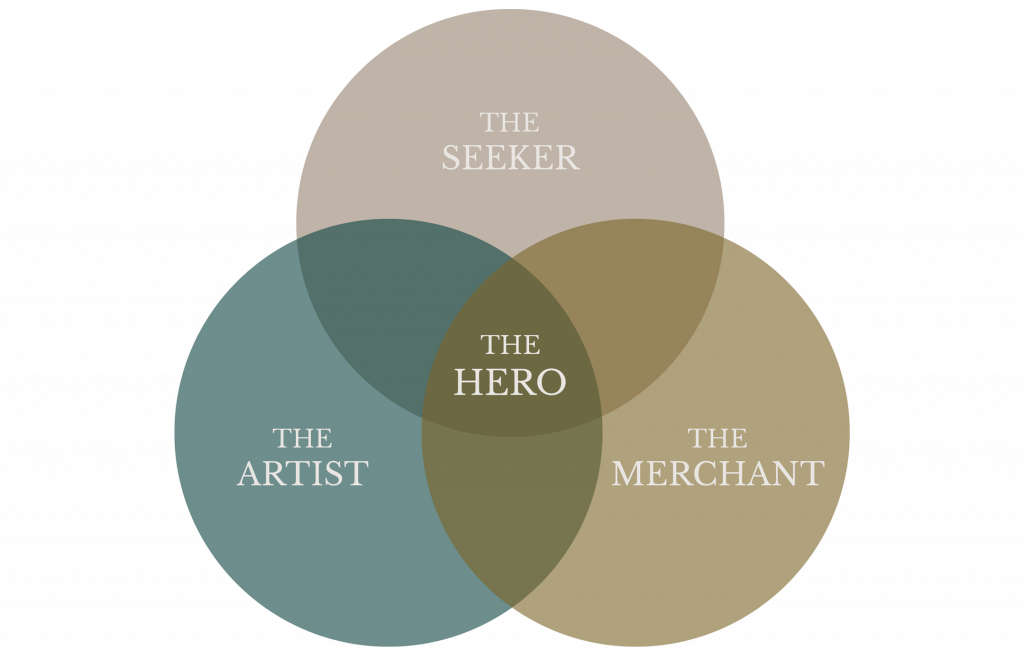
    The hero is the intersection of three fundamental professional archetypes – the seeker, the merchant and the artist, as I wrote about in part 1.

    The seeker seeks the truth and shows us the way. Their mapping of reality gives us a path through the struggle. Their unquenchable thirst for deeper understanding keeps us curious, humble, and constantly learning.

    The merchant is a tradesman of the good. Whether it is material goods, political good or spiritual good, the merchant knows that by trading what they have to those who want it, the world is made better.

    The artist creates beauty. Their compulsion is to make something from nothing – the mysterious process that even the artist himself does not understand. By doing so they create things that touch us and change us.

    The hero is a different order of archetype. The hero is all about the journey, not the character. The journey that the hero embarks upon is defined by the process, not the content.

    The hero walks the eternal quest, constantly working to unwind the code that lies deep within his soul, and to realize the vision that he is called to create.

    The hero is the one who hears the call to adventure, to transformation, and through doubt and resistance finds the courage to say yes.

    This great transformation changes you, and so as you complete the cycle, and return home, you return changed, and the world with it. You return to the marketplace, complete with a new consciousness, and new hands, with which you help those who need you.

    “We have only to follow the thread of the hero path, and where we had thought to find an abomination, we shall find a god. And where we had thought to slay another, we shall slay ourselves. Where we had thought to travel outward, we will come to centre of our own existence. And where we had thought to be alone, we will be with the whole world.”
    – Joseph Campbell, The Hero with a Thousand Faces

    Tension fuels transformation

    It is the creative tension that exists between the outer three types – the merchant, the seeker, and the artist – that drives the hero.

    It is the contradiction or paradox between the outer trinity that demands conversation. The heroic journey is in part, the quest to integrate these languages, these aspects inside you.

    How can I make money (merchant) from my creative expression (artist)? How do I bring the truth that I understand (seeker) into the marketplace (merchant)?

    The hero is not simply the overlap of the three types of the trinity. It is the transcendent principle, held in tension by the first three.

    The point is to mine that tension, for it is the fuel that propels the hero on his journey.

    The Hero Cycle

    Phase I – Disintegration

    No one knows how long ‘normal’ lasts. But if you pay attention, you’ll begin to notice that sooner or later, what once felt right, now feels wrong. What once worked, is starting to suck. Something is out of whack.

    This is not a fault in the execution of your life, or a fundamental flaw in who you are.

    No. This is simply the wheel of transformation starting to turn. God is beginning to crank on your lever, turning you toward a fuller, more beautiful version of yourself. Can you feel it?  This is the call to adventure – the whisper in your ear.

    You are so much more than you dare believe.

    You have a choice. Will you listen? You cannot turn off the whisper, but you can refuse its council.

    You can numb the pain of your dissatisfaction. You can eat burgers. You can binge on Game of Thrones. You can bury your head in the sand and simply refuse to look God in the eye.

    It is your right. But the consequence is an ever deeper journey into the cycle of phase one, into disintegration.

    If you refuse long enough your life will literally fall apart.

    Some choose to let themselves fall apart, and die. They live out increasingly empty and meaningless lives. They die from drugs or illness. They literally kill themselves.

    This is God’s way of forcing you to choose. Life or death?

    Will you choose life? Will you look into the light and see the image of who you are asked to become?

    The hero is the one who answers that call.

    When you surrender to this divine will, when you seize your own sovereignty and choose the path before you, you commit to something with untold power and consequence.

    “Until one is committed, there is hesitancy, the chance to draw back, always ineffectiveness. Concerning all acts of initiative and creation, there is one elementary truth, the ignorance of which kills countless ideas and splendid plans: that the moment one definitely commits oneself, then Providence moves too.”
    – William Murray, The Scottish Himalaya Expedition

    You say “yes”. You consent to the journey you have been asked to make. You step into the unknown, knowing it’s something you must do. And by doing so, you cross the first threshold.

    Phase II – Initiation

    The path extends before you. You are in esteemed company. Every great hero has passed this way.

    “Do you think that you shall enter the garden of bliss without such trials as came to those who passed before you”
    – The Quran, verse 2:214

    Turn to your mentors. Turn to those inside you – the harmony of your highest potential, who you are at your most essential. Turn to those around you – your friends and advisers, the ones you trust most deeply. Read again the great minds that nourish you and show you what you don’t yet understand.

    For you are on a journey that has already passed beyond the edges of your known reality. And as you consent to its invitation, you are drawn into the most challenging of new experiences.

    You will be stretched beyond your edge. You will be hurt. You will feel strife and suffering. But it is not the suffering of unmet commitment in the first phase, it is the existential kicking that you will receive at the boots of the unknown.

    Can you meet it? Can you rise up and face it with courage and conviction?

    These are the trials. Their purpose is not to ultimately break you, but to stress the muscle of your being, so you can be built anew.

    You will be tested for exactly as long as you need, in order to be ready for the great battle in the dark. Your initiation climaxes with the facing of your greatest fear – the great dragon at the heart of your being.

    You are both the hero, and the foe. It is not an exorcism of your demon, it is an alchemical meeting. Can the light in you meet its equal and opposite darkness?

    This is the culmination of all your initiatory challenge. The great showdown. The hero is the one whose leg shakes as he stands up tall, and looks the demon in the eye.

    You will be slain. Some great rock that your identity has rested on will be obliterated. Something or someone dear to you will die. Something that clouded your eyes from the truth will be ruthlessly ripped away.

    When you die, you cross the second threshold.

    Phase III – Transformation

    You have emerged from the dark underworld. But while you have faced down the great darkness and survived, your quest is far from over.

    For now, you must come to terms with who you have become, who you are becoming. You do not understand yourself, you have new eyes, new capacities, but they are foreign. The world has changed, because you have changed.

    Who are you now?

    You have been gifted a great blessing – your prize for meeting the dragon and being changed in the alchemical meeting of light and dark. But what do you now do with this great boon?

    If you were the protagonist in a movie, you would receive a great magical sword, or the secret to a great power. In your journey, the boon is one of deep and profound realization.

    You are rewarded with the greater consciousness and greater power of one who has faced down their fear and been reborn in their own higher image.

    You are on the road back home, but you may feel strangely alone. Perhaps those who you used to associate with no longer understand or see you. This is to be expected, for you no longer understand yourself.

    You are being transformed. What once propped up your identity has been whipped from under you. What once lay in the realm of strict possibility has been realized.

    You must come to terms with yourself – your new self – and realize what you are now capable of. What will you do with this great gift, this great boon?

    When this internal transformation is re-organised into a new understanding of who you are, you cross the third threshold.

    Phase IV – Integration

    The legend of a hero does not end with his great achievement, or her great discovery. The imperative for the one who has discovered great power, is to return with it. To return home.

    You return to the marketplace – the communities that matter most to you – with helping hands.

    “The Hero shall now begin the labour of bringing the runes of wisdom, the Golden Fleece, or his sleeping princess back into the kingdom of humanity, where the boon may redound to the renewing of the community, the nation, the planet, or the ten thousand worlds.”
    – Joseph Campbell, The Hero with a Thousand Faces

    You offer your goods, you speak your truth, you reveal your beauty. You integrate this new you, back into normal life, back into your work.

    You harvest the great fruits of your labour – the existential gift of your journey. You create your art, imbibed with the truth you now see. And give it, to feed those around you.

    As you do this, all the pieces begin to come together. The change that has occurred inside you is transmitted through you into the world around you. You change the world.

    It is not a single moment. This is your work now – to integrate who you have become with the world before you. You must straddle the two worlds of the dark and light, of the unknown and the known, and give yourself for the benefit of those around you.

    Blessings to you dear one, you have made it through. God has drawn you through the great change, the turning of the wheel, the latest revolution in the eternal quest.

    You now know your work. Your work is to live it, be it, create it. This is the phase of great productivity. Appreciate it honour it. For the next turning maybe closer than you would like to believe.

    The eternal cycle

    There is a new hero born anew with each cycle of the journey. For by the time the wheel turns full circle, and calls you on a new adventure, the hero that was born in the last chapter is now the one who clings to normality and safety.

    Every great leader knows that what got them to where they now are, is the very thing that will impede them from getting to the next stage.

    Where are you in the ever turning cycle of the hero? What phase do you find yourself in? For the nature and necessity of each phase is fundamentally different from the last.

    If you are trying to stably define who you are, and yet are in the first half of the cycle, your attempts will be fruitless. For the point of disintegration and initiation is to break you down, and burn off the dead wood of who you think you are. Give yourself to it.

    If you are looking for the thrill of adventure, and yet find yourself in the second half of the cycle, you will sabotage the work you must do. Your mission now is to understand yourself as you now are, and bring the fruits of your transformation back to the marketplace.

    The quest may be eternal. But your time here in this life is not. Know where you are, what you are asked.

    Your job as the hero is to devote yourself to this turning, no matter where you may find yourself on the journey.

  • Wish upon it. Pray to it. Follow it.

    Do not think you are it, or believe other people when they say you could be. Do not mistake the mortal for the divine.

    The proper posture is one of devotion. The star is not reached through fame, it is never reached. It is the source of divine potential, an infinite omega point to which we are endlessly beckoned.

    Where does your star call you? What do the heavens whisper?

    If you don’t know, you must ask.
    If you do know, you must ask.

    For your destination is that transcendent possibility, the unmanifest future that already rests within you. Just as the oak is already contained within the acorn.

    And when the light of heaven shines down upon you, you will reach toward it. Like the tree that grows steadily toward the sun. The reward is illumination. Of you and your extraordinary beauty. The price is the same.

    And you will shrink before its splendour, and the exposure of your own. This is only to be expected, for you are cradled in the innocence of one who has forgotten who you really are.

    This is not a fault to be corrected. It is the divine design of something we cannot comprehend.

    The star asks that you face it, and be guided by it. That you stand naked before the light, and follow the path it shows you.