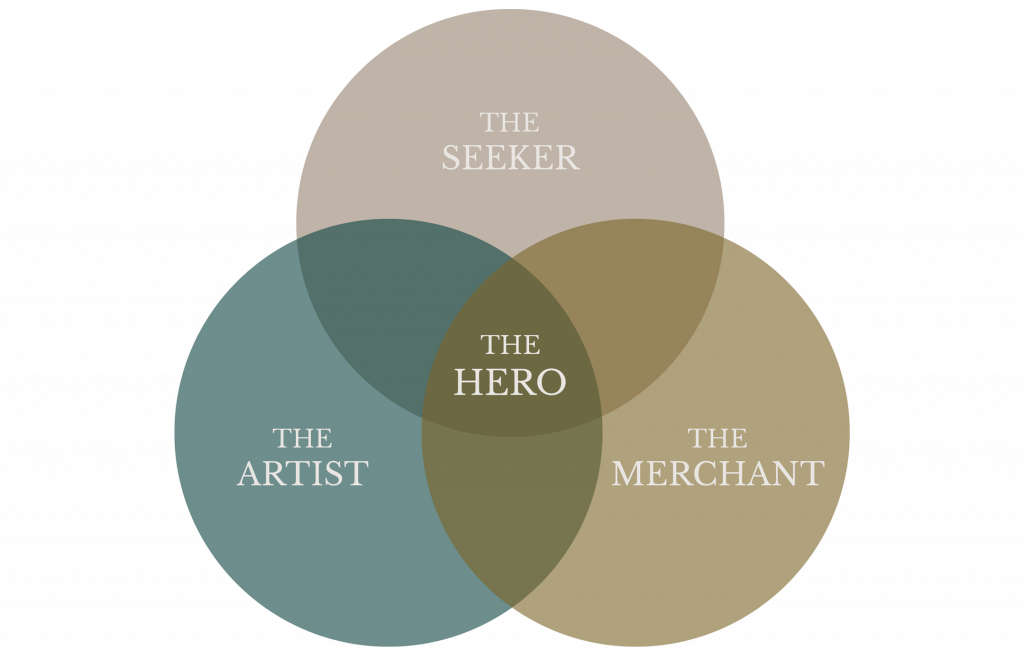
• This is part two of a three-part series leading up to the publishing of my first book—Artist, Merchant, Seeker.

    The book that will be released this Spring is about three archetypes, and how they form the basis of your work, no matter the profession or specialism you play in.

    These are very different archetypes, with entirely distinct ways of approaching the work of life.

    • The Artist is the creator in you, who makes things from the mysterious passions that light you up inside, forming artefacts of beauty that touch and move people.
    • The Seeker is the one who searches for the truth of this life, learning the nature of who we are and how the world works, bringing back wisdom that can be taught to others.
    • The Merchant is the trader in you, who offers the value you possess, in the marketplace, because mutual exchange benefits all of us, and propels our communities into richer lives.

    These are universal archetypes, and core to our work, but we tend to be native in one of these. And there’s one that feels foreign and unfamiliar.

    For me, and many of the people I work with, this is the Merchant.

    I’ve been long fascinated by the archetype. Because while it’s not native to me, I realised early on in my work life, that it was key. I couldn’t have named it that way. I just knew that if I wanted to make a difference in the world, in the way I felt called to, the path led through business.

    In inner city Sheffield where I grew up, Merchants were people with corner shops. I didn’t know any entrepreneurs. My social circles were filled with Artists, creatives and spiritual Seekers.

    My first business was high on idealism and low on know-how. Our one and only client was HolacracyOne who we helped to put on their first training events in Europe. At the first event, I asked one of the leaders, Tom Thomison what one business book he’d recommend I read (since I had never read one).

    I read it—Verne Harnish’s Mastering the Rockefeller Habits. It was the first book on a long path of self-learning. I’ve read a lot of business books since then, though I’ve probably spent more hours listening to business leaders and entrepreneurs on podcasts. And even more time learning through the direct experience of running businesses.

    I’ve studied the Merchant deeply, because it’s a place I have resistance, struggle and allergy. My native instinct is to steer away from the corrupting influence of the marketplace—to keep the dharma pure.

    So, in this article I’m going to reveal the heart of the Merchant archetype, and decode the dilemma that so many of us struggle with—how to embody its power without falling foul of its shadow.

    The Heart of the Merchant

    I love archetypal work, because it takes us to the root and heart of things. It helps us see the underlying code, as distinct from the infinite expressions we see around us in the world. This has been particularly important for me with the Merchant archetype.

    At the heart of the Merchant is a relational ethic—one that drives them to do good. They orient by what in the modern world we would call value. We use a sophisticated monetary system to track value and enable us to exchange it.

    For this is the central move of the Merchant—to trade in value, such that both parties benefit.

    If the thing I sell you is worth more to you than the value you’re paying, and the reverse is also true for me, then we’ve created extra value. More goodness, that didn’t exist before our exchange.

    This is a first principle of economics. When you take that principle, and build systems that allow and encourage it, the world becomes wealthier. Our modern culture is a living example of this.

    When this principle is channelled through an open heart it produces mutual thriving, progress for the community at large.

    When the underlying strategy is employed through a closed and wounded heart, we see instead into the Merchant’s shadow.

    There’s an idea I learned from Joseph Campbell. That you can see what’s centrally informing a society, by who creates its tallest buildings.

    It used to be castles because we were informed by conquest. Then it was temples and cathedrals because we were ruled by the gods. Now it’s skyscrapers because we are ruled by commerce.

    We are currently living through peak materialism. The Merchant sits at the height of his power.

    We are all reaping the unprecedented benefits of this. I am writing this, and you are reading this, on machines that were total science fiction not too long ago.

    And yet, as Gandalf teaches us, you cannot hold the ring of power without being affected by its corruption.

    The Shadow of the Merchant

    The shadow form of an archetype is what happens when it uses its power for dark aims, when the power is corrupted.

    The Shadow Merchant uses the power of trade, innovation and persuasion to win, at the expense of others. The move is driven by greed—an insatiable striving for more and greater. But the hole is never filled, and the scale of the enterprise never enough.

    While the heart of the Merchant’s ethic is mutual benefit, in its shadow form, this becomes singular benefit. And so, if the Merchant can win—at the expense of their customers, suppliers, or the environment itself—they will.

    In its darkest form this becomes gross deception, where the promised value the Merchant is offering does not even exist. It’s a scam.

    To live in this world is to live in the glory of the Merchant’s light, and the corruption of its shadow. For both are loud and present.

    And yet the shadow is not simply collective. I say this, in the (forthcoming) book…

    “The Shadow Merchant—if you’re willing to look—is plain to see. It’s all around us, cleverly using its power with greed, making profit at the expense of the wider good.

    Seeing this, though, can lead to a tragic mistake. Faced by the ugliness of the Merchant’s shadow, and not wanting to perpetuate its immorality, we then throw out the Merchant as a whole, declaring the whole game corrupt.

    This puts the Merchant in our own shadow—tucked away, where we can’t see it, and don’t use it. This then creates an internal suppression that robs us of our power to help and succeed. For the most precious and valuable work will do no good if it is not offered in the marketplace.”

    The Dilemma We’re Facing

    This, I think is the crux.

    It’s so easy for me—and so many people I know—to see with wide open eyes, the shadow of the Merchant, and resist its power. We fear being corrupted. Selling out. Selling our soul.

    And so, we’re stuck in a dilemma.

    Keep it pure and hide at the outskirts of the marketplace.

    OR

    Sell out in order to enter the centre of the marketplace.

    Faced with this choice, most of us choose to keep it pure. Anything rather than sell out.

    But the problem is the question itself. The dilemma itself is based on a false premise. That it’s either one or the other. It’s not. So, what’s the third option?

    It starts with integrity and honour. Don’t sell out.

    But neither can you avoid the act of selling itself.

    Rather, you learn how to courageously sell the value you possess, embodying the heart of the Merchant, without violating your ethical code.

    Though even knowing this doesn’t fully dissolve the dilemma. Even if we can choose to trade with integrity, why do so many of us still keep to the margins?

    In my experience, the story comes back to us, and our own insecurities.

    It’s easier to condemn the slimy marketplace and play it safe on the margins, than it is to step boldly forward, and be a stand for your own integrity.

    We fear we’re not strong, conscious or smart enough to work out how to do it ethically and effectively.

    This manifests as a feeling of insecurity—not fully believing in the value we possess. Or as a feeling of incompetence—unsure how to play the game in a way that works ethically and practically.

    This is central to the work I’ve done with my coaching clients over the years. It’s often the reason people come to me.

    The Merchant’s dilemma is not really about commerce and corruption. It’s about our own self-doubt.

    We doubt that we have enough value. Or enough mercantile competence. So, we play it safe. But the result is helpful for neither us nor the people who would really benefit from what we have.

    The solution is to find your own Merchant’s heart, trusting that your integrity will not be compromised. This same integrity is what will help you stand out in a marketplace full of shadow.

    I still remember writing the proposal for the people who became my first coaching clients twelve years ago. They were (lovingly) bugging me, asking when I would make a proposal for the work we’d talked about doing.

    I was filled with self-doubt, incredulous that I had the skills to help these amazing entrepreneurs, or that I could charge the amount of money I wanted to. I felt incompetent, unsure how I would help them with the marketing goals they had.

    It took me several days of writing, agonising over the right wording, trying to craft the offer to feel powerful, honest, and appealing. I remember sending it off, utterly unsure what would happen, but resolute in the knowledge I’d played my hand as best I could.

    I got a short email back very quickly “Yes, Ewan! We’re in”.

    This is the heart of the Merchant at work.
     

  • My upbringing gave me a very strong narrative about business: it’s corrupt and corrupts good people.

    It took me many years to unwind this story and reintegrate the archetype of the Merchant back into my worldview and life.

    It’s been a great lifeline for me, when I’m feeling like a shy artist, or entrepreneurial imposter, to remember the ethic of the Merchant. Giving the value and goodness you have is what makes things better for all of us.. And to not do that, for fear of this or that, is essentially selfish.

    This is a good antidote for any of us who can tend to hide away our light, for fear of what might happen.

    The archetype of the Merchant

    The Merchant is in the business of goods and services. Modern economic theory names this “value”. Which is a powerful, though somewhat dry notion. The deeper quality is “good” or “goodness.”

    This is the transcendent ethic at the heart of the Merchant, to offer goods in service of the greater good.

    It’s hard to appreciate this sometimes, given the scandalous ethics that so much of our actual global marketplace currently embodies. Nevertheless, beneath this cultural shadow is the deeper ethic of providing value, of creating goodness.

    Here’s the basic mechanic.

    When I provide you with something that carries high value for your particular circumstances, and you give me something back which is also highly valuable to me, then we both end up better off. The amount of total value is higher after our exchange. We’ve done something good for each other; we’ve created goodness that didn’t exist beforehand.

    Back in the day, this was pretty simple stuff. I’ve got goats, and you love goat sausages. You’re a baker, and I have no time/skill for making bread (I’m looking after all the goats). So we create an agreement, where I swap you my goat sausages for your bread. We’re both richer as a consequence of the exchange.

    We’ve both done something good for one another, and received that goodness back. The result is a net profit on both sides of the goodness equation.

    Our society is fixated on money as the metric of value. It’s so hard for us to imagine a world in which this wasn’t the case, that we’ve ended up falling foul of the shadow of money.

    The shadow of money is that it purports to be the goodness itself – that it itself is the value. While in fact, it is the measurement of value. We’re mistaking the sausage for the stick that measures it.

    Why is this important?

    Because understanding it unlocks a new level of freedom for the entrepreneur who doesn’t know how to “bring in more revenue” or the freelancer who wants to “make more money”.

    Magic dashboards

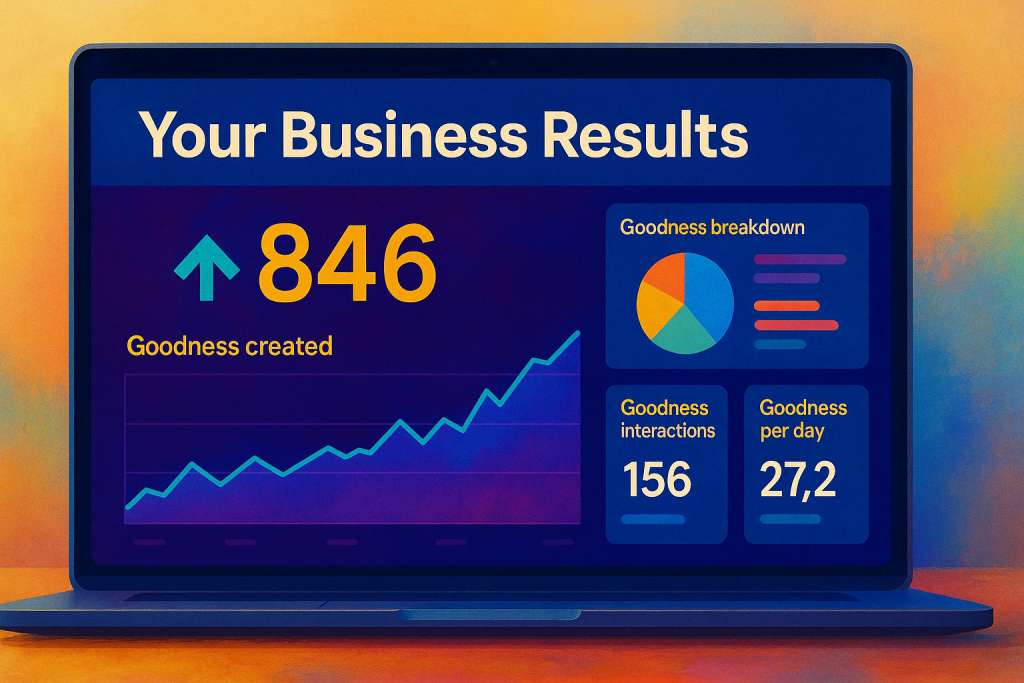
    Imagine a metrics dashboard that would show you the current status of your business. And the big window at the top says “Goodness provided to people this month”. (Rather than our actual metrics dashboards, which of course feature “income” or “revenue”.)

    It’s a magic dashboard, so it can actually measure the total value of all the things you’ve done. There are countless things that make this number go up, but which have no financial exchange attached.

    An hour on zoom with someone, helping them out with their thing. Sending out a productivity cheat sheet to the folks on your mailing list. Messaging someone with the idea that popped into your head on Thursday. Getting out the barbeque and cooking up some goat meat sausages for your friends and family.

    These things would all pump the numbers in this imaginary value dashboard. If this thing actually existed, you could measure your success by “goodness created” rather than “money earned” (or God forbid, “number of social media likes”.)

    I like this idea. It casts the game of business into an entirely different light. The goal is giving goodness, which by the law of the merchant’s code, and a result of his skill, results in a receiving back of reciprocal goodness.

    In other words, over the long term, as you saw your “goodness created” go up, you’d also see your revenue (monetary income) rise along with it. For the two are of course deeply related. Since, at the energetic root of the merchant’s action lies the exchange of value, which creates extra value.

    The filling of one extra goat intestine with fresh meat is no skin off my nose…it’s “cheap” to me. Yet the convenience of munching on your tasty bread with no extra effort expended, is really quite valuable to me. So the swap creates extra value that hitherto didn’t exist. That’s the equation at the root of commerce.

    Our culture has made it exceptionally easy to do. Because money fills a second role for us, alongside it’s “measurement of value”. It is a “store” of value. In other words, I can “store” the value of my goat sausages in the form of money. Classically this was coins. Everyone valued the metal the coins were made of, and so could safety “sell” the coins again in the future.

    We barely even use coins any longer. Our money is now digitalised, such that I can swap it for unprecedented numbers of things with unprecedented ease.

    And that’s of course where the shadow of money rears its ugly head. We shoot for money being the target, the goal of business and life. Forgetting that the point is the sausage, or the deep satisfaction that comes from doing what you’re really good at, knowing it really benefited someone else.

    Playing a good game

    The goal is to create goodness. Doing what you’re good at and giving that goodness to others in the form of goods or services.

    Even “non-professional” goodness counts! Calling your mother to catch up can create more goodness than brainstorming a new business strategy.

    One thing to remember however is that you create a great deal of goodness when you start with what you’re good at. Where is your value? I’m assuming you don’t make premium goat sausages. So what is it?

    From the ethical perspective of the merchant, selfishness is when you don’t proactively offer your goodness in the marketplace.

    I know a great many “old souls” (this one included) who struggle to fully present their value in the marketplace, because they don’t want to be pushy, or they feel like imposters. While from the inside this can feel real and important. From the outside it results in your goodness being withheld from people who would benefit from it. Which is indeed a form of selfishness.

    So the perspective shift is from “how can I make more money?” to “how can I create more goodness (value)? Even if you do want to create more money, the metric I suggest you optimise for is ‘goodness created’.

    If you want to be strategic about it, you can ask yourself “how can I create goodness for the people I want to work with professionally?” This helps you funnel your goodness toward the people you want to build your business for.

    It’s a lot easier for someone to say “I’d like to pay for more of the goodness you’re already giving me.”

    Another way of looking at this is that it’s a practice of generosity — of giving your goods, without a strategic objective of return. The law of the universe seems to handle the returns (you’re not in control what they are).

    This is a form of reciprocation. Humans are wired to reciprocally return generosity. Indeed, many people feel guilty if they’ve been given a kindness and haven’t returned one.

    The real payoff though, is the shift of focus from the stick to the sausage. The point is the goodness. The practice of doing what you’re good at, and of doing good in the world. This makes us feel useful, like we’re making good on the gifts and plans we came down here with.

    You get to be good to people. Live a good life. Which feels so good.

  • There’s an idea I’ve been fascinated for years now. It’s one of those things that has endured through different businesses and phases of my life.

    It is the idea that there is a new kind of professional role being formed in society at large – a kind of entrepreneur who is soul driven in some sense. A role where one’s professional work, is not seen as distinct from their spiritual path of awakening. It’s why I called my previous brand The Realized Entrepreneur.

    At the end of last year, I started writing about an archetypal way of modelling this character. I suggested that this new professional could be seen as the integration of three intrinsic archetypes – the artist, the merchant and the seeker.

    I then suggested the intersection of these was the hero.

    Honestly? I’m not convinced I’ve got the mapping quite right. But after a few months exploring some different writing avenues, I’m returning to this map in search of answers. Specifically, a topic that’s gnawed at me for years, that is, how on earth do art and marketing fit together?

    Temperamentally, I usually love creating new stuff, and desperately resist marketing it. And I know I’m not the only one that is like this.

    Is that because marketing is for shallow schmucks who can’t create interesting enough stuff that people naturally pay attention to?  Or is this my precious pretensions restricting me from actually publishing myself?

    Can the artist and the merchant work together?

    The Artist

    The artist is principally concerned with creativity. His objective is to create something original, something that provokes a deeper experience of the world, or elegantly solves the most complex of problems.

    Beauty is in the eye of the beholder, and so the artist creates things that they themselves find beautiful. They create to meet their own taste.

    They are driven by the creative impulse. And creativity, as Seth Godin so eloquently defines it, is the tension between “this might work” and “this might not work”. If you know it will work, or you know it will not, it’s not creative. If it’s pre-determined it’s not art.

    Art is not painting, it is not poetry, it is not design. It is what is created when we venture beyond the border of what we know, and allow the mysterious forces there to guide our hand as we create something that intrigues us. The artist knows that he does not truly control this creative process. 

    And so the artist is one who is furthest away from the mainstream. They are by definition at the fringe, for it is only at the fringe that you will find the boundary between the known and the unknown.

    The Merchant

    The merchant is principally concerned with trade. Her objective is to relationally connect with other people and swap what they each possess, and improve the lives of everyone involved.

    The merchant operates in a relational space, connecting those who need something, with those who can supply it.

    The marketplace is a full and bustling arena that determines what is good and needed. And so the merchant seeks to understand what is in short supply, what is in high demand, and how to best make trades that fill people’s needs.

    The merchant trades in value. She seeks out objects or goods, that she believes will be of value to those she can reach.

    The merchant believes that what they have to offer is valuable – that it would help others – and so they feel no shame in promoting their wares to others. For in fact, to withhold their wares would be to violate their chief objective and belief: that consensual trade is good.

    And so the merchant is one who connects people, allowing them to relationally exchange for their mutual benefit. They are by definition in the midst of things, for it is from the middle that the different sides can be connected in mutual exchange.

    A philosophical clash of values

    From the perspective of the artist, the work of the merchant is ugly.

    The artist looks at the trading that makes up the merchant’s nature and sees only presumption, and manipulation. The merchant seems to increases the shallowness of life which the artist seeks to deepen.

    The artist never presumes to know the needs or will of another. This is the antithesis of their work. To presume the mind of another and to create something for them – to meet their need – is not art. This would be to prostitute their creative talents for money or mutual exchange. In other words, to “sell out”, which to the artist is an aesthetic crime. And the merchant has made an entire career from selling out!

    Thus the artist condemns the merchant as ugly, shallow and greedy.

    The merchant is equally distaining of the artist. She looks at the artist as a narcissist. How does it help anyone to make such weird and odd things to satisfy one’s own personal whims? It seems to the merchant like a naïve and wasteful use of time.

    The merchant thus judges the artist as useless. For art does not help people with their needs, it is an indulgent luxury. What people need, are things they want to come back to day after day, things they will consistently trade for.

    The creation of art is unpredictable. The productive output of an artist is unpredictable, and the value of the art produced is unpredictable. The merchant is concerned with mutual benefit, about meeting the needs of others, and so from her perspective this creative unpredictability looks unproductive and selfish.

    Separation is no longer adequate

    While it has historically possible – perhaps even necessary – for these two archetypes to stay separate and pure, today’s world cannot sustain their separation.

    The artist needs the merchant. Because it is only the merchant who can be impartial as to the value of what the artist creates. The artist is so caught up in his creations that he finds it hard to step out of himself and effectively offer his art to those that would benefit.

    The merchant is guided by value exchange, and value is determined not by her own subjective opinions, but by the intersubjective consensus of the marketplace. If her customers thank her for a particular offering and return wanting more, then she trusts it is valuable. Her judgement of worth is intersubjective. Whereas the artist judges subjectively – whether he himself is impressed or moved by his creations.

    The merchant also needs the artist. Because left to her own devices, the merchant will simply rely on offering what the marketplace asks for. She will have no motivation to look deeper under the surface at what new innovation is required. As Henry Ford famously said (actually he didn’t, but he should have done because it’s a wonderful quote) “If I’d have asked people what they wanted, they would have said ‘faster horses’.”

    The needs of the market change. Things move on. And without the innovation of the artist, the merchant will continue to peddle popular and proven goods, being increasingly left behind, as evolution pushes the edges of what people need.

    These two opponents need one another.

    Without the merchant, the artist becomes increasingly obsessed with his own creative explorations, becoming out of touch with society at large, and not providing things that help and move people.

    Without the artist, the merchant becomes increasingly shallow, providing value that is popular, losing touch with the leading edge, and not risking new things that will change society.

    The necessity for integration

    The challenge for many of us, is that we must play both roles ourselves. Or at the very least, I would suggest we need to integrate these archetypal orientations in such a way that they are not at odds in our own psyche.

    The larger and more idealistic hypothesis is that it is the integration of these archetypes that will lead to the resolution of so many philosophical conflicts in our world.

    I’ll leave that grand idea for another day, and simply say that I believe it is imperative that we at least understand the intrinsic perspectives of these archetypes.

    As a native artist, my unconscious tendency is to fall into snobby distain for merchant activities.  If I’m not careful, marketing begins to  look rather ugly and uncouth, and I instinctively begin to distance myself from it.

    But unshared art is useless. Literally.

    The unconscious biases may be different for you (although I suspect many of you who read my work tend toward the creative and artistic). Nevertheless, the principle is the same – to progressively understand and embody these archetypes, allowing them to integrate and create a new kind of professionalism, a new kind of work.

    I would even suggest that bringing one’s art to the marketplace is one of the great evolutionary requests of this new world. It is a least one that burns brightly in my heart.

    For never before has art been so accepted in the marketplace, or more needed. But to bring our creative work to market means resolving philosophical conflicts that have deep roots.

    Playing favourites is not adequate any longer.

    Integrating these historically opposed worlds is what will contribute the creation of a new one.

  • The professional. A role as old as Adam.

    The professional used to be someone who had a trade – a craftsman, farmer, healer, soldier. The new professional is one who follows a vocation – literally a calling.

    And by following this calling, the call of the gods, we step into the shoes of the hero. We travel the mythological hero’s journey.

    The hero is the intersection of three fundamental professional archetypes – the seeker, the merchant and the artist, as I wrote about in part 1.

    The seeker seeks the truth and shows us the way. Their mapping of reality gives us a path through the struggle. Their unquenchable thirst for deeper understanding keeps us curious, humble, and constantly learning.

    The merchant is a tradesman of the good. Whether it is material goods, political good or spiritual good, the merchant knows that by trading what they have to those who want it, the world is made better.

    The artist creates beauty. Their compulsion is to make something from nothing – the mysterious process that even the artist himself does not understand. By doing so they create things that touch us and change us.

    The hero is a different order of archetype. The hero is all about the journey, not the character. The journey that the hero embarks upon is defined by the process, not the content.

    The hero walks the eternal quest, constantly working to unwind the code that lies deep within his soul, and to realize the vision that he is called to create.

    The hero is the one who hears the call to adventure, to transformation, and through doubt and resistance finds the courage to say yes.

    This great transformation changes you, and so as you complete the cycle, and return home, you return changed, and the world with it. You return to the marketplace, complete with a new consciousness, and new hands, with which you help those who need you.

    “We have only to follow the thread of the hero path, and where we had thought to find an abomination, we shall find a god. And where we had thought to slay another, we shall slay ourselves. Where we had thought to travel outward, we will come to centre of our own existence. And where we had thought to be alone, we will be with the whole world.”
    – Joseph Campbell, The Hero with a Thousand Faces

    Tension fuels transformation

    It is the creative tension that exists between the outer three types – the merchant, the seeker, and the artist – that drives the hero.

    It is the contradiction or paradox between the outer trinity that demands conversation. The heroic journey is in part, the quest to integrate these languages, these aspects inside you.

    How can I make money (merchant) from my creative expression (artist)? How do I bring the truth that I understand (seeker) into the marketplace (merchant)?

    The hero is not simply the overlap of the three types of the trinity. It is the transcendent principle, held in tension by the first three.

    The point is to mine that tension, for it is the fuel that propels the hero on his journey.

    The Hero Cycle

    Phase I – Disintegration

    No one knows how long ‘normal’ lasts. But if you pay attention, you’ll begin to notice that sooner or later, what once felt right, now feels wrong. What once worked, is starting to suck. Something is out of whack.

    This is not a fault in the execution of your life, or a fundamental flaw in who you are.

    No. This is simply the wheel of transformation starting to turn. God is beginning to crank on your lever, turning you toward a fuller, more beautiful version of yourself. Can you feel it?  This is the call to adventure – the whisper in your ear.

    You are so much more than you dare believe.

    You have a choice. Will you listen? You cannot turn off the whisper, but you can refuse its council.

    You can numb the pain of your dissatisfaction. You can eat burgers. You can binge on Game of Thrones. You can bury your head in the sand and simply refuse to look God in the eye.

    It is your right. But the consequence is an ever deeper journey into the cycle of phase one, into disintegration.

    If you refuse long enough your life will literally fall apart.

    Some choose to let themselves fall apart, and die. They live out increasingly empty and meaningless lives. They die from drugs or illness. They literally kill themselves.

    This is God’s way of forcing you to choose. Life or death?

    Will you choose life? Will you look into the light and see the image of who you are asked to become?

    The hero is the one who answers that call.

    When you surrender to this divine will, when you seize your own sovereignty and choose the path before you, you commit to something with untold power and consequence.

    “Until one is committed, there is hesitancy, the chance to draw back, always ineffectiveness. Concerning all acts of initiative and creation, there is one elementary truth, the ignorance of which kills countless ideas and splendid plans: that the moment one definitely commits oneself, then Providence moves too.”
    – William Murray, The Scottish Himalaya Expedition

    You say “yes”. You consent to the journey you have been asked to make. You step into the unknown, knowing it’s something you must do. And by doing so, you cross the first threshold.

    Phase II – Initiation

    The path extends before you. You are in esteemed company. Every great hero has passed this way.

    “Do you think that you shall enter the garden of bliss without such trials as came to those who passed before you”
    – The Quran, verse 2:214

    Turn to your mentors. Turn to those inside you – the harmony of your highest potential, who you are at your most essential. Turn to those around you – your friends and advisers, the ones you trust most deeply. Read again the great minds that nourish you and show you what you don’t yet understand.

    For you are on a journey that has already passed beyond the edges of your known reality. And as you consent to its invitation, you are drawn into the most challenging of new experiences.

    You will be stretched beyond your edge. You will be hurt. You will feel strife and suffering. But it is not the suffering of unmet commitment in the first phase, it is the existential kicking that you will receive at the boots of the unknown.

    Can you meet it? Can you rise up and face it with courage and conviction?

    These are the trials. Their purpose is not to ultimately break you, but to stress the muscle of your being, so you can be built anew.

    You will be tested for exactly as long as you need, in order to be ready for the great battle in the dark. Your initiation climaxes with the facing of your greatest fear – the great dragon at the heart of your being.

    You are both the hero, and the foe. It is not an exorcism of your demon, it is an alchemical meeting. Can the light in you meet its equal and opposite darkness?

    This is the culmination of all your initiatory challenge. The great showdown. The hero is the one whose leg shakes as he stands up tall, and looks the demon in the eye.

    You will be slain. Some great rock that your identity has rested on will be obliterated. Something or someone dear to you will die. Something that clouded your eyes from the truth will be ruthlessly ripped away.

    When you die, you cross the second threshold.

    Phase III – Transformation

    You have emerged from the dark underworld. But while you have faced down the great darkness and survived, your quest is far from over.

    For now, you must come to terms with who you have become, who you are becoming. You do not understand yourself, you have new eyes, new capacities, but they are foreign. The world has changed, because you have changed.

    Who are you now?

    You have been gifted a great blessing – your prize for meeting the dragon and being changed in the alchemical meeting of light and dark. But what do you now do with this great boon?

    If you were the protagonist in a movie, you would receive a great magical sword, or the secret to a great power. In your journey, the boon is one of deep and profound realization.

    You are rewarded with the greater consciousness and greater power of one who has faced down their fear and been reborn in their own higher image.

    You are on the road back home, but you may feel strangely alone. Perhaps those who you used to associate with no longer understand or see you. This is to be expected, for you no longer understand yourself.

    You are being transformed. What once propped up your identity has been whipped from under you. What once lay in the realm of strict possibility has been realized.

    You must come to terms with yourself – your new self – and realize what you are now capable of. What will you do with this great gift, this great boon?

    When this internal transformation is re-organised into a new understanding of who you are, you cross the third threshold.

    Phase IV – Integration

    The legend of a hero does not end with his great achievement, or her great discovery. The imperative for the one who has discovered great power, is to return with it. To return home.

    You return to the marketplace – the communities that matter most to you – with helping hands.

    “The Hero shall now begin the labour of bringing the runes of wisdom, the Golden Fleece, or his sleeping princess back into the kingdom of humanity, where the boon may redound to the renewing of the community, the nation, the planet, or the ten thousand worlds.”
    – Joseph Campbell, The Hero with a Thousand Faces

    You offer your goods, you speak your truth, you reveal your beauty. You integrate this new you, back into normal life, back into your work.

    You harvest the great fruits of your labour – the existential gift of your journey. You create your art, imbibed with the truth you now see. And give it, to feed those around you.

    As you do this, all the pieces begin to come together. The change that has occurred inside you is transmitted through you into the world around you. You change the world.

    It is not a single moment. This is your work now – to integrate who you have become with the world before you. You must straddle the two worlds of the dark and light, of the unknown and the known, and give yourself for the benefit of those around you.

    Blessings to you dear one, you have made it through. God has drawn you through the great change, the turning of the wheel, the latest revolution in the eternal quest.

    You now know your work. Your work is to live it, be it, create it. This is the phase of great productivity. Appreciate it honour it. For the next turning maybe closer than you would like to believe.

    The eternal cycle

    There is a new hero born anew with each cycle of the journey. For by the time the wheel turns full circle, and calls you on a new adventure, the hero that was born in the last chapter is now the one who clings to normality and safety.

    Every great leader knows that what got them to where they now are, is the very thing that will impede them from getting to the next stage.

    Where are you in the ever turning cycle of the hero? What phase do you find yourself in? For the nature and necessity of each phase is fundamentally different from the last.

    If you are trying to stably define who you are, and yet are in the first half of the cycle, your attempts will be fruitless. For the point of disintegration and initiation is to break you down, and burn off the dead wood of who you think you are. Give yourself to it.

    If you are looking for the thrill of adventure, and yet find yourself in the second half of the cycle, you will sabotage the work you must do. Your mission now is to understand yourself as you now are, and bring the fruits of your transformation back to the marketplace.

    The quest may be eternal. But your time here in this life is not. Know where you are, what you are asked.

    Your job as the hero is to devote yourself to this turning, no matter where you may find yourself on the journey.

  • We live in interesting times. The famed ‘fast changing world’ – the best we can do to describe the overwhelming whirl of evolution as it gathers pace.

    I believe that we’re in the midst of the early chapters of a new age. Ken Wilber calls it integral. James Altucher would call it “choose yourself”. Seth Godin talks about the connection economy. I used to think of it as the age of the realized entrepreneur. I think I was half right.

    Our ideas of professional work are in the midst of great flux. The professional used to be someone who had a trade – a craftsman, farmer, healer, soldier.  Then it was a job was had, with a contract and a role, and a boss.

    Now the standard is more like a vocation, which originally means calling. It’s professionally answering the call to the higher, to the gods, to what burns deep inside your heart.

    The enactment of this new professionalism is transformational by nature, that is, by following the call of the gods, we must become someone new and travel the mythological hero’s journey.

    The hero isn’t a person, the hero is an archetype – the one who hears the calls, steps onto the path, and is initiated into their higher self through great challenge. It is the sacrifice of comfort for the greater realization of your reason for being here.

    This is not an abstract concept. It is the thing that happens to us all, if we consent. Or even sometimes when we don’t. It was a hero’s journey for me 6 years ago when I decided to leave the comfort of employment at a fast growing internet company, and leapt into the unknown, with some vague notion of being an entrepreneur and talking about consciousness.

    It’s what it takes to write a book that bears genius in its pages. It’s what Steve Jobs must have had to go through to return to Apple after being fired, and creating the first iPhone.

    The map I present in this article is my attempt to show you who this hero is, or more precisely, what makes each of us heroic, and how we can use this map to better navigate our own journeys and transformations.

    This is the hero as I see it, the intersection of three fundamental professional archetypes – the seeker, the merchant and the artist.

    And it is the roots of this archetypal trinity that I will begin my story with.

    The philosophical roots of being

    Running throughout philosophy – from the Bhagavad Gita, through Plato, through Immanuel Kant, through Jurgen Habermas and up to the present day – is a triadic structure that under various guises, has been presented as deeply intrinsic to reality.

    The ancient Greeks thought of the three domains of life – art, morals and science, and the three transcendentals that related to them. Karl Popper called them the objective, subjective and cultural. Kant wrote his three great critiques.

    Ken Wilber, whose work first introduced me to this pattern, ties them to universal pronouns – I, We and It. He calls them The Big Three. They are the first demarcations we make in the oneness of reality. They are that fundamental.

    For Plato they were the good, the true and the beautiful. And it is that frame I want to use here.

    The three languages

    You can think of these three ideas – the good, the true and the beautiful – as three languages.

    Each one fundamentally different from the last, and yet each one fundamental to human experience. That is – one language cannot describe the territory of another language. Yet each one is part of the whole, and so where one finds truth, one will also find beauty, and goodness.

    “Words which give peace, words which are good and beautiful and true, and also the reading of sacred books: this is the harmony of words.”
    – Bhagavad Gita, 17:15

    To find the harmony in the three, you must learn to hear the individual melody of each language. For the language of truth, cannot tell us what is beautiful. The language of goodness cannot tell us what is true. The language of beauty cannot tell us what is right and just.

    The True

    The language of truth is the language of discovery and precision. It is the language of deep science – that deliberate and practical means by which we test the world, and ourselves, and discover ever deeper truth about its reality.

    It is something we uncover and reveal, it is something that we posit and falsify. The language of truth seeks to gently or forcefully, spear the squirming fish of meaning, and define its patterns and structure.

    Is it true that human beings evolved from higher apes? Yes. It took us a long time to discover this truth. But it’s now self evident for most fo the world.

    Is it true that if I spend enough time looking into the nature of my own experience, I will be unable to find the location of my own consciousness? Yes. I’ve tried. Like thousands of yogis and roshis. It’s not in my head, it’s not in my toes. It doesn’t even seem to limited to my body. It’s kind of everywhere and nowhere.

    When we seek the truth, we must attack and destroy our own assumptions about what is. We must bind together polarities that feel uncomfortable, and find harmony in the integration of relative truths. This frees us, and liberates our notions of what is possible, and who we are.

    “And you will know the truth, and the truth will set you free.”
    – Jesus of Nazareth, John 8:32

    Ken Wilber’s famous phrase is that “everyone is right”. Every single human perspective has some partial truth. But for that to be true, we must also hold that some are more right than others.

    The great seekers of truth understand this, they constantly seek for greater truth that transcends the partial truths.

    “He who knows only his own side of the case knows little of that. His reasons may be good, and no one may have been able to refute them. But if he is equally unable to refute the reasons on the opposite side, if he does not so much as know what they are, he has no ground for preferring either opinion.”
    ― John Stuart Mill, On Liberty

    Truth is an objective science, whether the terrain physical, conceptual or mystical. Mathematics is a dialect of truth. The Tao Te Ching is a treatise on mystical truth.  Cartography is mapping physical truth.

    To know what is true, reality must be examined, tested and mapped.

    The Good

    Whether any of this is a good thing is an entirely separate question.

    The good is the language of ethics.  What is right, just? How do we know? It is not an objective science – it is not a solitary investigation. It is a collective exploration of our own ethical principles. The codes by which we feel it is right to live.

    “To prefer evil to good is not in human nature; and when a man is compelled to choose one of two evils, no one will choose the greater when he might have the less.”
    – Plato, The Protagoras

    Is it good that many people still suffer, and struggle to have enough to live? No. I don’t know anyone who thinks that’s a good thing.

    Is it good that the homicide rate in the West are at their lowest rate in recorded history? Yes.

    Is it good that we have ever more free markets? That’s tough. I’d say yes. Many would say no. It’s an unknown. We’re still in the conversation.

    “Morality is not just any old topic in psychology but close to our conception of the meaning of life. Moral goodness is what gives each of us the sense that we are worthy human beings.”
    – Steven Pinker

    The language of the good is relational. You and I have a conversation, create mutual understanding, and thus form a We – something greater than the sum of its parts. And in that collective We, decide what we think is just and right. It is not scientific. It is not subjective. It is inter-subjective.

    To decide what is good, we must engage in a conversation about how we want to live with one another.

    The Beautiful

    When we ask what is beautiful, we enter the domain of art. It is about expression and provocation. It is the ultimate subjective world. For beauty is in the eye of the beholder, and the I alone.

    Beauty cannot be scientifically tested – it cannot be proved to be true or false. No one can declare that the Mona Lisa is officially ‘beautiful’ or that Star Trek is not.

    Nor can it be said to have moral foundation. Is it good that Tolkien spent two decades making up Middle Earth, and writing The Lord of the Rings? It’s the wrong question.

    The question is, did it change your experience? Were you struck by it? Did it leave you with a question mark in your experience?

    “We can slip into the Beautiful with the same ease as we slip into the seamless embrace of water; something ancient within us already trusts that this embrace will hold us.”
    – John O’Donohue

    Beauty is the ultimate subjective experience. The phenomenological aesthetic. An expression of something utterly indescribable, and yet instantly recognizable.

    How can you describe the language of a sun set? The untranslatable feeling of looking out as our great star sinks once more behind the horizon, as it’s done since the beginning. Writers have spent centuries to describe the beauty of a sun set, and none of them have nailed it. We can never nail it.

    Beauty is what is all around us, we know it intimately, and yet to capture it, is to capture the most striking and elegant butterfly. As soon as it’s in a net, it becomes less beautiful.

    “Never lose an opportunity of seeing anything beautiful, for beauty is God’s handwriting.”
    – Ralph Waldo Emerson

    To see what is beautiful, I must look with my own eyes.

    The three archetypes

    It is these languages that the three archetypes – the seeker, the merchant and the artist, speak in.

    These are not the only branches that grow from the roots of the languages. These are what I have come to think of as the professional dimension of these three languages. That is, how do the good, the true and the beautiful, show up in the domain of contemporary work?

    The Seeker

    The seeker seeks truth. Whether it is the deep spiritual truth of Adyashanti or the deeply human truths of Brene Brown, the impetus is to explore the unexplored, map the terrain, and come back to teach us.

    “It is not the possession of truth, but the success which attends the seeking after it, that enriches the seeker and brings happiness to him.”
    – Max Planck

    It’s manifest in the Tibetans who sat in caves in silence for thousands of years and developed the most exquisite maps of human consciousness. It’s the Victorian explorer who braved the dangers of uncharted seas and discovered new lands. It’s the physicist who finds new theoretical models that explain the unexplainable.

    In the professional arena, it is the seeker who shows us the way. Their brilliant mapping of difficult things gives us a path through the struggle. Their unquenchable thirst for deeper understanding keeps us curious, humble, and constantly learning. It could be a scientific seeking of truth, like Tim Ferris. It could be mystical seeking of truth, like the Dalai Lama.

    The vice of the seeker is pride – the seeker who claims to have found the truth, a truth no-one else has. They revel in it, boasting of the truth they know, denigrating the truth of others.

    It is the spiritual teacher whose existential arrogance leads them to outrageous claims, or relational abuse. It is the scientist who refuses to believe any kind of truth other than his paradigm, disparaging claims that fall into a different language or dialect.

    The mature seeker understands that they are an instrument for truth, using themselves to understand ever deeper and more elusive truth that they share for the benefits of others.

    Famous Seekers
    Jesus Christ, Albert Einstein, James Cook, Brene Brown, Adyashanti, Tim Ferris, Isaac Newton, Christopher Columbus, Alan Watts.

    The Merchant

    The merchant trades in the good. Whether it is the material goods of Wholefoods or the political goods of Barack Obama, the conviction is the same – that trading goods benefits everyone.

    “Man is an animal that makes bargains: no other animal does this – no dog exchanges bones with another.”
    – ­Adam Smith

    Trade happens between people. It is an intersubjective conversation about trust, permission and integrity. To trade, you have to believe the other person has good intentions. When they do, and you do too, more good is created, more ethical wealth is generated. The world becomes richer, in materials, freedom and culture.

    In the professional arena, it is the merchant that knows how to scale their impact, to bring their goods to ever increasing numbers of people, or at ever increasing depth. The merchant is the innovator who who builds brilliant new apps, or the marketer, who knows how to speak to their audience.

    The great vice of the merchant is greed – they use their mercantile skill, subterfuge and manipulation to extract maximum value for them self, at the expense of everyone else. This is the Victorian factory that uses its workers as expendable cogs in an industrial machine.

    They have forgotten that what is good is only determined in fair and transparent marketplace of goods and ideas, where we decide together, what is ultimately valuable, just and good.

    Famous Merchants
    Adam Smith, Steve Jobs, Seth Godin, Bill Gates, Warren Buffet, John Mackey, Jeff Bezos, Henry Ford.

    The Artist

    The artist creates beauty. Whether it is the mystical beauty of Leonard Cohen or the magical beauty of Neil Gaiman, the compulsion is to make something from nothing, and touch us.

    “Every human is an artist. The dream of your life is to make beautiful art.”
    – Don Miguel Ruiz

    The artist follows an invisible design, obscured even from the artist them self. It reveals itself as the artistic path is followed, and the picture comes as if from the page.

    Art happens in the spaces between things. The afternoon left free of appointments, and a song on the radio inspiring a burst of new writing for hours. It happens when you walk in the park, enjoying the beauty of the birds playing in the trees, and something moves in you.

    In the professional arena, the artist is the one who creates things. Through some mysterious process they produce artifacts – writing, paintings, music, design – that touch people and change things.

    The artist’s great sin is envy, or more precisely, the great fear that they are in truth, mediocre, one of the bottle, not special. And so to spare them this great pain, they seek to acquire the prestige or standing of others around them.

    They forget that beauty is seen through the eyes of the gods, and instead, judge their beauty through their own narcissistic eyes. They replace the great I for the small I, and endeavour to prop up their own ego by being the most beautiful person, rather than the person who creates the most beauty.

    Famous Artists
    Michelangelo, Neil Gaiman, Leonard Cohen, William Shakespeare, John Lennon, Rumi, Darren Aronofsky, Rainer Maria Rilke, Herman Hesse.

    The hero of a new age

    These are three fundamentally different vocations. They are based on languages that describe three fundamentally different worlds. And while each of us will be a native speaker in one archetypal language, the goal is to integrate these three archetypes in you, infusing their worlds into your work.

    Never has there been a time when integration across these three worlds has been more needed or more possible. This I believe, is the professional imperative of our age.

    Now I have given you a simple map, can you see where you are on it? What is your native language? Which is most foreign to you? Where do you have tension between the types?

    I am a native artist. And for most of my life, the world of the merchant was completely foreign to me. Much of my personal work over the last few years has been to integrate the merchant more deeply into my work.

    This is the first part of the map – the outer three archetypes. In part two, I will explore the fourth archetype – the hero – and how it relates to this trinity of the seeker, the merchant and the artist.

    For the hero is you, the future you, that is yet to be created through the journey of transformation. And to be a professional hero, is I believe, the vocation of this new age.

  • Money is not what you think it is.

    It’s not what I thought it was. It used to be something that was hard to find, harder to keep, and very hard to talk about. It was unspiritual, a sign of selling out, or worse.

    Money is like a lover, and I must confess; she and I used to have a rather strained relationship. I resented her, and she avoided me.

    I think she found my judgement of her hard to swallow. I don’t blame her. I was pretty scathing sometimes. And self-involved.

    She left me completely once. It was only for a week, but it was a big wake-up call. I had to survive on cheese biscuits, Joni Mitchell records and cigarettes.

    We had some tough times with one another, but we’ve worked hard, and now we’re in a really good place together.

    I understand and appreciate her for who she is, and she brings increasing flow and juice to my life.

    So, this piece is all about money. What it is. What it isn’t.

    It’s in seven parts.

    1. Money is a Concept

    You can’t find it anywhere.

    It’s the pixels on a digital display. It’s the words on the paper “I promise to pay the bearer on demand the sum of £20.”

    Money used to be gold, which is a real thing. Money is a concept. It’s a signifier. An idea. A measurement.

    Money is like feet and inches, or liters and milliliters. It measures something. But while a measuring tape, or set of weighing scales measures stuff in the physical domain, money measures something else.

    Money measures value.

    Money is an arbitrary, yet universally agreed measuring scale for value. Value is what human beings create for one another.

    We want to help another, or get helped. So we collaborate with one another, exchanging the things we make, and the talents we’ve honed.

    2. Money is Flow

    Money is a form of currency. So, to understand money, you need to understand currency.

    Currency has been around a long time. A lot longer than money. Alternative forms of currency include:

    • Goats – “I’ll offer you 60 goats as a dowry for your son’s marriage to my daughter”
    • Cigarettes – Allied soldiers in Nazi prisoner of war camps would use cigarettes as an internal currency.
    • Salt – The Roman’s sometimes paid their soldiers in salt, which is where the word ‘salary’ comes from.

    Currency is what the world needs to make it easier for us human beings to share stuff and trade stuff.

    Currency literally means flow. It comes from Latin, from the same root as the word current, like the current of a river. Currency is a form of flow and circulation.

    A river’s flow is the flow of water. The flow of currency is the flow of mutual exchange.

    Money is a wonderfully clever form of currency. It’s a concept. It’s virtual. Which means it’s easily transferable, and universally recognizable.

    If goats were the global currency, the flow of service and exchange would be rather cumbersome. Think paying Amazon a quarter of a goat for a book.

    Money is the most elegant currency we’ve made so far. It’s incredibly powerful. And creates immense flow. If you recognize it for what it truly is.

    3. Money is a Story

    Money, like any concept, is defined by its narrative. It carries a story that gives it meaning. Without our stories around money, the paper notes in my wallet mean nothing, are worth nothing.

    Money has a universal story. The story of universal value. And because we all share an understanding of this story, we exchange money for real things.

    I can give the baker €2 and he will give me a freshly baked loaf. My client can give me $3000 and I’ll devote myself to coaching her deeply. I can give my landlord €1300 and he gives me permission to live in his apartment for a month.

    Money has many other stories that are not universally shared.

    Here’s the story I had of money growing up.

    “Money is the cause of the world’s problems. It is the lever that the rich use to keep themselves high, and the poor low. It is what corrupts good people, destroys equality, and feeds greed and oppression. To save the world, we must tear down the pillars of capitalism, and eradicate the disease of money.”

    I didn’t invent that story, or choose it. It was what was given to me by my sub-culture and my elders. I swallowed it as gospel.

    I carried it for many years, until I saw it as a story. And then I asked myself whether I believed the story. I found that I did not.

    Here’s another story about money that I discovered I carried.

    “Money is hard to find. It’s a scarce and limited resource. When I get it, I should be careful with it, save a bunch of it and feed it into a pension, so that I still have some when I get old.”

    My grandparents carried this story. They lived through the Second World War in England when food was nationally rationed. They had to scrimp and save to survive.

    I don’t live in a country at war. I live in one of the richest and most democratic countries the world has ever seen. But during the time I carried that story, I did ration my money. And as a consequence, I didn’t have very much. It was hard to find.

    4. Money is a Tool

    There’s a new field of study called neuroeconomics. It explores how our human brain makes decisions. One of the things that neuroeconomics has discovered, is that on a neuronal level, the brain apprehends money the same way it would apprehend a hammer, a fishing rod, or a plough.

    On an unconscious level, we see money as simply a tool.

    I don’t need to hammer metal into shape. I don’t need to catch fish to eat. I don’t need a tractor or a combine harvester.

    My trade is consciousness.

    The tools of my trade are my mind, my being, my relationships, my heart, my knowledge. So I use money as a tool of consciousness.

    I use it to ensure that the clients I work with are ready to commit to the deep work that I do with people.

    I use money as a tool to create enough time and space in my own working week so that I can read, muse, meditate and write.

    I use money as a tool to create experiences.

    5. Money is Fuel

    “The purpose of a business is to maximize profit for its shareholders.”

    Or so the old maxim used to go.

    The business that you and I create is different. The purpose is deep, creative. It is to bring forth something that doesn’t yet exist. It is to make things that the world wants. The purpose is to serve.

    Business is the vehicle from which we change things, create things and awaken things.

    And like any vehicle, business needs a fuel source to power its engine. The vehicle of business needs the fuel of money. A business without money doesn’t go very far, very fast.

    But, just like the purpose of a car is not to have fuel. The purpose of a business is not to have money.

    That would be idiotic.

    6. Money is a Terrible Thing

    “I’m worried. I’m worried that money and wealth will corrupt my meditation practice.”

    The student had just married a very rich woman, and was now wealthy. He was asking his teacher Suzuki Roshi what to do about it.

    “Yes, wealth is a terrible thing.” Roshi replied.

    “Yes, yes it is.” said the student.

    “And poverty is also a terrible thing.” Said Roshi, smiling.

    The student was perplexed for a moment, then smiled too.

    “I think I understand” he said.

    “Good, now that you understand, it is better to be rich.” said Roshi.

    I heard the philosopher Ken Wilber recount this story. He pointed out that money is not the crux of the issue, attachment is. And once you can transcend your own attachment to money (either having it or not having it), you are then freed to inhabit money and wealth with luminosity, and to serve the world in a much more powerful way.

    7. Money is Something We Create

    Last year, I earned rather a lot of money. More than I had in a long time, and certainly the most I’d earned since leaving the comfort of corporate employment.

    And yet my stress levels about having enough didn’t diminish.

    I would still wake up in the middle of the night, anxious about how I was going to earn more, desperately spinning different possibilities in my mind, trying to find the one that would pay well, with minimal effort, and tolerable compromise.

    I hired a coach, a wonderful man who helped me explore it all. The entire story is a long one, but I’ll give you the punchline.

    I thought my stress came from not having enough. It didn’t.

    I thought my stress would diminish when I had enough squirreled away in a savings account. Or when I secured enough contracts, and guaranteed enough income each month for a sustained period.

    But actually, my stress dissolved when I realized I had the capacity to create money when I wanted to.

    I create money when I serve. I create money when I offer help. I create money when my actions generate value that didn’t exist before.

    The game has changed for me.

    Money isn’t a scarce resource anymore. It’s not a corrupting influence. It’s not something I avoid relating to.

    Money is a measurement of how deeply I’m serving people. Money is a measurement of how well I know my tribe, and how well I’m helping them do what they’re here to do.

    Money is an indicator of how bravely and vulnerably I am devoting myself to the purpose for which I was born.