• As the events of the world continue to deepen into an unprecedented state, I have been sitting with the question of service.

    What is it to serve in these times of crisis?

    How do we give what we have—if indeed we have space to give—in the midst of these extraordinary times?

    My thoughts crystalized last week as I sat in ritual by the fire outside my home. During my vigil I listened to a question and answer session with futurist Jordan Hall. And it was in one of his answers that things started to come together.

    He provided a mytho-poetic frame that helped me make sense of the strong intuition that I wrote about in my previous article—that this was a time to double down on the change work that so many of us are dedicated to.

    And so it this article, I will extend those ideas, and speak to the question of service, leaning on the scaffolding that Hall provided.

    For I continue to feel a deep conviction that not only is there a great opportunity before us, but that the changes that can be made are considerable.

    But to answer the question of how we are asked to serve in these times, we must first understand the dynamic of change itself.

    The Hero’s Journey

    Mythopoetic maps give us—if we are able to grasp their nature—the blueprints for the deep dynamics of reality.

    The mythopoetic map that charts the nature of change is the Hero’s Journey.

    This journey at its essence, is the consensual adventure through the cycle of Order and Chaos, such that the old is destroyed, and the new can be born.

    The Hero in the myth leaves the Order of their village—stable society and life—because of a call from beyond. When they consent to the call, and step outside of what they know they enter the domain of Chaos—the trials and initiations that stretch them beyond their competency, preparing them for the culminating fight with the mythical dragon.

    The dragon is the symbol of what the adventurer is most afraid of—whether consciously or not. It is Chaos condensed into a great enemy who seeks the Heros destruction.

    But it is through the fight with this dragon that the Hero is reborn. The old self, the one that lived in ignorant bliss in the village, is slain. And from the ashes of the old, the new arises. The Hero, is simultaneously destroyed and remade.

    As they come to terms with who they now are, the inner transformation becomes complete. They integrate the unconscious gifts and treasure that they recovered by facing that which they were most afraid of—the dragon— and become a new whole.

    And now, changed, they return to the village—to Order, to society— ready to serve in a whole new way.

    This is the journey of individual transformation.

    It is not a single journey. It is a constant cycling of Order and Chaos. If we are sensitive to invitation, it is the process by which we are constantly re-made.

    This journey occurs on micro-scales—the process of learning a new skill, feeling the pull to try it, coming up against your incompetence, facing the heart of your fear, and coming out the other side more skilled than you were ready to engage anew.

    This journey also operates on existential levels. These are the great times of change, when we must face the very notion of who we are, and have great swathes of our identity destroyed, such that the truer aspects of ourselves have the room to grow and become real.

    For those of us dedicated to the path—to becoming who we are asked to be—this cycle is part of the work. A foundational aspect of our job.

    This is the way we are change, and become agents of change in the larger world.

    But we live in unprecedented times. The territory we live within, and must travel through, has changed fundamentally.

    Chronos and Kairos

    The ancient Greeks had two words for time, Chronos and Kairos.

    Chronos is linear time. It is chronological. It proceeds in an ordered and predictable way from before to after. This is “business as usual”.

    Kairos is the time between time, the pregnant moment. This is the time when Chaos descends, time bends, and what was normal falls apart.

    As I listened to Hall last week by the fire, he said something, which struck me deeply. The more I’ve thought about it since, the more I realized he was absolutely right. His point was this.

    For those of us whose work is dedicated to change, Chronos is a time of limited return-on-investment. The structures of Order are tight, leaving little room for the crow bar of transformation to find purchase. Everything is working. Why would we need to change?

    But when the time of Kairos begins, those structures crack and crumble. The openings are created. The deeper and wider transformational work has the conditions it needs to gain purchase.

    That time is now. For we are living in a time of great Kairos.

    And now, the Hero’s Journey is flipped on its head.

    During times of Kairos, Order and Chaos are reversed. Now, the village from which the hero comes—society at large—is in the domain of Chaos. The Order of society has disintegrated, and the mythical village is in disarray.

    And so the Hero now makes a different journey. This time it is to leave the Chaos of society so as to build new Order out in the hinterlands, at the edge of what is known.

    The old structures have come to the end of their lifetime, and the new order that will replace them must be built. This building will be done by those who did their preparatory work—the myriad individual hero cycles—during the previous time of Chronos.

    Your choice amidst the crisis

    We are in crisis. The time of Kairos has begun, and the world is falling apart.

    How can your serve?

    There are two essential roles. And your fit for each stems from your relationship to the crisis.

    The word for crisis in Chinese contains two separate characters. One of them is the word for threat, the other the word for opportunity. It is this difference that points to the difference in our role.

    How are you relating to this crisis?

    Are you anxious and afraid? Are you struggling to keep your head above water, whether psychologically, economically or otherwise? Are you plugged into the air of fear, struggling to see the end, and hoping that help comes soon?

    If so, then Kairos has thrown you into the individual hero’s journey I outlined above. The one that asks you to face your own inadequacies and fears. The invitation is to face that which you’ve spent peacetime avoiding.

    Now is the time to find help from those who are resourced. Now is the time to get support and help as you venture into the depths of yourself in search of the stability that eludes you. Maybe it’s time to take a good hard look at the way you create money. Maybe it’s time to really face the fact that you’re not doing the work you feel called to. These are the questions that want to be gently encountered, as you do the short-term work of finding Order amongst the Chaos that this crisis has erupted into.

    How best can you serve yourself?  Put your own oxygen mask on first. Always you first, then you build the strength to help those immediately around you—your friends and family.

    And then there is the second role.

    If instead, you are predominantly tuned to the opportunity frequency of the crisis, then your role is different. Are you excited by the chaos that is ensuing? Does your energy rise as you consider all the things that could change as a consequence of this crisis?

    If you’ve done your work during Chronos—if you’ve run through the hero cycles that strengthen and empower you, then now comes the time to jump into the breach.

    If so, then Kairos is inviting you into the breach.

    Now is the time to step in.

    For the underlying cracks in the Order of society have become great gaping fissures. And you have juice to give—power and skill that you’ve diligently developed—how are you called to give it in service?

    I’ve spoken with friends and peers over the last few weeks who have been doing exactly this—stepping into the breach. My friend Mark trained 500 yoga teachers to take their classes online. My business mentor Rand has gathered his community of CEOs each week to explore how they can go on the offense, in service to their customers. My partners and I in my other business are mobilizing to offer our community resources to deepen their own leadership.

    I feel the tremor in my legs as I consider the things that have been slowly percolating over the last year. I feel that unmistakable sense of vulnerability as I too prepare myself to step into the unknown—the places that I have feared to tread.

    How about you?

    What is your role?

    How are you asked to serve during these times of crisis?

    Is your deepest service to bed down, get help, and tool up?

    Or is your deepest to service to stand up, step out and help build the new?
  • What extraordinary times.

    How quickly everything has changed. As our governments desperately try to contain the spread of the coronavirus, we are left in the liminal space between spaces. The old world has ceased to function, with all the privileges we have become used to. The world beyond it cannot be seen yet. It will not be the same place. Normal is gone.

    And so we exist here, in a world between worlds.

    We have committed to a strategy of suppression—to lock down society and thus slow the spread of the virus, so our limited health care systems can handle the influx of those in critical condition. This enables us to save as many lives as possible. The cost is economic and social. As our human systems are starved of the interaction they require, they begin to atrophy and disintegrate.

    The scariest part perhaps, is that we have no exit strategy. We do not know how long our isolation will last, nor what state the world will be in when we emerge.

    And yet amidst the deep uncertainty, fear and contraction, I sense a great invitation. It’s one that shows itself to me as I descend beneath the surfaces of the news cycle and the inconvenience of my family being shut up in our little house.

    It’s an invitation that I hear echoed in the gnosis of my friends.

    It’s an invitation that has deep archetypal roots and collective implications.

    The collapse of what we know

    It was late January that I had a session with my astrologer Mark Borax. I asked him to give me a reading on the coming year.

    Astrology was something I had deep suspicion about just a few years ago. But as I have relaxed my New Age allergies, the symbolic truths it is able to draw out have become deeply important to me.

    As I listened, amongst the collection of gold nuggets that were for my personal journey, Mark spoke to the great theme of the year for all of us. This year, 2020, is a hugely significant year astrologically. The significance is created by a planetary pattern has not been seen for 4000 years.

    This is what he said.

    “The old world order is disintegrating. And what needs to replace it is a new dream of what can be. This process—of dismantling the old world structures and replacing them with structures, stories and ideas that are healthy and whole—is going to reach a state of huge intensity this year.”

    Prophetic? It has felt so for me.

    Jordan Hall, in this excellent article speaks to this theme from a meta-systemic perspective.

    We have driven our human systems to fragile extremes—obsessed with short term gains, we have eroded their resilience, exposing them to the possibility of mass collapse in the face of black swan events—things we do not see coming.

    And boy, did we just get ambushed by one hell of a black swan.

    We can look at this as an accidental tragedy with no meaning. Or we can look for the deeper archetypal theme—as Mark showed to me—and see the great invitation.

    This virus is a harbinger of the collapse of the old world. It is speeding the work that has been gathering steam for some years. And now, as we stand before the great unknown, it is inviting those of us who are called, to deepen our work and contribute to the building of the new world. This is the gift amidst the chaos.

    The great collective call

    We have been plunged into a great collective transformational journey. The kind that cycles throughout time, eternally. The kind we each embark upon as we journey from what was, to what could be. But this is of a different ilk. It has been thrust upon us—all of us—simultaneously. All are at risk. Each underlying weakness exposed.

    We are being shoved into the gauntlet of deep change. It cannot be avoided. We cannot bury our head under the duvet and hope it passes. We have no choice—the great collective call is echoing out around the world. We cannot escape the cycle.

    This is the first phase of the great cycle of the hero’s journey. The call to adventure. It is a journey that will change us irrevocably—if we embrace it. We have been given no choice about its arrival in the world. It is here.

    The only choice is whether we consent to the journey and walk into the unknown with conviction and courage, or whether we are dragged kicking and screaming, crying out for the nanny of society to save us from our fear, desperately numbing ourselves to the deeper invitation.

    For there are in fact two viruses in operation. The first is the one featured in every news headline—Corona. It is a highly infection and aggressive virus that overloads our physical immune system and exposes any underlying weakness in our body.

    The second is a psychic virus of fear and panic. It is at least as infectious, and it’s spread is outdistancing corona by degrees of magnitude. It is spread through our communication channels and behaviour. It exposes any underlying weaknesses in our psychology, economy and society.

    The fear that this second virus spreads is not something to be rejected. It is an invitation. It is showing us what my friend Andrew calls “the flinch”—the particular way we recoil from life and brace against that which we are unable to tolerate. This fear can be a gateway, pitilessly highlighting the places we contract, and pull away from life. And yet they are the very same places that we must encounter if we are to accept this great invitation amidst the chaos.

    Together, these viruses are accelerating the disintegration of the old world. It cannot endure. To hold onto it ever harder will increase our suffering, and entrench our incompetence. For the purpose of this cycle is to make us ready for what comes after. We are being offered a future in the new world, but to reach that destination we must journey through the trials and transformations that kill the old, and birth the new.

    It’s time to double down on the deep work

    The severity of what we now face can be met with equal fortitude. As we stare down the barrel of months of social isolation and mass disruption, a space opens up.

    I spoke with my sister last week. Her work as a DJ is reliant on joyful gatherings of large groups of people. She can no longer do this work. Millions are in similar situations, robbed of the life blood of their work.

    And yet as we spoke, she told me that she could feel the invitation within the crisis. Her dissatisfaction for her work, and the yearning for deeper contribution and meaning were being thrust into the spotlight, as she stared at a calendar with nothing on it. What did she really want to do?

    This is the personal quest amidst the great call to adventure.

    What plans, ideas or callings have you been sitting on, that you couldn’t or wouldn’t action? As the old safety is eroded, the path is laid clear for you to take a risk, and follow that which is closer to the soul of what drives you.

    Can you hear the deeper invitation, the higher calling? It’s here, right now, in the centre of you. Feel it in your heart. You are needed. Your work is needed. How can you contribute? What service can you offer to us in the midst of this chaos?

    As I write this, I am caught, in the same spotlight. The plans I have been slowly working myself toward, juggling the sensations of excitement and resistance, announce themselves in my consciousness.

    “It’s time to double down Ewan. Build it.”

    This is the clear message I keep hearing, every time I sense deeply—that this is not simply about enduring the storm, or “getting on with work”. It’s time to double down on the deep work. This is the moment. The great opening.

    And so our task now is to listen to what is asked of us. To hear it with as much presence as we can muster. To tune the dial of our attention to the signal of a deeper calling, letting the noise of fear subside. Not repressed or denied, but felt as the anxious potential for what lies before us.

    And when you find that frequency—or perhaps you already know exactly what is asked—the invitation becomes real.

    The invitation is to embark upon the heroic journey that will rot away the old habits, reliance and assumptions, and create the fertile soil from which the new world can be built.

    This is the start of the journey. The mythical moment that the evil knight enters the castle and lays down the challenge to those gathered.

    You have been asked to embark upon a quest.

    Will you accept?

    If you do, and I do, and all those who can hear the call amidst the cacophony of panic and misinformation do, then perhaps we will be able to look back on this momentous time not simply as the catastrophe is surely is, but also as the time we stood up, and set ourselves upon a new course that led towards a new world.

  • I’m in the “business of transformation”. If you’re reading this, I’ll assume you are too. The transformational professional seeks to create an experience for someone that allows them to change, not on the surface, not in their “efficiency”, but in the very structure of their being.

    This is becoming big business.

    As the new marketplace of coaches, purpose guides, cacao yogis, and unicorn shamans grows ever busier, I want to address the economics of transformation—how we as professionals sell this elusive outcome.

    Because there are plenty of snake-oil peddlers out there—plenty of “discover your purpose in 30 days” or “heal your soul wounds with these 6 easy steps”. If you listen carefully, you’ll discern the subtle scream for attention between their words.

    It is not this prevalence of this naïveté that I want to address however. I want to talk about the genuine problem of selling this “merchandise”. For transformation is a tricky product to package. And an even trickier effect to measure.

    You can’t measure it in hours. It’s not a tactical exercise. There is no clear “problem” that we’re seeking to solve in the next 90 minutes of our coaching session. I can’t put “hours in one end” and “get transformation out of the other.” It doesn’t work like that.

    Cultivating the mysterious

    The transformational process is mysterious, and unpredictable. It is by definition, surprising—the results of a genuine metamorphosis cannot be accurately discerned from the prior state. Transformation brings together the existential dilemmas that bind us, lights a fire under our ass, burns away the old, and creates the new from its ashes. It draws us down into the deepest questions we hold.

    Who are you?

    What is being asked of you?

    These are not questions that can be fully lived into and unfolded, within the confines of a “two-day intensive”. The goal cannot be achieved in this time frame. In fact, the goal cannot even be achieved in a year, or ten.

    Because the goal is not something that is “achieved”. It is of a different categorical nature.

    The goal is the cultivation an unknown future potential, whose seed can be planted, nurtured, and encouraged. But the result is not within the control of our conceptual minds, or pragmatic hands. It cannot be promised by the practitioner.

    What can be achieved in the creation of a space—an existential garden—where Being itself can grow, from the deep substructures of our archetypal nature, up into the luminous heights of our divine potential.

    The great Chaos of Nature gives no guarantees. The process is an alchemical meeting between two human beings, between a coach and a client, between the conscious and the unconscious, between the known and the unknown, between the past of identity and the future of our potentials.

    Nut nevertheless, it is an experience—a product—that must be sold, in the marketplace. This is new.

    The Merchant and the Seeker

    The enlightened master in the mountains—the seeker of the spiritual path— is not generally close friends with the merchant in the marketplace. It is an estranged relationship, as it has been for centuries past.

    The purity of the spiritual path has hitherto rejected the profit of trade— “the dharma should be free” they have cried through the halls of the temples. The substance of the spiritual path cannot be turned into a commodity that is sold.

    Equally, the marketable needs of the commons do not stretch to such abstract and unquantifiable notions as “awakening” or “self-realization”, The merchants and traders have ignored the spiritual technologies, favouring more “saleable” and “immediate” goods that can reliable turn a profit.

    It is only in the last half century that these archetypal postures, have begun to rub shoulders, and have had to contend with their apparently oppositional moral outlook.

    And it is only now, in the new bazaar of work that the information age has birthed, that it has gone beyond the possible integration of these opposites, into the necessary integration of them—the necessity to integrate them to such an extent that it underlies the way we actually go about our day, and enact our work.

    This integration work entails an honest and oftentimes humbling admission of our biases, and caricaturing of “the other”. I have found, both in myself and many of the people I work with, a preferencing of the spiritual, and a suspicion of the mercantile. The spiritual is “high”, “luminous” and “worthy”. The mercantile is “shallow”, “manipulative” and “greedy”.

    But to the extent that we deny the intrinsic and necessary truth of the mercantile perspective, we banish said truth to the shadows. The repression of this posture creates a “shadow merchant” that we see everywhere out in the world, and not at all in ourselves.

    “Capitalism” and its exponents then becomes a dark spectre over our world, manipulatively siphoning off wealth and exploiting anything and anyone they can extract profit from. This is a problem.

    The Good Merchant

    There is a “good merchant” that is revealed when the “shadow merchant” has been faced, and reabsorbed. This archetypal posture is based on the ethics of trade. And to be an “agent of change”, to “give your gifts to the world”, to “live your purpose”, you must understand and embody this posture.

    The ethics of trade are based on a very simple truth—voluntary and honourable exchange enriches society.

    When we both walk away from an exchange, feeling like we got a good deal, it enriches both of us with goodness.

    This is the brilliant insight of the merchant. Slowly, though each incremental exchange between honest people, society at large becomes enriched, and we all benefit.

    This is true whether the exchange be material, informational, or transformational. It is true when I work with a client.

    “I feel so grateful. I get to work with someone who inspires me. We have fascinating discussions about the nature of work, and the ways in which he is called to his deepest expression. It fulfils me more than anything, to see another human being grow into who they are, and touch the communities around them. And for this I get paid so handsomely that I can dedicate myself to this work with all my vitality. Fuck yeah.”

    “Wow. I worked with him for a year, and he helped me transform the entire way I approach my work. I’m clearer than ever about what I’m here to do. I signed my dream client. I’m super productive, and my wife just told me she’s never felt more in love with me. What a bargain.”

    The world is literally a richer place after this exchange has taken place.

    I have more than when I started. More money. More understanding of the transformational journey. More gratitude for life. More pride at the work of my fellow human.

    He has more than when we started. More clarity about his work. More energy and juju. More creative production. More income. More love. More embodiment of his purpose here in life.

    The transformation that has occurred will ripple out into the future—in both our lives—in ways neither of us can predict or track.

    This kind of trade is hard to put a price on. But value it we must.

    The price of change

    A life transformed. What is this worth?

    €1,000?
    $10,000?

    There is no one number. The price is determined by the context—it is the figure that energetically charges the container with commitment and devotion, on both sides.

    A close friend of mine coaches CEOs. He is very skilled. He changes people’s lives deeply. To work with him for a year costs $100,000. I mentioned this to my mother once, and she felt really quite uncomfortable about the whole affair. It looked greedy, and ugly to her. But this is because the context is foreign to her.

    The CEO pays $100,000 because that’s the number that symbolizes commitment to him—investment in a demanding process. The fee for coaching is in one important respect the “promise to do the deep work required”. This is why “free coaching” rarely works. There’s not enough at stake. There isn’t enough energetic commitment, and so the whole project deflates and falls flat.

    The CEO’s $100k is like my €10k. Or another’s €1k. It’s a big investment—whatever “big” means to me. It’s a stretch. I know that to get the return, I really need to show up and access a different level of being and functioning. The size of the number is symbolic of the level of significance it holds for me. It’s a “big” moment.

    When I pay a “big amount” at a “big moment” in life, “big things” happen.

    I paid my first coach $4,000. It felt like a ridiculous sum at the time. I freaked—the—fuck—out. But now I can look back at the change that occurred, and see what an absolute bargain it was.

    $10k to the CEO, or €1,000 to me is a figure that can just be thrown at something. And if it doesn’t work out? No biggie.

    Money is the way we “charge” the transformational container with energy. It’s not about the actual figure. It’s about the contextual figure that represents both the size of the game we want to play, and the nature of the arena in which we’re playing.

    The new way

    It is a tricky business. To hold in one hand, the integrity of a process of awakening that cannot be measured by material means, or “replicated at scale”—and in the other, the goodness of trade, and the necessity to offer our products in the marketplace at a price that makes the transformation itself possible.

    But it is this integration that we must each contend with as transformational professionals, walking the line between self-gratifying greed and selflessly inept charity, between impractical spiritual depth and well-packaged superficiality.

    We must come to understand the world of the merchant and the seeker to such a degree that we can embody their essentials truths, and weave them together so as to seed the transformation we are devoted to in the first place.

    This is new. The new way. To hold the ethical precepts of both the merchant and the seeker—the marketer and the mystic—in such a way as the economics of transformation make it available to those who need it, and profit those who offer it.

  • The professional. A role as old as Adam.

    The professional used to be someone who had a trade – a craftsman, farmer, healer, soldier. The new professional is one who follows a vocation – literally a calling.

    And by following this calling, the call of the gods, we step into the shoes of the hero. We travel the mythological hero’s journey.

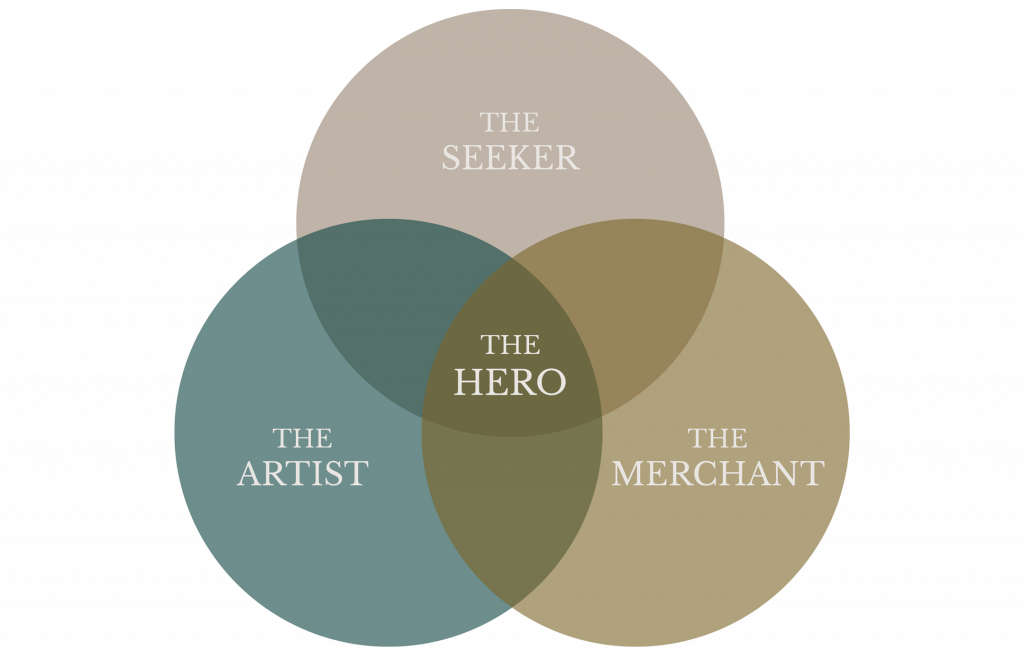
    The hero is the intersection of three fundamental professional archetypes – the seeker, the merchant and the artist, as I wrote about in part 1.

    The seeker seeks the truth and shows us the way. Their mapping of reality gives us a path through the struggle. Their unquenchable thirst for deeper understanding keeps us curious, humble, and constantly learning.

    The merchant is a tradesman of the good. Whether it is material goods, political good or spiritual good, the merchant knows that by trading what they have to those who want it, the world is made better.

    The artist creates beauty. Their compulsion is to make something from nothing – the mysterious process that even the artist himself does not understand. By doing so they create things that touch us and change us.

    The hero is a different order of archetype. The hero is all about the journey, not the character. The journey that the hero embarks upon is defined by the process, not the content.

    The hero walks the eternal quest, constantly working to unwind the code that lies deep within his soul, and to realize the vision that he is called to create.

    The hero is the one who hears the call to adventure, to transformation, and through doubt and resistance finds the courage to say yes.

    This great transformation changes you, and so as you complete the cycle, and return home, you return changed, and the world with it. You return to the marketplace, complete with a new consciousness, and new hands, with which you help those who need you.

    “We have only to follow the thread of the hero path, and where we had thought to find an abomination, we shall find a god. And where we had thought to slay another, we shall slay ourselves. Where we had thought to travel outward, we will come to centre of our own existence. And where we had thought to be alone, we will be with the whole world.”
    – Joseph Campbell, The Hero with a Thousand Faces

    Tension fuels transformation

    It is the creative tension that exists between the outer three types – the merchant, the seeker, and the artist – that drives the hero.

    It is the contradiction or paradox between the outer trinity that demands conversation. The heroic journey is in part, the quest to integrate these languages, these aspects inside you.

    How can I make money (merchant) from my creative expression (artist)? How do I bring the truth that I understand (seeker) into the marketplace (merchant)?

    The hero is not simply the overlap of the three types of the trinity. It is the transcendent principle, held in tension by the first three.

    The point is to mine that tension, for it is the fuel that propels the hero on his journey.

    The Hero Cycle

    Phase I – Disintegration

    No one knows how long ‘normal’ lasts. But if you pay attention, you’ll begin to notice that sooner or later, what once felt right, now feels wrong. What once worked, is starting to suck. Something is out of whack.

    This is not a fault in the execution of your life, or a fundamental flaw in who you are.

    No. This is simply the wheel of transformation starting to turn. God is beginning to crank on your lever, turning you toward a fuller, more beautiful version of yourself. Can you feel it?  This is the call to adventure – the whisper in your ear.

    You are so much more than you dare believe.

    You have a choice. Will you listen? You cannot turn off the whisper, but you can refuse its council.

    You can numb the pain of your dissatisfaction. You can eat burgers. You can binge on Game of Thrones. You can bury your head in the sand and simply refuse to look God in the eye.

    It is your right. But the consequence is an ever deeper journey into the cycle of phase one, into disintegration.

    If you refuse long enough your life will literally fall apart.

    Some choose to let themselves fall apart, and die. They live out increasingly empty and meaningless lives. They die from drugs or illness. They literally kill themselves.

    This is God’s way of forcing you to choose. Life or death?

    Will you choose life? Will you look into the light and see the image of who you are asked to become?

    The hero is the one who answers that call.

    When you surrender to this divine will, when you seize your own sovereignty and choose the path before you, you commit to something with untold power and consequence.

    “Until one is committed, there is hesitancy, the chance to draw back, always ineffectiveness. Concerning all acts of initiative and creation, there is one elementary truth, the ignorance of which kills countless ideas and splendid plans: that the moment one definitely commits oneself, then Providence moves too.”
    – William Murray, The Scottish Himalaya Expedition

    You say “yes”. You consent to the journey you have been asked to make. You step into the unknown, knowing it’s something you must do. And by doing so, you cross the first threshold.

    Phase II – Initiation

    The path extends before you. You are in esteemed company. Every great hero has passed this way.

    “Do you think that you shall enter the garden of bliss without such trials as came to those who passed before you”
    – The Quran, verse 2:214

    Turn to your mentors. Turn to those inside you – the harmony of your highest potential, who you are at your most essential. Turn to those around you – your friends and advisers, the ones you trust most deeply. Read again the great minds that nourish you and show you what you don’t yet understand.

    For you are on a journey that has already passed beyond the edges of your known reality. And as you consent to its invitation, you are drawn into the most challenging of new experiences.

    You will be stretched beyond your edge. You will be hurt. You will feel strife and suffering. But it is not the suffering of unmet commitment in the first phase, it is the existential kicking that you will receive at the boots of the unknown.

    Can you meet it? Can you rise up and face it with courage and conviction?

    These are the trials. Their purpose is not to ultimately break you, but to stress the muscle of your being, so you can be built anew.

    You will be tested for exactly as long as you need, in order to be ready for the great battle in the dark. Your initiation climaxes with the facing of your greatest fear – the great dragon at the heart of your being.

    You are both the hero, and the foe. It is not an exorcism of your demon, it is an alchemical meeting. Can the light in you meet its equal and opposite darkness?

    This is the culmination of all your initiatory challenge. The great showdown. The hero is the one whose leg shakes as he stands up tall, and looks the demon in the eye.

    You will be slain. Some great rock that your identity has rested on will be obliterated. Something or someone dear to you will die. Something that clouded your eyes from the truth will be ruthlessly ripped away.

    When you die, you cross the second threshold.

    Phase III – Transformation

    You have emerged from the dark underworld. But while you have faced down the great darkness and survived, your quest is far from over.

    For now, you must come to terms with who you have become, who you are becoming. You do not understand yourself, you have new eyes, new capacities, but they are foreign. The world has changed, because you have changed.

    Who are you now?

    You have been gifted a great blessing – your prize for meeting the dragon and being changed in the alchemical meeting of light and dark. But what do you now do with this great boon?

    If you were the protagonist in a movie, you would receive a great magical sword, or the secret to a great power. In your journey, the boon is one of deep and profound realization.

    You are rewarded with the greater consciousness and greater power of one who has faced down their fear and been reborn in their own higher image.

    You are on the road back home, but you may feel strangely alone. Perhaps those who you used to associate with no longer understand or see you. This is to be expected, for you no longer understand yourself.

    You are being transformed. What once propped up your identity has been whipped from under you. What once lay in the realm of strict possibility has been realized.

    You must come to terms with yourself – your new self – and realize what you are now capable of. What will you do with this great gift, this great boon?

    When this internal transformation is re-organised into a new understanding of who you are, you cross the third threshold.

    Phase IV – Integration

    The legend of a hero does not end with his great achievement, or her great discovery. The imperative for the one who has discovered great power, is to return with it. To return home.

    You return to the marketplace – the communities that matter most to you – with helping hands.

    “The Hero shall now begin the labour of bringing the runes of wisdom, the Golden Fleece, or his sleeping princess back into the kingdom of humanity, where the boon may redound to the renewing of the community, the nation, the planet, or the ten thousand worlds.”
    – Joseph Campbell, The Hero with a Thousand Faces

    You offer your goods, you speak your truth, you reveal your beauty. You integrate this new you, back into normal life, back into your work.

    You harvest the great fruits of your labour – the existential gift of your journey. You create your art, imbibed with the truth you now see. And give it, to feed those around you.

    As you do this, all the pieces begin to come together. The change that has occurred inside you is transmitted through you into the world around you. You change the world.

    It is not a single moment. This is your work now – to integrate who you have become with the world before you. You must straddle the two worlds of the dark and light, of the unknown and the known, and give yourself for the benefit of those around you.

    Blessings to you dear one, you have made it through. God has drawn you through the great change, the turning of the wheel, the latest revolution in the eternal quest.

    You now know your work. Your work is to live it, be it, create it. This is the phase of great productivity. Appreciate it honour it. For the next turning maybe closer than you would like to believe.

    The eternal cycle

    There is a new hero born anew with each cycle of the journey. For by the time the wheel turns full circle, and calls you on a new adventure, the hero that was born in the last chapter is now the one who clings to normality and safety.

    Every great leader knows that what got them to where they now are, is the very thing that will impede them from getting to the next stage.

    Where are you in the ever turning cycle of the hero? What phase do you find yourself in? For the nature and necessity of each phase is fundamentally different from the last.

    If you are trying to stably define who you are, and yet are in the first half of the cycle, your attempts will be fruitless. For the point of disintegration and initiation is to break you down, and burn off the dead wood of who you think you are. Give yourself to it.

    If you are looking for the thrill of adventure, and yet find yourself in the second half of the cycle, you will sabotage the work you must do. Your mission now is to understand yourself as you now are, and bring the fruits of your transformation back to the marketplace.

    The quest may be eternal. But your time here in this life is not. Know where you are, what you are asked.

    Your job as the hero is to devote yourself to this turning, no matter where you may find yourself on the journey.

  • We live in interesting times. The famed ‘fast changing world’ – the best we can do to describe the overwhelming whirl of evolution as it gathers pace.

    I believe that we’re in the midst of the early chapters of a new age. Ken Wilber calls it integral. James Altucher would call it “choose yourself”. Seth Godin talks about the connection economy. I used to think of it as the age of the realized entrepreneur. I think I was half right.

    Our ideas of professional work are in the midst of great flux. The professional used to be someone who had a trade – a craftsman, farmer, healer, soldier.  Then it was a job was had, with a contract and a role, and a boss.

    Now the standard is more like a vocation, which originally means calling. It’s professionally answering the call to the higher, to the gods, to what burns deep inside your heart.

    The enactment of this new professionalism is transformational by nature, that is, by following the call of the gods, we must become someone new and travel the mythological hero’s journey.

    The hero isn’t a person, the hero is an archetype – the one who hears the calls, steps onto the path, and is initiated into their higher self through great challenge. It is the sacrifice of comfort for the greater realization of your reason for being here.

    This is not an abstract concept. It is the thing that happens to us all, if we consent. Or even sometimes when we don’t. It was a hero’s journey for me 6 years ago when I decided to leave the comfort of employment at a fast growing internet company, and leapt into the unknown, with some vague notion of being an entrepreneur and talking about consciousness.

    It’s what it takes to write a book that bears genius in its pages. It’s what Steve Jobs must have had to go through to return to Apple after being fired, and creating the first iPhone.

    The map I present in this article is my attempt to show you who this hero is, or more precisely, what makes each of us heroic, and how we can use this map to better navigate our own journeys and transformations.

    This is the hero as I see it, the intersection of three fundamental professional archetypes – the seeker, the merchant and the artist.

    And it is the roots of this archetypal trinity that I will begin my story with.

    The philosophical roots of being

    Running throughout philosophy – from the Bhagavad Gita, through Plato, through Immanuel Kant, through Jurgen Habermas and up to the present day – is a triadic structure that under various guises, has been presented as deeply intrinsic to reality.

    The ancient Greeks thought of the three domains of life – art, morals and science, and the three transcendentals that related to them. Karl Popper called them the objective, subjective and cultural. Kant wrote his three great critiques.

    Ken Wilber, whose work first introduced me to this pattern, ties them to universal pronouns – I, We and It. He calls them The Big Three. They are the first demarcations we make in the oneness of reality. They are that fundamental.

    For Plato they were the good, the true and the beautiful. And it is that frame I want to use here.

    The three languages

    You can think of these three ideas – the good, the true and the beautiful – as three languages.

    Each one fundamentally different from the last, and yet each one fundamental to human experience. That is – one language cannot describe the territory of another language. Yet each one is part of the whole, and so where one finds truth, one will also find beauty, and goodness.

    “Words which give peace, words which are good and beautiful and true, and also the reading of sacred books: this is the harmony of words.”
    – Bhagavad Gita, 17:15

    To find the harmony in the three, you must learn to hear the individual melody of each language. For the language of truth, cannot tell us what is beautiful. The language of goodness cannot tell us what is true. The language of beauty cannot tell us what is right and just.

    The True

    The language of truth is the language of discovery and precision. It is the language of deep science – that deliberate and practical means by which we test the world, and ourselves, and discover ever deeper truth about its reality.

    It is something we uncover and reveal, it is something that we posit and falsify. The language of truth seeks to gently or forcefully, spear the squirming fish of meaning, and define its patterns and structure.

    Is it true that human beings evolved from higher apes? Yes. It took us a long time to discover this truth. But it’s now self evident for most fo the world.

    Is it true that if I spend enough time looking into the nature of my own experience, I will be unable to find the location of my own consciousness? Yes. I’ve tried. Like thousands of yogis and roshis. It’s not in my head, it’s not in my toes. It doesn’t even seem to limited to my body. It’s kind of everywhere and nowhere.

    When we seek the truth, we must attack and destroy our own assumptions about what is. We must bind together polarities that feel uncomfortable, and find harmony in the integration of relative truths. This frees us, and liberates our notions of what is possible, and who we are.

    “And you will know the truth, and the truth will set you free.”
    – Jesus of Nazareth, John 8:32

    Ken Wilber’s famous phrase is that “everyone is right”. Every single human perspective has some partial truth. But for that to be true, we must also hold that some are more right than others.

    The great seekers of truth understand this, they constantly seek for greater truth that transcends the partial truths.

    “He who knows only his own side of the case knows little of that. His reasons may be good, and no one may have been able to refute them. But if he is equally unable to refute the reasons on the opposite side, if he does not so much as know what they are, he has no ground for preferring either opinion.”
    ― John Stuart Mill, On Liberty

    Truth is an objective science, whether the terrain physical, conceptual or mystical. Mathematics is a dialect of truth. The Tao Te Ching is a treatise on mystical truth.  Cartography is mapping physical truth.

    To know what is true, reality must be examined, tested and mapped.

    The Good

    Whether any of this is a good thing is an entirely separate question.

    The good is the language of ethics.  What is right, just? How do we know? It is not an objective science – it is not a solitary investigation. It is a collective exploration of our own ethical principles. The codes by which we feel it is right to live.

    “To prefer evil to good is not in human nature; and when a man is compelled to choose one of two evils, no one will choose the greater when he might have the less.”
    – Plato, The Protagoras

    Is it good that many people still suffer, and struggle to have enough to live? No. I don’t know anyone who thinks that’s a good thing.

    Is it good that the homicide rate in the West are at their lowest rate in recorded history? Yes.

    Is it good that we have ever more free markets? That’s tough. I’d say yes. Many would say no. It’s an unknown. We’re still in the conversation.

    “Morality is not just any old topic in psychology but close to our conception of the meaning of life. Moral goodness is what gives each of us the sense that we are worthy human beings.”
    – Steven Pinker

    The language of the good is relational. You and I have a conversation, create mutual understanding, and thus form a We – something greater than the sum of its parts. And in that collective We, decide what we think is just and right. It is not scientific. It is not subjective. It is inter-subjective.

    To decide what is good, we must engage in a conversation about how we want to live with one another.

    The Beautiful

    When we ask what is beautiful, we enter the domain of art. It is about expression and provocation. It is the ultimate subjective world. For beauty is in the eye of the beholder, and the I alone.

    Beauty cannot be scientifically tested – it cannot be proved to be true or false. No one can declare that the Mona Lisa is officially ‘beautiful’ or that Star Trek is not.

    Nor can it be said to have moral foundation. Is it good that Tolkien spent two decades making up Middle Earth, and writing The Lord of the Rings? It’s the wrong question.

    The question is, did it change your experience? Were you struck by it? Did it leave you with a question mark in your experience?

    “We can slip into the Beautiful with the same ease as we slip into the seamless embrace of water; something ancient within us already trusts that this embrace will hold us.”
    – John O’Donohue

    Beauty is the ultimate subjective experience. The phenomenological aesthetic. An expression of something utterly indescribable, and yet instantly recognizable.

    How can you describe the language of a sun set? The untranslatable feeling of looking out as our great star sinks once more behind the horizon, as it’s done since the beginning. Writers have spent centuries to describe the beauty of a sun set, and none of them have nailed it. We can never nail it.

    Beauty is what is all around us, we know it intimately, and yet to capture it, is to capture the most striking and elegant butterfly. As soon as it’s in a net, it becomes less beautiful.

    “Never lose an opportunity of seeing anything beautiful, for beauty is God’s handwriting.”
    – Ralph Waldo Emerson

    To see what is beautiful, I must look with my own eyes.

    The three archetypes

    It is these languages that the three archetypes – the seeker, the merchant and the artist, speak in.

    These are not the only branches that grow from the roots of the languages. These are what I have come to think of as the professional dimension of these three languages. That is, how do the good, the true and the beautiful, show up in the domain of contemporary work?

    The Seeker

    The seeker seeks truth. Whether it is the deep spiritual truth of Adyashanti or the deeply human truths of Brene Brown, the impetus is to explore the unexplored, map the terrain, and come back to teach us.

    “It is not the possession of truth, but the success which attends the seeking after it, that enriches the seeker and brings happiness to him.”
    – Max Planck

    It’s manifest in the Tibetans who sat in caves in silence for thousands of years and developed the most exquisite maps of human consciousness. It’s the Victorian explorer who braved the dangers of uncharted seas and discovered new lands. It’s the physicist who finds new theoretical models that explain the unexplainable.

    In the professional arena, it is the seeker who shows us the way. Their brilliant mapping of difficult things gives us a path through the struggle. Their unquenchable thirst for deeper understanding keeps us curious, humble, and constantly learning. It could be a scientific seeking of truth, like Tim Ferris. It could be mystical seeking of truth, like the Dalai Lama.

    The vice of the seeker is pride – the seeker who claims to have found the truth, a truth no-one else has. They revel in it, boasting of the truth they know, denigrating the truth of others.

    It is the spiritual teacher whose existential arrogance leads them to outrageous claims, or relational abuse. It is the scientist who refuses to believe any kind of truth other than his paradigm, disparaging claims that fall into a different language or dialect.

    The mature seeker understands that they are an instrument for truth, using themselves to understand ever deeper and more elusive truth that they share for the benefits of others.

    Famous Seekers
    Jesus Christ, Albert Einstein, James Cook, Brene Brown, Adyashanti, Tim Ferris, Isaac Newton, Christopher Columbus, Alan Watts.

    The Merchant

    The merchant trades in the good. Whether it is the material goods of Wholefoods or the political goods of Barack Obama, the conviction is the same – that trading goods benefits everyone.

    “Man is an animal that makes bargains: no other animal does this – no dog exchanges bones with another.”
    – ­Adam Smith

    Trade happens between people. It is an intersubjective conversation about trust, permission and integrity. To trade, you have to believe the other person has good intentions. When they do, and you do too, more good is created, more ethical wealth is generated. The world becomes richer, in materials, freedom and culture.

    In the professional arena, it is the merchant that knows how to scale their impact, to bring their goods to ever increasing numbers of people, or at ever increasing depth. The merchant is the innovator who who builds brilliant new apps, or the marketer, who knows how to speak to their audience.

    The great vice of the merchant is greed – they use their mercantile skill, subterfuge and manipulation to extract maximum value for them self, at the expense of everyone else. This is the Victorian factory that uses its workers as expendable cogs in an industrial machine.

    They have forgotten that what is good is only determined in fair and transparent marketplace of goods and ideas, where we decide together, what is ultimately valuable, just and good.

    Famous Merchants
    Adam Smith, Steve Jobs, Seth Godin, Bill Gates, Warren Buffet, John Mackey, Jeff Bezos, Henry Ford.

    The Artist

    The artist creates beauty. Whether it is the mystical beauty of Leonard Cohen or the magical beauty of Neil Gaiman, the compulsion is to make something from nothing, and touch us.

    “Every human is an artist. The dream of your life is to make beautiful art.”
    – Don Miguel Ruiz

    The artist follows an invisible design, obscured even from the artist them self. It reveals itself as the artistic path is followed, and the picture comes as if from the page.

    Art happens in the spaces between things. The afternoon left free of appointments, and a song on the radio inspiring a burst of new writing for hours. It happens when you walk in the park, enjoying the beauty of the birds playing in the trees, and something moves in you.

    In the professional arena, the artist is the one who creates things. Through some mysterious process they produce artifacts – writing, paintings, music, design – that touch people and change things.

    The artist’s great sin is envy, or more precisely, the great fear that they are in truth, mediocre, one of the bottle, not special. And so to spare them this great pain, they seek to acquire the prestige or standing of others around them.

    They forget that beauty is seen through the eyes of the gods, and instead, judge their beauty through their own narcissistic eyes. They replace the great I for the small I, and endeavour to prop up their own ego by being the most beautiful person, rather than the person who creates the most beauty.

    Famous Artists
    Michelangelo, Neil Gaiman, Leonard Cohen, William Shakespeare, John Lennon, Rumi, Darren Aronofsky, Rainer Maria Rilke, Herman Hesse.

    The hero of a new age

    These are three fundamentally different vocations. They are based on languages that describe three fundamentally different worlds. And while each of us will be a native speaker in one archetypal language, the goal is to integrate these three archetypes in you, infusing their worlds into your work.

    Never has there been a time when integration across these three worlds has been more needed or more possible. This I believe, is the professional imperative of our age.

    Now I have given you a simple map, can you see where you are on it? What is your native language? Which is most foreign to you? Where do you have tension between the types?

    I am a native artist. And for most of my life, the world of the merchant was completely foreign to me. Much of my personal work over the last few years has been to integrate the merchant more deeply into my work.

    This is the first part of the map – the outer three archetypes. In part two, I will explore the fourth archetype – the hero – and how it relates to this trinity of the seeker, the merchant and the artist.

    For the hero is you, the future you, that is yet to be created through the journey of transformation. And to be a professional hero, is I believe, the vocation of this new age.

  • You have the ability to change time.

    You can change it, because you can think about it, and change the frame. No other creature we know about can do this.

    Our ability to think in time is one of the super-powers we are given as human beings. A lizard is perpetually stuck in the now. A complex adult can project their imagination billions of years in either direction.

    I’ve been thinking a lot about time-frames recently. I think they have significant implications for our work in the world and the way we go about realizing it.

    Let me explain.

    The entire expanse of history in a single map

    I remember when I first got interested (actually somewhat obsessed) with the work of integral philosopher Ken Wilber. His huge maps of reality saved me during a time of existential soul searching.

    One of the huge gifts that I got from his work, was that I started to think about human history in terms of epochs.

    Modern humans have been around for about 180,000 years, which is a stupendous amount of time, and hard to grasp. But when it was broken down into a handful of major paradigms, I could start to see the broad strokes of the evolution of human consciousness.

    It meant I could now look at the existential conundrums that had been plaguing me inside a huge context. It was not that I now had the answers, but rather that my frustration was dissolved inside a container big enough to hold the questions.

    Here’s another example of the power of time-frame manipulation.

    The earth has been around a while. It’s hard to grasp just how long. So let’s switch the time-frame.

    If the entire 4.5 billion year history of the earth were condensed into a single year, here’s what we see.

    Life arrives as single celled bacteria around the beginning of March. And things move pretty slowly for quite some time!

    In the middle of November we get the oceans filling up with multi-cell organisms.

    At the beginning of December, amphibians venture onto dry land.

    On December 13th Dinosaurs arrive on the scene, and stick around until 26th when they’re wiped out. Mammals come along the following day.

    It’s not until December 31st that the first hominids (apes on 2 legs) appear.

    Modern humans rock up at about 11:35 pm.

    And the industrial revolution happens in the last 2 seconds before midnight.

    Why are time-frames powerful?

    When you change the context of something, you simultaneously change the content.

    In other words, change the frame, and you can look at things in a completely different way.

    This is definitely true with time-frames.

    For example, let’s look at slavery. It can look like a very different issue if I change the time-frame.

    If I look at slavery through a 500 year time frame, I will see it as a horrific, barbaric thing that powerful white people did to defenseless black people.

    If I look at it through a 180,000 year time frame, I’ll see it as something that is common to every single human culture we know about, regardless of race, until the industrial revolution, when it was outlawed on a mass scale in a relatively short period of time.

    When I expand the time frame around a particular topic – when I stretch the edges to increase the canvas – I see a different picture.

    What time frame are you thinking about your work in?

    The next few hours of urgent to-dos you have to get through?

    The remaining few weeks until your next vacation?

    The 2 months until your big launch?

    The next 10 years as you build your legacy?

    The next 10 lifetimes as you unwind your evolutionary destiny?

    When I look at my business in the time-frame of the next product launch I’m performing, then success looks like nailing that launch. It looks like hitting the financial targets I have in mind, converting the right number of people into customers, persuading enough people of the value of my offer.

    When I look at my business in the time-frame of the next 30 years, it doesn’t matter if the next launch fails. In fact, I’ll learn much more from an abject failure than I will from a success.

    When I look at my business in the time-frame of the next 30 years, then I don’t want to persuade as many people as possible to buy my thing, I want to build relationships of intimacy and trust that will have people become customers and partners for decades to come.

    Stretch your frame

    You’re here for some particular work. It’s your work. It’s your life’s work. What happens if you examine that work in the context of the rest of your life?

    When you take things out of the context of financial success during this calendar year, and place them in the context of a lifetime of discovery and growth, what picture can be painted?

    Your dreams are big. Too big to hold sometimes. So put them in bigger hands. Put them in a time-frame of the rest of your life. What is possible now?

    Or go really creatively out there. Stretch the time frame beyond this life-time.

    What would happen to your work, if you knew that the mission would be taken up again, after you die, by a version of you that forgot all your memories, but retains all your implicit learning and ability? How would that change things?

    In other words, your work is so important, that you don’t have to rush to nail it all today, or this week, or this year.

    You have at least the rest of your life to work on it.

    Expand your frame. Give your dreams a big enough field to play in, and your stress a long enough journey to be belittled by.

    Now the frame is different.

    What picture do you see?


  • It all just came to me, and I realized the truth. My world changed, the heavens opened up, I saw the light. It was beautiful. I was beautiful.

    It’s a mistaken story.

    Transformation is not the euphoria that we think it is.

    Realization can be exquisite. The alethic moment, when what was once hidden, is now revealed. What was once obscured, is now seen.

    “Aahhh.”

    And then there is the consequence of insight—the unpredictable roll of a great change released upon a static body.

    Transformation is not joyful insight. Transformation is what ensues from insight.

    Transformation is the painful shedding of an old skin that no longer fits. Transformation is the shocking realization of looking in the mirror, day after day, and not recognizing the one who stares back at you.

    Transformation is slow, and unpleasant.

    Can you submit to the deepest change?

    To transform is to go beyond your current form, your current shape. It is metamorphosis.

    When you change shape, you hurt.

    The old dies, the new grows.

    Who you considered yourself to be, is not someone you can find anymore. What you assumed would always be true is no longer true.

    “I’m struggling. I don’t really know where I am. It’s all so confusing. I’m anxious, and I don’t really know what’s going on. Nothing seems to be working anymore.”

    It’s not working anymore, because the old things can’t work anymore, when you realize they’re old.

    Transformation has this glittery idealistic reputation. A breakthrough at a weekend workshop. An epiphany during a heightened state. An intense moment of spiritual realization.

    The reality of transformation is dark, confusing and painful.

    Who are you?

    You think you’re this one? Ewan. Who was born in England and likes pecans? You think that’s you?

    You think you’re the eternal one? The one who was here before your parents were born? You think that’s you?

    You are this. This moment. You are the culmination of a thousand lives, brought into this body by a thousand desires. You are this one, a cacophony of selves, loosely tied together with a narrative we call ego.

    You are this one. The one who cannot choose his destiny. The one who does not choose her true name.

    You are a thousand voices, channeled through a single throat. You are a thousand hearts, held by a singular love.

    You think you are the same one as 10 years ago? A month ago? A second ago? You are the one that transforms in every single moment.

    And yet you resist this eternal transformation. You seek to categorize yourself, to define yourself. You form a picture frame around your form.

    “This is me. I’m like this. I’m not like that.”

    It’s a frame you create. One that helps you link together the past memories, with a future possibility. A frame that gives your ever changing nature a sense of sane continuity.

    And when one day, you see the frame you’ve been seeing through, when one day you see the eyes you’ve been seeing with, your security is shattered. You are enveloped by the visceral anxiety of impermanence.

    “I thought I knew who I was. I do not.”

    It is in that moment, that transformation starts to wind its ruthless will around your being. And you will realize you are not who you considered yourself to be…

    You cannot choose this

    The plague is coming. The dead are walking. What was once, will never be.

    And it is into this inevitability that you throw your sense of will.

    You believe you can choose to be transformed? You believe this is a ‘personal development’ that improves you, that gives you more of what you want?

    Transformation is not a choice. It is the great surrender.

    When she comes for you, you have two choices.

    Resist her power, fight for your right to choose, and suffer, immeasurably.

    Or you can bend over and spread your cheeks.

    It may or may not be gentle.

    Part of you is dying. You cannot cheat the reaper.

    Let God have you. You cannot choose his claim on you. You can only choose your acquiescence as He has His way with you.

    He does this from the greatest love you can imagine. He is not punishing you. God no. He is opening you. He is fucking you into the vulnerable and beautiful truth that you dare not admit.

    What are you going to do?

    Struggle? Or spit on your fingers, and help him enter you.

    You have one choice only

    The circle has turned. The rot is setting in.

    That identity you had, where you knew who you were? It’s breaking down. If you try and hold onto it, it will decompose between your very fingers.

    That idea of what was true is turning to dust and clogging up your throat.

    What dies is no longer you. Let yourself fall apart, and you will discover that from the composting remains of your former identity, springs the new shoots of a greater consciousness.

    This is the cycle. Life, into death, into ever changing life, into ever deeper death.

    You have one choice.

    Suffer. Or surrender.

    If you submit to His will, you cannot fuck it up.

    If you do not submit to His will, you cannot fuck it up.

    Yet resistance is optional.

    Where do you still cling to your outmoded sense of entitlement? Where do you still grasp to a concept of fairness, or rightness?

    These are human ideas. Beautiful ideas.

    But now you are in the realm of God. And here there is one choice only.

    How deeply will you allow Him to enter you?

    She loves you.

    Die to Him.