• My upbringing gave me a very strong narrative about business: it’s corrupt and corrupts good people.

    It took me many years to unwind this story and reintegrate the archetype of the Merchant back into my worldview and life.

    It’s been a great lifeline for me, when I’m feeling like a shy artist, or entrepreneurial imposter, to remember the ethic of the Merchant. Giving the value and goodness you have is what makes things better for all of us.. And to not do that, for fear of this or that, is essentially selfish.

    This is a good antidote for any of us who can tend to hide away our light, for fear of what might happen.

    The archetype of the Merchant

    The Merchant is in the business of goods and services. Modern economic theory names this “value”. Which is a powerful, though somewhat dry notion. The deeper quality is “good” or “goodness.”

    This is the transcendent ethic at the heart of the Merchant, to offer goods in service of the greater good.

    It’s hard to appreciate this sometimes, given the scandalous ethics that so much of our actual global marketplace currently embodies. Nevertheless, beneath this cultural shadow is the deeper ethic of providing value, of creating goodness.

    Here’s the basic mechanic.

    When I provide you with something that carries high value for your particular circumstances, and you give me something back which is also highly valuable to me, then we both end up better off. The amount of total value is higher after our exchange. We’ve done something good for each other; we’ve created goodness that didn’t exist beforehand.

    Back in the day, this was pretty simple stuff. I’ve got goats, and you love goat sausages. You’re a baker, and I have no time/skill for making bread (I’m looking after all the goats). So we create an agreement, where I swap you my goat sausages for your bread. We’re both richer as a consequence of the exchange.

    We’ve both done something good for one another, and received that goodness back. The result is a net profit on both sides of the goodness equation.

    Our society is fixated on money as the metric of value. It’s so hard for us to imagine a world in which this wasn’t the case, that we’ve ended up falling foul of the shadow of money.

    The shadow of money is that it purports to be the goodness itself – that it itself is the value. While in fact, it is the measurement of value. We’re mistaking the sausage for the stick that measures it.

    Why is this important?

    Because understanding it unlocks a new level of freedom for the entrepreneur who doesn’t know how to “bring in more revenue” or the freelancer who wants to “make more money”.

    Magic dashboards

    Imagine a metrics dashboard that would show you the current status of your business. And the big window at the top says “Goodness provided to people this month”. (Rather than our actual metrics dashboards, which of course feature “income” or “revenue”.)

    It’s a magic dashboard, so it can actually measure the total value of all the things you’ve done. There are countless things that make this number go up, but which have no financial exchange attached.

    An hour on zoom with someone, helping them out with their thing. Sending out a productivity cheat sheet to the folks on your mailing list. Messaging someone with the idea that popped into your head on Thursday. Getting out the barbeque and cooking up some goat meat sausages for your friends and family.

    These things would all pump the numbers in this imaginary value dashboard. If this thing actually existed, you could measure your success by “goodness created” rather than “money earned” (or God forbid, “number of social media likes”.)
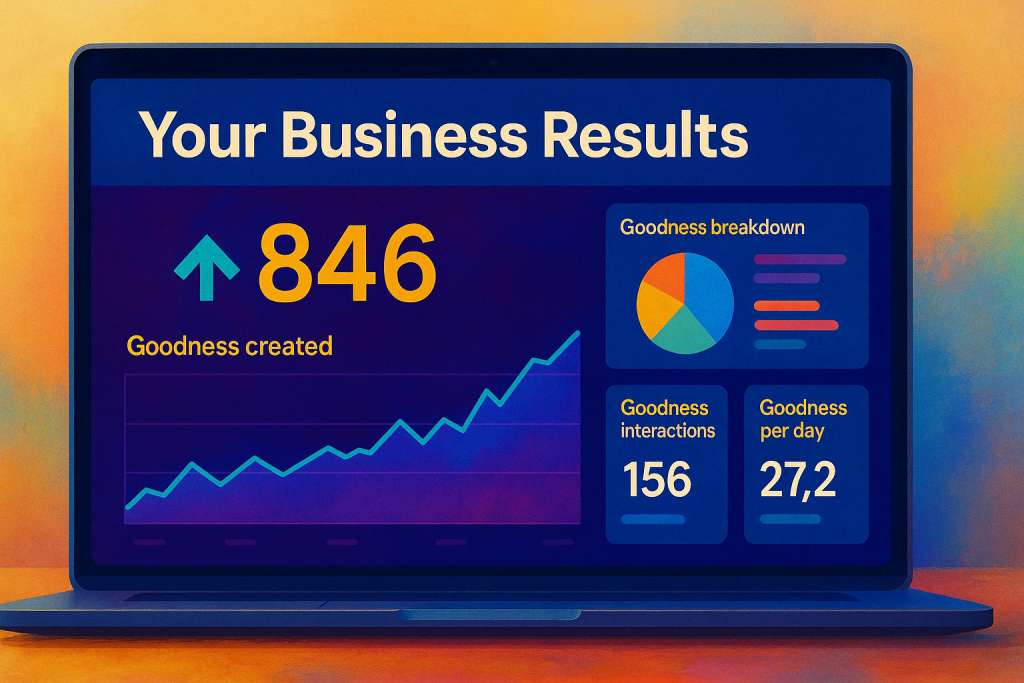
    I like this idea. It casts the game of business into an entirely different light. The goal is giving goodness, which by the law of the merchant’s code, and a result of his skill, results in a receiving back of reciprocal goodness.

    In other words, over the long term, as you saw your “goodness created” go up, you’d also see your revenue (monetary income) rise along with it. For the two are of course deeply related. Since, at the energetic root of the merchant’s action lies the exchange of value, which creates extra value.

    The filling of one extra goat intestine with fresh meat is no skin off my nose…it’s “cheap” to me. Yet the convenience of munching on your tasty bread with no extra effort expended, is really quite valuable to me. So the swap creates extra value that hitherto didn’t exist. That’s the equation at the root of commerce.

    Our culture has made it exceptionally easy to do. Because money fills a second role for us, alongside it’s “measurement of value”. It is a “store” of value. In other words, I can “store” the value of my goat sausages in the form of money. Classically this was coins. Everyone valued the metal the coins were made of, and so could safety “sell” the coins again in the future.

    We barely even use coins any longer. Our money is now digitalised, such that I can swap it for unprecedented numbers of things with unprecedented ease.

    And that’s of course where the shadow of money rears its ugly head. We shoot for money being the target, the goal of business and life. Forgetting that the point is the sausage, or the deep satisfaction that comes from doing what you’re really good at, knowing it really benefited someone else.

    Playing a good game

    The goal is to create goodness. Doing what you’re good at and giving that goodness to others in the form of goods or services.

    Even “non-professional” goodness counts! Calling your mother to catch up can create more goodness than brainstorming a new business strategy.

    One thing to remember however is that you create a great deal of goodness when you start with what you’re good at. Where is your value? I’m assuming you don’t make premium goat sausages. So what is it?

    From the ethical perspective of the merchant, selfishness is when you don’t proactively offer your goodness in the marketplace.

    I know a great many “old souls” (this one included) who struggle to fully present their value in the marketplace, because they don’t want to be pushy, or they feel like imposters. While from the inside this can feel real and important. From the outside it results in your goodness being withheld from people who would benefit from it. Which is indeed a form of selfishness.

    So the perspective shift is from “how can I make more money?” to “how can I create more goodness (value)? Even if you do want to create more money, the metric I suggest you optimise for is ‘goodness created’.

    If you want to be strategic about it, you can ask yourself “how can I create goodness for the people I want to work with professionally?” This helps you funnel your goodness toward the people you want to build your business for.

    It’s a lot easier for someone to say “I’d like to pay for more of the goodness you’re already giving me.”

    Another way of looking at this is that it’s a practice of generosity — of giving your goods, without a strategic objective of return. The law of the universe seems to handle the returns (you’re not in control what they are).

    This is a form of reciprocation. Humans are wired to reciprocally return generosity. Indeed, many people feel guilty if they’ve been given a kindness and haven’t returned one.

    The real payoff though, is the shift of focus from the stick to the sausage. The point is the goodness. The practice of doing what you’re good at, and of doing good in the world. This makes us feel useful, like we’re making good on the gifts and plans we came down here with.

    You get to be good to people. Live a good life. Which feels so good.

  • I’m in the “business of transformation”. If you’re reading this, I’ll assume you are too. The transformational professional seeks to create an experience for someone that allows them to change, not on the surface, not in their “efficiency”, but in the very structure of their being.

    This is becoming big business.

    As the new marketplace of coaches, purpose guides, cacao yogis, and unicorn shamans grows ever busier, I want to address the economics of transformation—how we as professionals sell this elusive outcome.

    Because there are plenty of snake-oil peddlers out there—plenty of “discover your purpose in 30 days” or “heal your soul wounds with these 6 easy steps”. If you listen carefully, you’ll discern the subtle scream for attention between their words.

    It is not this prevalence of this naïveté that I want to address however. I want to talk about the genuine problem of selling this “merchandise”. For transformation is a tricky product to package. And an even trickier effect to measure.

    You can’t measure it in hours. It’s not a tactical exercise. There is no clear “problem” that we’re seeking to solve in the next 90 minutes of our coaching session. I can’t put “hours in one end” and “get transformation out of the other.” It doesn’t work like that.

    Cultivating the mysterious

    The transformational process is mysterious, and unpredictable. It is by definition, surprising—the results of a genuine metamorphosis cannot be accurately discerned from the prior state. Transformation brings together the existential dilemmas that bind us, lights a fire under our ass, burns away the old, and creates the new from its ashes. It draws us down into the deepest questions we hold.

    Who are you?

    What is being asked of you?

    These are not questions that can be fully lived into and unfolded, within the confines of a “two-day intensive”. The goal cannot be achieved in this time frame. In fact, the goal cannot even be achieved in a year, or ten.

    Because the goal is not something that is “achieved”. It is of a different categorical nature.

    The goal is the cultivation an unknown future potential, whose seed can be planted, nurtured, and encouraged. But the result is not within the control of our conceptual minds, or pragmatic hands. It cannot be promised by the practitioner.

    What can be achieved in the creation of a space—an existential garden—where Being itself can grow, from the deep substructures of our archetypal nature, up into the luminous heights of our divine potential.

    The great Chaos of Nature gives no guarantees. The process is an alchemical meeting between two human beings, between a coach and a client, between the conscious and the unconscious, between the known and the unknown, between the past of identity and the future of our potentials.

    Nut nevertheless, it is an experience—a product—that must be sold, in the marketplace. This is new.

    The Merchant and the Seeker

    The enlightened master in the mountains—the seeker of the spiritual path— is not generally close friends with the merchant in the marketplace. It is an estranged relationship, as it has been for centuries past.

    The purity of the spiritual path has hitherto rejected the profit of trade— “the dharma should be free” they have cried through the halls of the temples. The substance of the spiritual path cannot be turned into a commodity that is sold.

    Equally, the marketable needs of the commons do not stretch to such abstract and unquantifiable notions as “awakening” or “self-realization”, The merchants and traders have ignored the spiritual technologies, favouring more “saleable” and “immediate” goods that can reliable turn a profit.

    It is only in the last half century that these archetypal postures, have begun to rub shoulders, and have had to contend with their apparently oppositional moral outlook.

    And it is only now, in the new bazaar of work that the information age has birthed, that it has gone beyond the possible integration of these opposites, into the necessary integration of them—the necessity to integrate them to such an extent that it underlies the way we actually go about our day, and enact our work.

    This integration work entails an honest and oftentimes humbling admission of our biases, and caricaturing of “the other”. I have found, both in myself and many of the people I work with, a preferencing of the spiritual, and a suspicion of the mercantile. The spiritual is “high”, “luminous” and “worthy”. The mercantile is “shallow”, “manipulative” and “greedy”.

    But to the extent that we deny the intrinsic and necessary truth of the mercantile perspective, we banish said truth to the shadows. The repression of this posture creates a “shadow merchant” that we see everywhere out in the world, and not at all in ourselves.

    “Capitalism” and its exponents then becomes a dark spectre over our world, manipulatively siphoning off wealth and exploiting anything and anyone they can extract profit from. This is a problem.

    The Good Merchant

    There is a “good merchant” that is revealed when the “shadow merchant” has been faced, and reabsorbed. This archetypal posture is based on the ethics of trade. And to be an “agent of change”, to “give your gifts to the world”, to “live your purpose”, you must understand and embody this posture.

    The ethics of trade are based on a very simple truth—voluntary and honourable exchange enriches society.

    When we both walk away from an exchange, feeling like we got a good deal, it enriches both of us with goodness.

    This is the brilliant insight of the merchant. Slowly, though each incremental exchange between honest people, society at large becomes enriched, and we all benefit.

    This is true whether the exchange be material, informational, or transformational. It is true when I work with a client.

    “I feel so grateful. I get to work with someone who inspires me. We have fascinating discussions about the nature of work, and the ways in which he is called to his deepest expression. It fulfils me more than anything, to see another human being grow into who they are, and touch the communities around them. And for this I get paid so handsomely that I can dedicate myself to this work with all my vitality. Fuck yeah.”

    “Wow. I worked with him for a year, and he helped me transform the entire way I approach my work. I’m clearer than ever about what I’m here to do. I signed my dream client. I’m super productive, and my wife just told me she’s never felt more in love with me. What a bargain.”

    The world is literally a richer place after this exchange has taken place.

    I have more than when I started. More money. More understanding of the transformational journey. More gratitude for life. More pride at the work of my fellow human.

    He has more than when we started. More clarity about his work. More energy and juju. More creative production. More income. More love. More embodiment of his purpose here in life.

    The transformation that has occurred will ripple out into the future—in both our lives—in ways neither of us can predict or track.

    This kind of trade is hard to put a price on. But value it we must.

    The price of change

    A life transformed. What is this worth?

    €1,000?
    $10,000?

    There is no one number. The price is determined by the context—it is the figure that energetically charges the container with commitment and devotion, on both sides.

    A close friend of mine coaches CEOs. He is very skilled. He changes people’s lives deeply. To work with him for a year costs $100,000. I mentioned this to my mother once, and she felt really quite uncomfortable about the whole affair. It looked greedy, and ugly to her. But this is because the context is foreign to her.

    The CEO pays $100,000 because that’s the number that symbolizes commitment to him—investment in a demanding process. The fee for coaching is in one important respect the “promise to do the deep work required”. This is why “free coaching” rarely works. There’s not enough at stake. There isn’t enough energetic commitment, and so the whole project deflates and falls flat.

    The CEO’s $100k is like my €10k. Or another’s €1k. It’s a big investment—whatever “big” means to me. It’s a stretch. I know that to get the return, I really need to show up and access a different level of being and functioning. The size of the number is symbolic of the level of significance it holds for me. It’s a “big” moment.

    When I pay a “big amount” at a “big moment” in life, “big things” happen.

    I paid my first coach $4,000. It felt like a ridiculous sum at the time. I freaked—the—fuck—out. But now I can look back at the change that occurred, and see what an absolute bargain it was.

    $10k to the CEO, or €1,000 to me is a figure that can just be thrown at something. And if it doesn’t work out? No biggie.

    Money is the way we “charge” the transformational container with energy. It’s not about the actual figure. It’s about the contextual figure that represents both the size of the game we want to play, and the nature of the arena in which we’re playing.

    The new way

    It is a tricky business. To hold in one hand, the integrity of a process of awakening that cannot be measured by material means, or “replicated at scale”—and in the other, the goodness of trade, and the necessity to offer our products in the marketplace at a price that makes the transformation itself possible.

    But it is this integration that we must each contend with as transformational professionals, walking the line between self-gratifying greed and selflessly inept charity, between impractical spiritual depth and well-packaged superficiality.

    We must come to understand the world of the merchant and the seeker to such a degree that we can embody their essentials truths, and weave them together so as to seed the transformation we are devoted to in the first place.

    This is new. The new way. To hold the ethical precepts of both the merchant and the seeker—the marketer and the mystic—in such a way as the economics of transformation make it available to those who need it, and profit those who offer it.

  • Sweetheart, you don’t get it.

    You don’t realize just how beautifully valuable you are. So very precious. So very special.

    Because you’re like me. You forget. You deny it. You disbelieve it.

    It’s not your fault. It’s not a pathology – something that went wrong. There’s a disease. Adyashanti says it’s an affliction of the Western mind. It’s the disease of chronic unworthiness.

    That no matter how well you do, how much people love and appreciate you for who you are, you have this doubt. This place deep inside, where you actually don’t believe you have any value. You’re not worthy.

    It shows up in everything you do.

    You’re confusing things. It’s ok sweetheart. I do it too. It’s not a mistake, it’s part of the path. But you still don’t get it.

    Value. Worth. Worthiness.

    It’s not all the same. There are two radically distinct kinds of value. And when you confuse them, it’s a recipe for existential crises, delusion and confusion.

    Which is never fun.

    So, let’s see if we can’t clear that up.

    Essential Worth

    You have this in complete abundance. And what’s even cooler, you don’t have to do anything to create it or prove it.

    You are one of the most conscious and beautiful beings the world has ever seen. So am I. And so is your grandmother, the wall street banker and Justin Beiber (yup, even Justin).

    You’re a human being. That’s already pretty fucking rad. It’s a precious, precious gift.

    The Tibetans say it’s very rare to be born as a human. They tell a story. Imagine the whole world is a giant ocean. And there’s a turtle that swims around under the surface. And there’s a golden ball, floating around in the currents. Now what are the chances of that turtle popping up above the surface and catching that golden ball in its mouth? Pretty darned slim. Well, that’s the same chance you have of being born human.

    You get born a human. Wow!

    And just like the snowflakes and the trees, every single one of us is totally unique.

    By definition of being uniquely human, you have essential worth. You have the most sophisticated biological hardware in the known universe. And you have a unique software system – your own consciousness – that sees things distinctly from every other human being.

    Essential worth. You don’t have to prove it, or stress about it because you were born with it. And it can never be taken away.

    Worldly Worth

    This one is different.

    When you’re born, your worldly worth bank account starts at zero. It’s something you must create. It’s your usefulness out in reality.

    Imagine Mozart was alive today. He had all his musical genius. But in this world he doesn’t compose or perform anything. He spends his life eating nachos on the sofa, beating off to expensive porn and never leaving the apartment someone else pays for. He has no worldly worth. In fact, he may even have negative worth. He consumes more that he creates. He consumes a lot of nachos, a lot of porn, and doesn’t create anything in return.

    Worldly worth must be created. It’s the value that is useful to other people.

    And this is what business is interested in. The market place.

    If I spend 2,000 hours learning the ancient art of cosmic monkey spanking, then I am valuable to all the people that want to spank their own cosmic monkeys, but don’t know how.

    And they will want to give me value in return for teaching them. They give me $100 a session, or special primal favours.

    When we make that trade, the world literally gets more valuable.

    Worldly worth. You have a bunch of it already, but you can create more. You must create more, if you want to do your true work in the world.

    We confuse these kinds of value

    If you deny the existence of essential value, like the modern marketplace often does, then you will spend your live striving to prove your worth by building immense worldly value. But its fruitless, because you’re trying to prove your humanity, your essential value, and that can never be proved.

    If you deny the existence of worldly value, then you become impotent. You wait for your work to ‘emerge’ (often spiritual speak for naïve inaction), believing your natural inner unicorn will be recognized if you ‘trust’ in it. But it’s crazy making, because your worldly value has to be created. It doesn’t just pop along magically.

    When I put out new stuff, the fear is that my heartfelt offer will be met with indifferent silence. No one gives a shit. No one wants to accept my invitation.

    And when I’m not watching, the undifferentiated scripts start to wind their suffocating bodies around me.

    “If no one pays you for this, it’s going to confirm that you’re actually worthless Ewan. I know you think you’re special and unique, but the evidence will be there fuckwit. You’re worthless.”

    What it would actually confirm is that my worldly worth in the particular area I just created something in, is not what I thought it was.

    And the antidote is simple. Either I’m offering my worldly value to the wrong folks, in which case I find the right tribe. Or I don’t have enough value in this area, and I just need to put the work in to get better.

    Usually it’s just fear and doubt though. And it can be so insidious. “Maybe it was all a delusion. Maybe I’m actually not worthy.”

    And of course, the irony of it is that the more we trust in our essential worth, the easier it is to own and create our worldly worth.

    Do you invest in your worldly worth?

    You can’t invest in your essential worth. It’s not a thing that can be increased or decreased, only felt or denied.

    But your worldly worth can be increased indefinitely. If you want it to be.

    And that’s where you and I tend to struggle isn’t it? In our noble attempt to transcend the materialistic absolutism of the modern marketplace, we throw out the worldly baby with the greedy bathwater.

    But worldly worth is the root of service and making a difference in the world.

    The math is simple. The more you invest in and develop a worldly capacity, the more it’s worth.

    I’m a more valuable coach today than I was 3 years ago. Because I’ve run the cycles on it. I’ve clocked up hundreds of hours of coaching, and it shows when I sit down with someone to help them.

    How seriously do you invest in your worldly worth? Do you put your money on the line?

    Often we shy away for paying for our own growth, because we doubt the value.

    “Oh, it looks interesting, but $2,000 for a 5 day falafel workshop? That’s too steep. It’s not worth it.”

    But you love falafel! It’s your life, your passion, your love!

    The absence of value lies not in the promise of the program. It lies in you. You don’t believe you are worth $2,000 of investment.

    “I’m a falafel amateur. I’m not ready for spending that kind of money. It’s above my level.”

    It might be true. But more often than not, we doubt our worth. We don’t trust our essential worth, and so we shy away from investing in our worldly worth.

    We believe the story in our head, that’s compounded by a confusion about the nature of value. Because what’s the point in investing in myself if I’m worthless in the first place?

    Then it’s like pouring champagne in a toilet full of piss.

    I’m in your corner

    Sweetheart, you don’t realize just how valuable you are. And how valuable you can be.

    It makes me sad. It’s sadness at my own doubt too.

    I was told “whatever you do Ewan, it’s wonderful. It doesn’t matter how good it is!” It was progressive at the time. Now it’s painfully lopsided.

    Because we hold back don’t we? We don’t trust we can do it, create it, own it. We doubt it will turn out well if we really own our essential value, and step forth and develop our value in the world.

    But that’s why we’re here. If we couldn’t grow and serve, and leave the world better than when we came in, we wouldn’t be here. That’s the whole point sweetheart.

    You’re so fucking valuable. Never believe the doubt that you are. You already know how much worth you possess.

    And go forth, and build a level of value in your world that matches that inner knowing. That is what will enable you to leave your beautiful mark on the world.


    If you’d like to go deeper into this mission – your mission – and learn how to courageously step out into the world, then take a look at my new small group program: Emerge.

    There are still a few places left.

    Take a look here.

    And if you do feel called to step in. Do so. You’re worth it.


  • Money is not what you think it is.

    It’s not what I thought it was. It used to be something that was hard to find, harder to keep, and very hard to talk about. It was unspiritual, a sign of selling out, or worse.

    Money is like a lover, and I must confess; she and I used to have a rather strained relationship. I resented her, and she avoided me.

    I think she found my judgement of her hard to swallow. I don’t blame her. I was pretty scathing sometimes. And self-involved.

    She left me completely once. It was only for a week, but it was a big wake-up call. I had to survive on cheese biscuits, Joni Mitchell records and cigarettes.

    We had some tough times with one another, but we’ve worked hard, and now we’re in a really good place together.

    I understand and appreciate her for who she is, and she brings increasing flow and juice to my life.

    So, this piece is all about money. What it is. What it isn’t.

    It’s in seven parts.

    1. Money is a Concept

    You can’t find it anywhere.

    It’s the pixels on a digital display. It’s the words on the paper “I promise to pay the bearer on demand the sum of £20.”

    Money used to be gold, which is a real thing. Money is a concept. It’s a signifier. An idea. A measurement.

    Money is like feet and inches, or liters and milliliters. It measures something. But while a measuring tape, or set of weighing scales measures stuff in the physical domain, money measures something else.

    Money measures value.

    Money is an arbitrary, yet universally agreed measuring scale for value. Value is what human beings create for one another.

    We want to help another, or get helped. So we collaborate with one another, exchanging the things we make, and the talents we’ve honed.

    2. Money is Flow

    Money is a form of currency. So, to understand money, you need to understand currency.

    Currency has been around a long time. A lot longer than money. Alternative forms of currency include:

    • Goats – “I’ll offer you 60 goats as a dowry for your son’s marriage to my daughter”
    • Cigarettes – Allied soldiers in Nazi prisoner of war camps would use cigarettes as an internal currency.
    • Salt – The Roman’s sometimes paid their soldiers in salt, which is where the word ‘salary’ comes from.

    Currency is what the world needs to make it easier for us human beings to share stuff and trade stuff.

    Currency literally means flow. It comes from Latin, from the same root as the word current, like the current of a river. Currency is a form of flow and circulation.

    A river’s flow is the flow of water. The flow of currency is the flow of mutual exchange.

    Money is a wonderfully clever form of currency. It’s a concept. It’s virtual. Which means it’s easily transferable, and universally recognizable.

    If goats were the global currency, the flow of service and exchange would be rather cumbersome. Think paying Amazon a quarter of a goat for a book.

    Money is the most elegant currency we’ve made so far. It’s incredibly powerful. And creates immense flow. If you recognize it for what it truly is.

    3. Money is a Story

    Money, like any concept, is defined by its narrative. It carries a story that gives it meaning. Without our stories around money, the paper notes in my wallet mean nothing, are worth nothing.

    Money has a universal story. The story of universal value. And because we all share an understanding of this story, we exchange money for real things.

    I can give the baker €2 and he will give me a freshly baked loaf. My client can give me $3000 and I’ll devote myself to coaching her deeply. I can give my landlord €1300 and he gives me permission to live in his apartment for a month.

    Money has many other stories that are not universally shared.

    Here’s the story I had of money growing up.

    “Money is the cause of the world’s problems. It is the lever that the rich use to keep themselves high, and the poor low. It is what corrupts good people, destroys equality, and feeds greed and oppression. To save the world, we must tear down the pillars of capitalism, and eradicate the disease of money.”

    I didn’t invent that story, or choose it. It was what was given to me by my sub-culture and my elders. I swallowed it as gospel.

    I carried it for many years, until I saw it as a story. And then I asked myself whether I believed the story. I found that I did not.

    Here’s another story about money that I discovered I carried.

    “Money is hard to find. It’s a scarce and limited resource. When I get it, I should be careful with it, save a bunch of it and feed it into a pension, so that I still have some when I get old.”

    My grandparents carried this story. They lived through the Second World War in England when food was nationally rationed. They had to scrimp and save to survive.

    I don’t live in a country at war. I live in one of the richest and most democratic countries the world has ever seen. But during the time I carried that story, I did ration my money. And as a consequence, I didn’t have very much. It was hard to find.

    4. Money is a Tool

    There’s a new field of study called neuroeconomics. It explores how our human brain makes decisions. One of the things that neuroeconomics has discovered, is that on a neuronal level, the brain apprehends money the same way it would apprehend a hammer, a fishing rod, or a plough.

    On an unconscious level, we see money as simply a tool.

    I don’t need to hammer metal into shape. I don’t need to catch fish to eat. I don’t need a tractor or a combine harvester.

    My trade is consciousness.

    The tools of my trade are my mind, my being, my relationships, my heart, my knowledge. So I use money as a tool of consciousness.

    I use it to ensure that the clients I work with are ready to commit to the deep work that I do with people.

    I use money as a tool to create enough time and space in my own working week so that I can read, muse, meditate and write.

    I use money as a tool to create experiences.

    5. Money is Fuel

    “The purpose of a business is to maximize profit for its shareholders.”

    Or so the old maxim used to go.

    The business that you and I create is different. The purpose is deep, creative. It is to bring forth something that doesn’t yet exist. It is to make things that the world wants. The purpose is to serve.

    Business is the vehicle from which we change things, create things and awaken things.

    And like any vehicle, business needs a fuel source to power its engine. The vehicle of business needs the fuel of money. A business without money doesn’t go very far, very fast.

    But, just like the purpose of a car is not to have fuel. The purpose of a business is not to have money.

    That would be idiotic.

    6. Money is a Terrible Thing

    “I’m worried. I’m worried that money and wealth will corrupt my meditation practice.”

    The student had just married a very rich woman, and was now wealthy. He was asking his teacher Suzuki Roshi what to do about it.

    “Yes, wealth is a terrible thing.” Roshi replied.

    “Yes, yes it is.” said the student.

    “And poverty is also a terrible thing.” Said Roshi, smiling.

    The student was perplexed for a moment, then smiled too.

    “I think I understand” he said.

    “Good, now that you understand, it is better to be rich.” said Roshi.

    I heard the philosopher Ken Wilber recount this story. He pointed out that money is not the crux of the issue, attachment is. And once you can transcend your own attachment to money (either having it or not having it), you are then freed to inhabit money and wealth with luminosity, and to serve the world in a much more powerful way.

    7. Money is Something We Create

    Last year, I earned rather a lot of money. More than I had in a long time, and certainly the most I’d earned since leaving the comfort of corporate employment.

    And yet my stress levels about having enough didn’t diminish.

    I would still wake up in the middle of the night, anxious about how I was going to earn more, desperately spinning different possibilities in my mind, trying to find the one that would pay well, with minimal effort, and tolerable compromise.

    I hired a coach, a wonderful man who helped me explore it all. The entire story is a long one, but I’ll give you the punchline.

    I thought my stress came from not having enough. It didn’t.

    I thought my stress would diminish when I had enough squirreled away in a savings account. Or when I secured enough contracts, and guaranteed enough income each month for a sustained period.

    But actually, my stress dissolved when I realized I had the capacity to create money when I wanted to.

    I create money when I serve. I create money when I offer help. I create money when my actions generate value that didn’t exist before.

    The game has changed for me.

    Money isn’t a scarce resource anymore. It’s not a corrupting influence. It’s not something I avoid relating to.

    Money is a measurement of how deeply I’m serving people. Money is a measurement of how well I know my tribe, and how well I’m helping them do what they’re here to do.

    Money is an indicator of how bravely and vulnerably I am devoting myself to the purpose for which I was born.