My upbringing gave me a very strong narrative about business: it’s corrupt and corrupts good people.
It took me many years to unwind this story and reintegrate the archetype of the Merchant back into my worldview and life.
It’s been a great lifeline for me, when I’m feeling like a shy artist, or entrepreneurial imposter, to remember the ethic of the Merchant. Giving the value and goodness you have is what makes things better for all of us.. And to not do that, for fear of this or that, is essentially selfish.
This is a good antidote for any of us who can tend to hide away our light, for fear of what might happen.
The archetype of the Merchant
The Merchant is in the business of goods and services. Modern economic theory names this “value”. Which is a powerful, though somewhat dry notion. The deeper quality is “good” or “goodness.”
This is the transcendent ethic at the heart of the Merchant, to offer goods in service of the greater good.
It’s hard to appreciate this sometimes, given the scandalous ethics that so much of our actual global marketplace currently embodies. Nevertheless, beneath this cultural shadow is the deeper ethic of providing value, of creating goodness.
Here’s the basic mechanic.
When I provide you with something that carries high value for your particular circumstances, and you give me something back which is also highly valuable to me, then we both end up better off. The amount of total value is higher after our exchange. We’ve done something good for each other; we’ve created goodness that didn’t exist beforehand.
Back in the day, this was pretty simple stuff. I’ve got goats, and you love goat sausages. You’re a baker, and I have no time/skill for making bread (I’m looking after all the goats). So we create an agreement, where I swap you my goat sausages for your bread. We’re both richer as a consequence of the exchange.
We’ve both done something good for one another, and received that goodness back. The result is a net profit on both sides of the goodness equation.
Our society is fixated on money as the metric of value. It’s so hard for us to imagine a world in which this wasn’t the case, that we’ve ended up falling foul of the shadow of money.
The shadow of money is that it purports to be the goodness itself – that it itself is the value. While in fact, it is the measurement of value. We’re mistaking the sausage for the stick that measures it.
Why is this important?
Because understanding it unlocks a new level of freedom for the entrepreneur who doesn’t know how to “bring in more revenue” or the freelancer who wants to “make more money”.
Magic dashboards
Imagine a metrics dashboard that would show you the current status of your business. And the big window at the top says “Goodness provided to people this month”. (Rather than our actual metrics dashboards, which of course feature “income” or “revenue”.)
It’s a magic dashboard, so it can actually measure the total value of all the things you’ve done. There are countless things that make this number go up, but which have no financial exchange attached.
An hour on zoom with someone, helping them out with their thing. Sending out a productivity cheat sheet to the folks on your mailing list. Messaging someone with the idea that popped into your head on Thursday. Getting out the barbeque and cooking up some goat meat sausages for your friends and family.
These things would all pump the numbers in this imaginary value dashboard. If this thing actually existed, you could measure your success by “goodness created” rather than “money earned” (or God forbid, “number of social media likes”.)
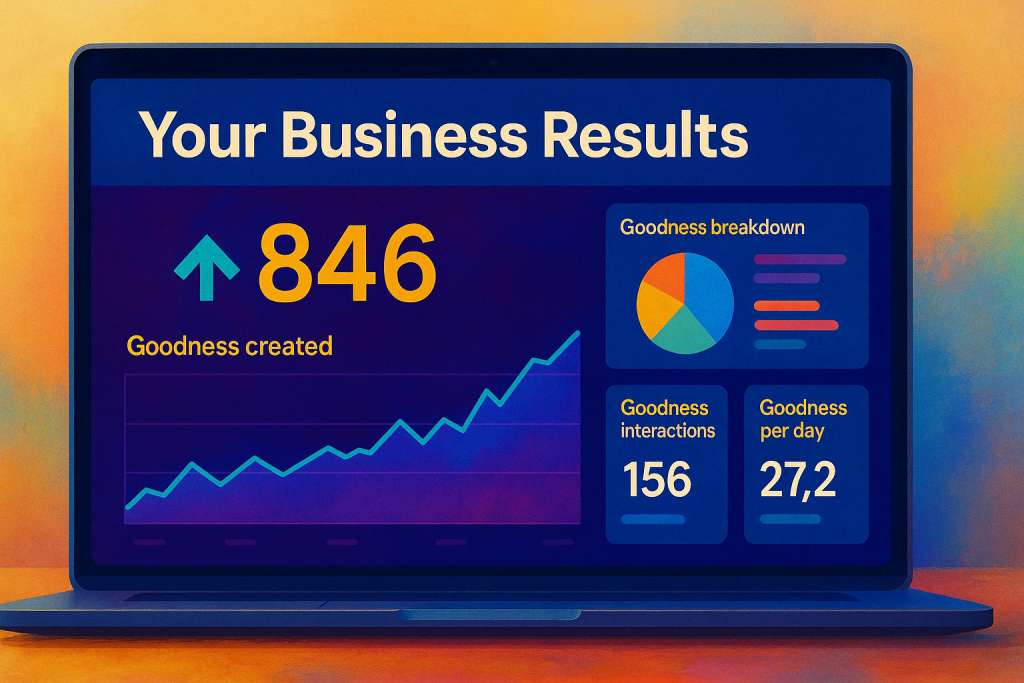
I like this idea. It casts the game of business into an entirely different light. The goal is giving goodness, which by the law of the merchant’s code, and a result of his skill, results in a receiving back of reciprocal goodness.
In other words, over the long term, as you saw your “goodness created” go up, you’d also see your revenue (monetary income) rise along with it. For the two are of course deeply related. Since, at the energetic root of the merchant’s action lies the exchange of value, which creates extra value.
The filling of one extra goat intestine with fresh meat is no skin off my nose…it’s “cheap” to me. Yet the convenience of munching on your tasty bread with no extra effort expended, is really quite valuable to me. So the swap creates extra value that hitherto didn’t exist. That’s the equation at the root of commerce.
Our culture has made it exceptionally easy to do. Because money fills a second role for us, alongside it’s “measurement of value”. It is a “store” of value. In other words, I can “store” the value of my goat sausages in the form of money. Classically this was coins. Everyone valued the metal the coins were made of, and so could safety “sell” the coins again in the future.
We barely even use coins any longer. Our money is now digitalised, such that I can swap it for unprecedented numbers of things with unprecedented ease.
And that’s of course where the shadow of money rears its ugly head. We shoot for money being the target, the goal of business and life. Forgetting that the point is the sausage, or the deep satisfaction that comes from doing what you’re really good at, knowing it really benefited someone else.
Playing a good game
The goal is to create goodness. Doing what you’re good at and giving that goodness to others in the form of goods or services.
Even “non-professional” goodness counts! Calling your mother to catch up can create more goodness than brainstorming a new business strategy.
One thing to remember however is that you create a great deal of goodness when you start with what you’re good at. Where is your value? I’m assuming you don’t make premium goat sausages. So what is it?
From the ethical perspective of the merchant, selfishness is when you don’t proactively offer your goodness in the marketplace.
I know a great many “old souls” (this one included) who struggle to fully present their value in the marketplace, because they don’t want to be pushy, or they feel like imposters. While from the inside this can feel real and important. From the outside it results in your goodness being withheld from people who would benefit from it. Which is indeed a form of selfishness.
So the perspective shift is from “how can I make more money?” to “how can I create more goodness (value)? Even if you do want to create more money, the metric I suggest you optimise for is ‘goodness created’.
If you want to be strategic about it, you can ask yourself “how can I create goodness for the people I want to work with professionally?” This helps you funnel your goodness toward the people you want to build your business for.
It’s a lot easier for someone to say “I’d like to pay for more of the goodness you’re already giving me.”
Another way of looking at this is that it’s a practice of generosity — of giving your goods, without a strategic objective of return. The law of the universe seems to handle the returns (you’re not in control what they are).
This is a form of reciprocation. Humans are wired to reciprocally return generosity. Indeed, many people feel guilty if they’ve been given a kindness and haven’t returned one.
The real payoff though, is the shift of focus from the stick to the sausage. The point is the goodness. The practice of doing what you’re good at, and of doing good in the world. This makes us feel useful, like we’re making good on the gifts and plans we came down here with.
You get to be good to people. Live a good life. Which feels so good.